Showing posts with label Milky Way. Show all posts

Friday, June 30, 2023

Reasons to Be Cheerful

I am a big fan of the Talking Heads and David Byrne. I admire not only his music but also his passion for social consciousness, which is evident in his music, art, and writing. In 2018, he launched the web site and lecture series Reasons to Be Cheerful. Over the years their articles have been a great source of hopefulness and inspiration. 

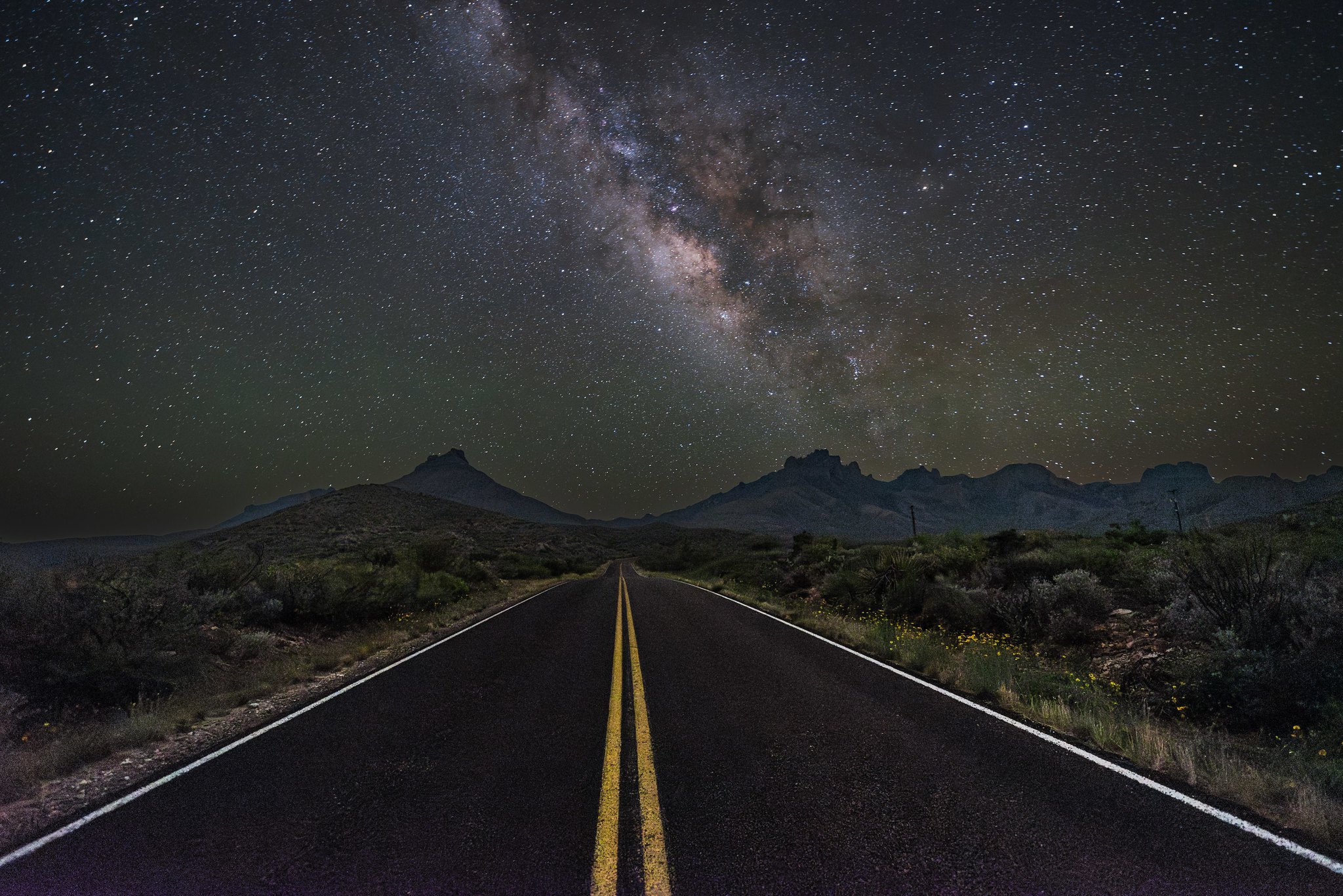
The title of one of their latest articles, West Texas Oil Country is Revealing a Sky Full of Stars, caught my eye as my son Brian and I visited Big Bend National Park and McDonald Observatory back in April and had driven through the Permian Basin. Imagine my surprise to find that the article showcased a photo taken on that trip, the one I now use as the header for this blog and described in the post The Road to the Stars. Thanks to the author for including my image and for providing proper attribution. 


The article itself discusses the encouraging progress being made to reduce light pollution in West Texas, with the assistance of the oil industry. If you haven't been to Big Bend, you should definitely put it on your bucket list as the night sky there is truly breathtaking and must be witnessed firsthand. And make sure to attend a star party at McDonald Observatory, where scientists are conducting valuable research and the visitor staff excels at explaining the wonders of the night sky. 

Personally, I feel protecting the dark skies of West Texas is something worthwhile. In addition to the article above, you can find out more about dark sky protection in the area at web sites for the Greater Big Bend International Dark Sky Reserve and the International Dark Sky Association.

I still have addditional images and some video from our trip to share. Here is one of the Milky Way over Casa Grande taken from the Chisos Basin. This was captured with using the incredible Night Sight feature on my Pixel 7 phone. 


As always, click on images to see full-sized. 

Monday, May 1, 2023

The Road to the Stars

The Road to the Stars
neatonjr @ Flickr

After a long session capturing images of the Milky Way in Big Bend National Park for time lapse, my son Brian and I headed back to the Chisos Basin, stopping along the way at a spot I had mapped out in PhotoPills to capture a shot with a perspective view of the road ahead with the Milky Way beyond. 

Initially the plan had been to capture a sequence of relatively short exposure images with separate foreground and sky shots at different ISO, then stacking registration frames to get the highest quality result possible. Unfortunately, just as I was setting up, we saw headlights down below. With such dark skies, the headlights were obvious while the car was still on Gano Springs Road and about 4 miles away so we knew we had 5-6 minutes but that wasn't enough to capture the planned sequence, just enough to get the composition framed and focused using test shots. I went for one 30 second shot knowing I'd get a little star trailing, then we threw everything back in the car and headed to the lodge. We had finished with enough time that the other car was still a mile or more behind us.

To pull out detail in the foreground, I did initial adjustments to the sky such as exposure, curves, white balance, etc. and then used the Lightroom sky masking tool to mask the sky, inverted it and then made adjustments to lighten the foreground. After touching up some noise spots with the healing brush, this is the end result.

Image details:
Nikon D750 on Radian tripod
Irix Firefly f/2.4 15mm lens
ISO 6400
30 seconds @ f/2.8

Click on the image to see large on Flickr. 

Enjoy! 

Monday, May 30, 2022

A Night to Remember

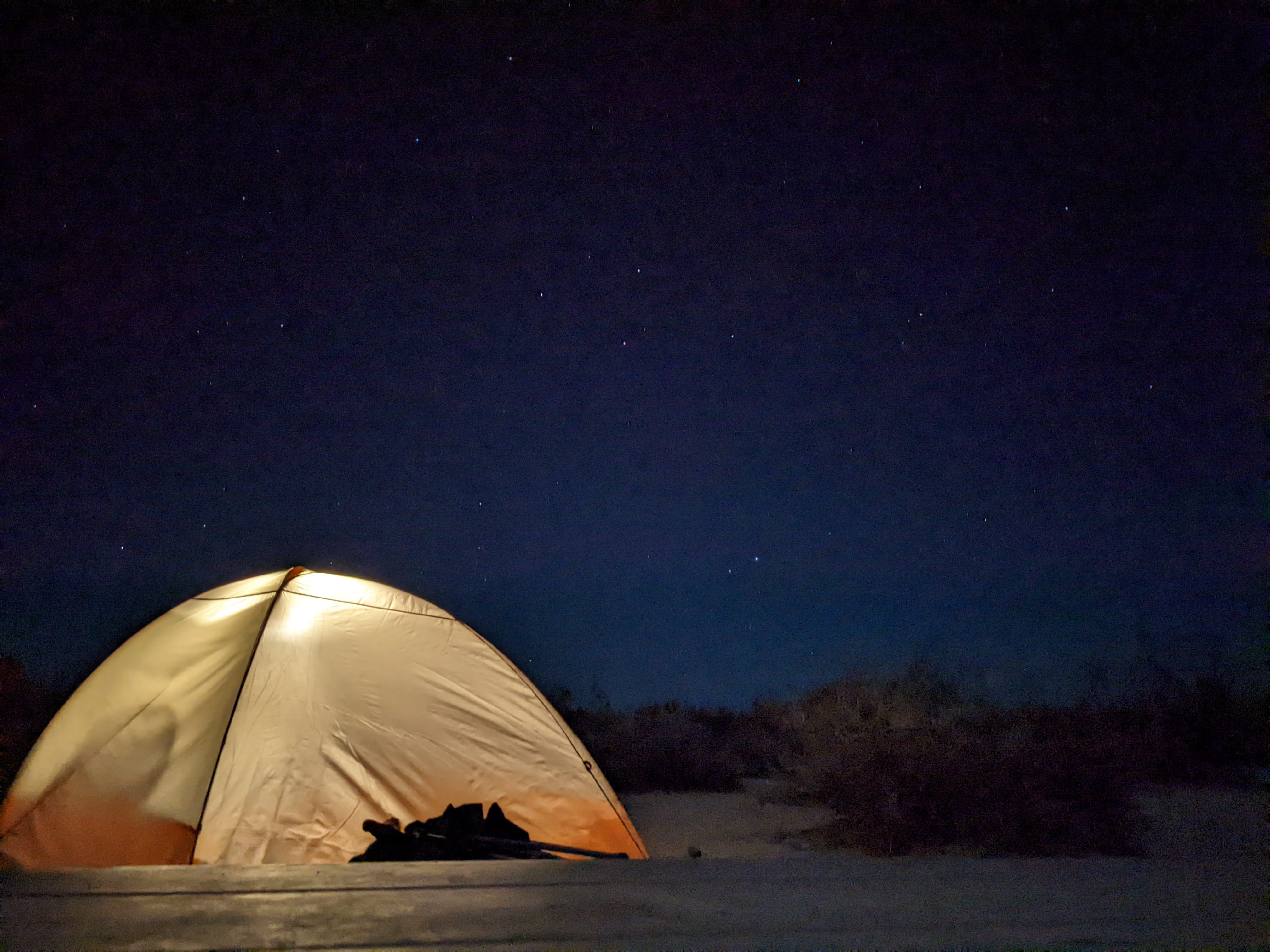
When traveling to visit our friends who live in Palm Desert, CA, I packed the gear I could carry on a flight, opting for my travel tripod instead of a heavier Radian tripod and leaving the Star Adventurer tracker at home. My friend David had reserved a camp site for us for Mother's Day evening and his son-in-law Erik joined us. After setting up camp and enjoying the view as twilight ended, we hit the sack and set alarms.

My original plan was to do a multi-shot panorama of the full Milky Way arch. Unfortunately, when planning the shoot in PhotoPills (photo planning software), I had inadvertently scrolled forward a day so when my alarm went off instead of having a half-hour of moonlight to shoot the foreground and time enough to shoot the full arch while it was relatively low in the sky, I woke up up to a moonless sky and the arch already getting a bit too high for the shot I planned. Once I realized my mistake, I focused on just enjoying the view and getting a few decent shots including this one, taken with a Nikon D750 and an Irix Firefly 15mm f/2.4 wide angle lens.

My decision to go with B&W was in part because the sky colors were off and rather than do heavy edits to get a more natural look, I chose to take color out of the equation. My assumption about the colors I found when editing the raw image is that it perhaps had to do with the massive amount of dust in the air. That entire weekend, winds from San Bernadino south to the Salton Sea where blowing so hard that when we left Palm Desert Sunday afternoon headed to the campground, we couldn't see a mile down the road and could hardly see the mountains of Joshua Tree. At the campground at 3000 feet, the air was much clearer but the sunset that evening was orangish as was the light dome from Blythe that shows up in this image (which I also think was more prominent due to the amount of dust in the atmosphere).

The labels in this image were carried forward from a test shot done a few nights before taken at our friend's place above Palm Desert, an attempt to do some test shooting for the panorama that was thwarted by high, thin clouds. I had shared the one shot from that night where Scorpius was visible with friends, including similar labeling, so this version of this shot was labeled to relate the two images. See below for the unlabeled version plus a few other shots from the trip.

Click on any image to see enlarged.

The Milky Way over Joshua Tree National Park
(Light dome is Blythe, CA)

Low visibility leaving Palm Desert, CA

Sunset at Joshua Tree National Park

Cottonwood Campground Amphitheater

Campsite


Thursday, April 14, 2022

The Milky Way Outside Our Door

One thing that has been on my bucket list for a long time has been staying at a resort that focuses on astronomy and dark sky observing. The closest to us is Canyon of the Eagles resort near Lake Buchanan in the Texas hill country north west of Austin. Now that I have retired, Linda and I decided to take a few days to check it out. I'll share more about the trip later but for now I'll just share this image of the Milky Way taken just in front of our room. 

I literally took this photo in my PJs!

About 4:30 am, I pulled on a coat and stepped out the door of our room with my equipment to try catching the Milky Way at its highest elevation but also at a time when the moon was close to setting since the nearly full moon is so bright it makes it difficult to see dim things like the Milky Way. I started shooting with my rig out on the open area overlooking the lake about 10 yards from the room. I haven't taken a close look at those shots yet but hopefully a few will turn out okay in spite of the moonshine.  

Just as I was about to quit and go back to bed, I decided to try one more set of shots from the steps to our room. This was taken at 6:07 am, just minutes after the moon set so the sky wasn't quite as washed out as earlier shots were. And although it was about 24 minutes past the start of astronomical morning twilight (typically too late for a good capture of the Milky Way) I think it came out pretty good considering the conditions. 

Click on the image to see full-screen. If you look closely, you will see a few white streaks. Those are satellites. The exposure time for this image was 8 seconds so those streaks represent the path of each of those satellites over that period of time. 

Note that editing Milky Way images is a bit of an art and something I don't have a lot of experience with yet so you may see this or other images from this trip posted later on with improved edits.

Saturday, August 19, 2017

Waiting Patiently for Eclipse

We arrived at base camp for Project Stratoclipse, a farm in Marshall, Missouri, on Thursday evening and have been busy preparing for Monday's big event ever since. I am still refining my technique for capturing the eclipse but in the mean time I'm taking a break from the sun and reviewing some of the other images I've captured in the past few days.

Most of these have very little editing, just some basic tweaks to brightness and color, so later on (i.e., after the eclipse) I'll go through all my shots in detail and post (or repost) the best once after I've had time to take a closer look at them and do some fine tuning.

What's amazing is how much less light pollution there is here than at home. Marshall's not a large town but it's also not that far from places like Kansas City, Springfield, etc. so I was a little surprised at how dark the skies are... it has a Bortle Scale of 4 compared to 8 for home (Mesquite, Texas). That's a huge difference!

Enjoy! We're less than 48 hours from the eclipse!

Sunset the first night. This is a high dynamic range (HDR) image
created by combining 3 images taken at different exposures.

Same tractor, this time with Milky Way instead of the Sun. 

Last night we got hit by a thunderstorm but it was pretty mild.
However, after it rolled by us it really exploded with activity.
We watched it carry on like this for a half-hour or more. 

The storm was still going on but had moved far enough to the
south-east for our skies to clear, allowing me to capture both the
distant storm and the Milky Way. 

A similar view of the storm in the distance with the Milky Way
rising above farm equipment. 

Tuesday, July 25, 2017

West Texas Milky Way

When's the last time you saw the Milky Way? I mean really saw it in all its splendor under the night sky, not just a ghost of it from the suburbs or a picture of it?

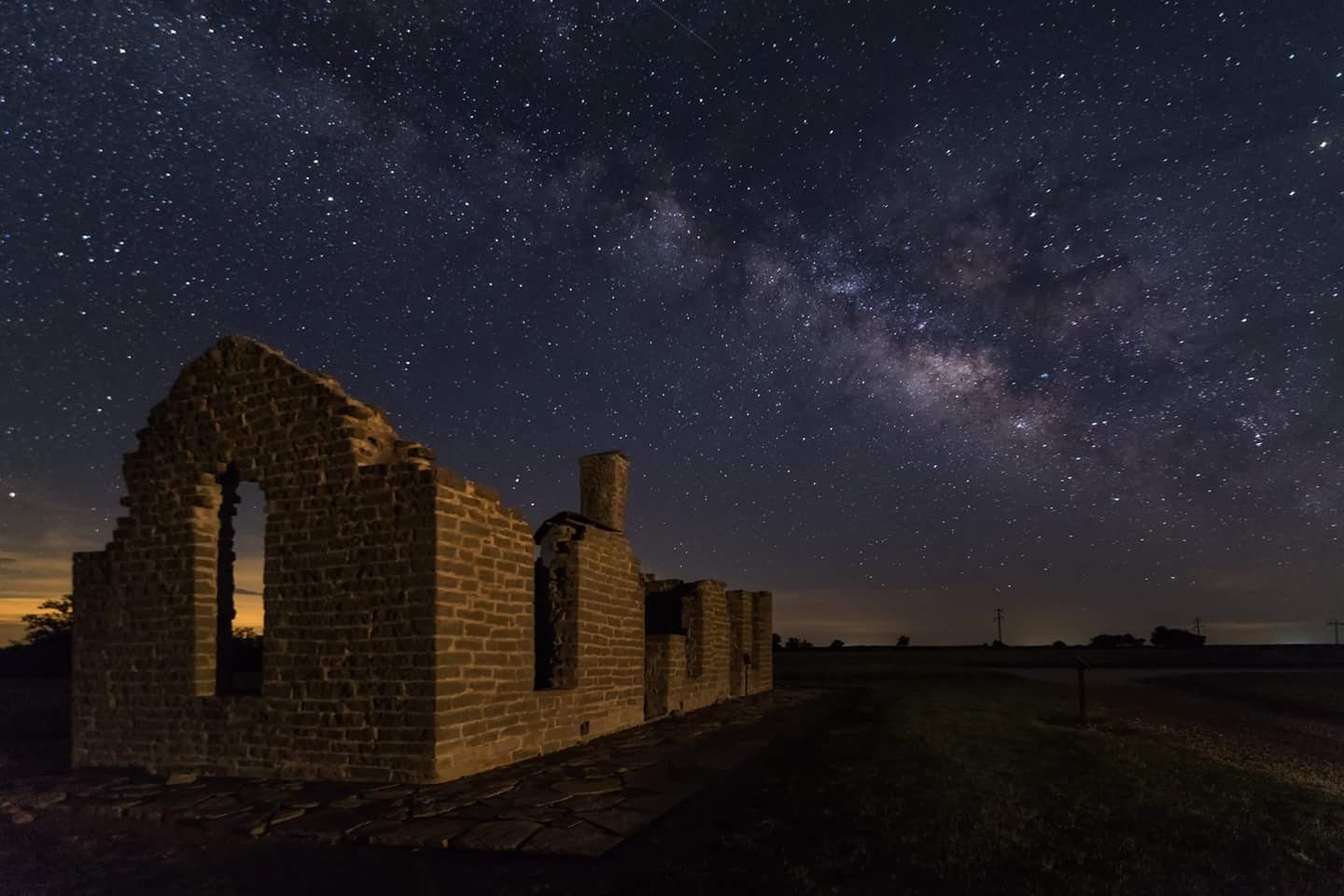
Recently, my son Brian and I trekked from Dallas out to the near edge of West Texas to the Fort Griffin State Historical Site. We braved black widows, skunks, swarms of mosquitos, way-too-close pack of coyotes and other things lurking in the dark we're just as happy to have not known were there, all to capture the beauty of the summer night sky.

We are pretty happy with the results. They aren't great - we made plenty of mistakes - but I think it's a good start. We're looking forward to shooting some place like this again. Perhaps from the even darker skies of Big Bend next year.

One thing you may notice about the last shot is why, under pitch dark skies, are the ruins lit? We were practicing a technique called low level landscape lighting. It's similar to another night photography technique called light painting but we both think it makes for a more pleasing view, allowing us to add a foreground element without it dominating the shot.

Enjoy and clear skies!


A view of the site from visitor center while we wait for the sun to set. 

A daylight view of the ruins we shot. 

One of Brian's shots of the site with thunderheads rising far to the north over Wichita Falls.
Photo edits by Brian Eaton 

A silhouette of the ruins and the Milky Way Brian shot with our Nikon D7000.
Photo edits by Brian Eaton

One of my better shots of the ruins and Milky Way shot with our new Nikon D750.
Photo edits by Brian Eaton

Friday, February 20, 2009

Spotting Venus in Daylight

I've been planning a post on how bright Venus has been in the evening sky lately, but it's turned into more of a research effort than I expected. I still plan on posting about that eventually but in the meantime let's talk about a side effect of how bright Venus is.

At its brightest, Venus is normally1 the third brightest object in the sky behind the Moon and the Sun. We don't typically see celestial objects during the day other than the Sun and, depending on its phase, the Moon. The reason has to do with contrast - the difference in brightness between two objects. To see an object in the sky, it has to be brighter than the background. That's why you can see stars at night but not during the day: the scattering of sunlight in the atmosphere makes the sky too bright compared to the stars. This is also why you can't see the Milky Way in urban areas. Light pollution increases the brightness of the sky, reducing the contrast between the Milky Way and the background sky until there isn't enough difference for the Milky Way to stand out.

So, if you can't see stars during the day then is it possible to see Venus? As bright as it gets (apparent magnitude -4.7), it is still not nearly as bright as the Moon (-12.6). As it turns out though, it is bright enough to see in broad daylight. You just have to know where to look.

As bright as Venus is right now and given how far it is above the Sun (its elongation), now is a great time to try spotting it during the day. To find it, it helps to have something else nearby to start your search from. A good candidate is the Moon. I checked using one of my favorite pieces of software (Planetarium) and found that over North Texas the Moon and Venus will be just a few degrees apart about 2:30 p.m. on February 27th. Although the Moon will be a thin crescent on that date, it should still be a good starting point for finding Venus. I plan to try this approach on the 27th but in the meanwhile there is another alternative that you can try tomorrow. 

First, find a building with an exterior wall that runs generally north and south. The next step is to know what time during the day Venus will be directly over head (it's transit time). To find that for your location, use this tool hosted by the U.S. Naval Observatory. Scroll down to Form A, enter the date, Venus as the object, your state and city and optionally your elevation above sea level, then click on the Compute button. The resulting data includes the time Venus rises and sets but more importantly its transit time and how high in degrees above the southern horizon it will be at that time (its altitude). 

With this information in hand, grab a pair of binoculars and stand next to your north/south wall shortly before the specified transit time. It needs to be a wall facing east so that as you stand next to it you're in shade (or, if viewing when Venus is in the morning skies, use a wall facing west as Venus would transit before the sun). This will avoid glare from the Sun as you search for Venus and also guard against accidentally looking at the Sun through the binoculars. Standing next to the building, search the sky just along the edge of the roof of the building, scanning back and forth at approximately the angle Venus should be above the southern horizon. 

I tried this yesterday and it worked great. Venus was to be straight overhead at 2:57 pm at an altitude of 67 degrees. Our house faces due south so all I had to do was step outside on my patio and stand next to the east-facing wall.  By scanning the sky along the edge of the roof overhead I was able to spot Venus easily through my Canon 8x25 binoculars (you don't need big, powerful binoculars - almost any decent pair will do). I got a great view of a crescent Venus. 

For something a little harder, once you've spotted Venus through binoculars try searching that same spot without them. It takes a bit more effort but once you know where to look and what you are looking for it is possible to spot it with the unaided eye. 

I'll post an update the next time I've spotted Venus during the day and include a photograph. In the meantime, once you've succeeded in spotting Venus in the daytime yourself, share the wealth and show it to your friends, family or neighbors. I bet they'll be amazed!


1 According to this Wikipedia article, objects (past and present) brighter than Venus include the Crab supernova of 1054 and Iridium satellite flares.