Showing posts with label Photoshop. Show all posts

Saturday, April 13, 2024

April 8th 2024 Total Solar Eclipse: Initial Telescopic Images

Fine details in the solar corona


One of my primary goals for this total solar eclipse was to capture a variety of telescopic views of the eclipse. The similar goal I had in 2017 was spoiled by overcast skies that resulted in a mad dash down the road with Beau Hartwig chasing clear skies. Seeing totality with my own eyes meant giving up on my photographic goal. I don't regret that for a minute but I was thrilled that this time the skies cleared for us just in time for the "Big Show". 

To avoid having to split my attention between experiencing totality and taking pictures, I used our old 2012 MacBook Pro running a software package called Solar Eclipse Maestro to control the camera, snapping pictures at pre-defined times and exposure settings. SEM worked flawlessly and had it not been for a user-error on my part (which I'll cover in a future post), I would have captured everything I planned for. As it is, I still was able to capture most of what I planned including:
Although the images captured were as good or better than I hoped, post-processing them to fully bring out the available detail is a rather complicated thing involving a variety of software tools. I am still working on that but I wanted to go ahead and share some initial edits. 

The image above is a blend of each of the 19 different shutter speeds used to capture images to submit to the Eclipse Megamovie project. They were taken during totality to capture as much fine detail of the solar corona as possible. The project team will use the calibration frames to pull out even more detail than appears in this image but, for my first pass at this I used some basic stacking techniques in Photoshop. Click on it to see enlarged... isn't the level of detail incredible?

I'm also including some cursory edits I've done of a few other images below including a partial phase image and a picture of Baily's Beads. What I am the most excited about though is the spectacular solar prominences that appear in the Baily's Beads shot. Wow! Even more incredible is that the largest one was visible naked-eye. 

Once I've had time to go through the rest of my images and finish some of the more complicated editing processes, I'll share more of these. I'll also do a follow-up post on my equipment and what went into capturing these images. 

I hope you got a chance to see totality for yourself but, if not, please enjoy my first pass at sharing the view with you. 

Late in the partial phase of the eclipse. Note the sunspot in the center!

  
Baily's Beads and Solar Prominences


Wednesday, January 17, 2024

Experimenting with AI

Over the course of my career in technology, I gained an appreciation of the use of 'accelerators' — utilities, tools, and techniques that help get a task done more quickly than doing the same task by hand. Although I am retired now, I have various personal projects that involve some form of coding so accelerators are still useful. A new option that has really been a game-changer is ChatGPT. By describing the logic I need, it can sometimes provide complete, working code. At worst, it offers a foundation I can adapt, significantly cutting down the time it takes to create a new script or automation, especially in languages that I didn't use professionally like Python.

With the integration Microsoft has provided between ChatGPT 4 and DALL-E 3 under the covers of Copilot (previously Bing Chat), I decided to try my hand using it as an accelerator for creating images. For a few years now, I've had the idea of having a blog title image that highlighted the various interests I write about on this blog, primarily astronomy, photography and sailing: a nighttime seascape with a sailboat and the Milky Way arching overhead. As I have never received a response to my post seeking help from an artist, I decided to experiment with Copilot to create the image myself.

One thing I learned along the way is that creating with ChatGPT and DALL-E isn't like painting with a tool like Photoshop... there are limits to the degree of control you have. My original intent was to have the horizon centered in the image with a pretty plain foreground and limited detail at the top so that I could crop the standard DALL-E square image down to a landscape orientation. The initial images often placed the horizon lower or higher than specified, and revising the prompt didn't always affect its position in the final image. Similarly, I originally had specified having a single-masted sailboat yet every image generated had a two or three-masted ship. Anyway, it appears you have flexible about the details of the generated image.

After numerous passes, I started from scratch with the following prompt which didn't include a reference to a sailboat.

Create a photo-realistic image of a night-time  seascape with a calm sea with a large foreground of water and no land visible, with the stars across the sky an do the Milky Way rising high the the sky on the right side of the image, a low line of clouds along the horizon with a few small lightning bolts in the far distance and a full moon just above the horizon on the far left side of the image.

Of the 4 images generated, I chose the one that was closest to what I had in mind and provided a second prompt to add a small sailboat off in the distance, along the horizon. Here is the result.

This image came close to matching my original vision. The unexpected rocks under the water in the foreground were easily cropped out, although I left a few visible in the final version. Similarly, the Moon was up high instead of on the horizon but, again, not something I minded cropping out. Although the sailboat was a bit smaller than I'd like, I think it works well.

The one issue with this version is the reflection on the water in the middle. It's obviously not the Moon as that's at top right but it's not clear what it is a reflection of. The brightness on the horizon looks a bit like a sunset so perhaps it is supposed to be the Sun behind the clouds. I decided that I'm fine with the sky brightness but the reflection had to go.

Picking the image in Copilot opened it in Image Creator where I could pick Customize which opened the image in Microsoft Designer, an AI-powered design app. One of its features is 'generative erase'. Basically, all I had to do was select the reflection on the water with a brush and Designer replaced it by filling in that space with something that looked like everything around it. This is similar to the 'generative fill' feature in Photoshop. As you can see, it worked pretty well.

If you read the post linked above, you'll see that my ultimate goal was to have an image like this animated as a GIF. My research suggests that using existing AI tools for this is feasible, but it's not as straightforward as just giving ChatGPT a prompt. It involves creating and compiling a series of images, then employing tools like Stable Diffusion to convert them into a video, which can subsequently be saved as a GIF. It sounds like that could even involve writing code. Eventually, I may give that a try but, for now, I'm satisfied with just cropping this image down and using it as the blog title image for a while.

Your thoughts? Whether you love AI, hate it or are ambivalent, I'd like to hear about it in the comments.

As always, just click on an image to see it full screen!

Friday, August 4, 2023

Olivia and Papa Chase the ISS and More

Last month, my granddaughter Harper and I went out to capture an image of the International Space Station (ISS) flying over Dallas. As described in my post about that effort, we were only partially successful, foiled by clouds. This past Tuesday evening, granddaughter Olivia and I headed up to the north shore of White Rock Lake to try again. In spite of being a little late getting to the lake and rushing to set up cameras, we managed to catch the last 90 seconds or so of the ISS flyover as it traveled from the northwest, overhead and down to the southeast. Here is the result.


This is a composite image created by stacking 9 images taken with a Nikon D750 and a Rokinon 14mm wide angle lens mounted on a tripod. Each shot was 8 seconds long with 2 seconds between each shot. What Olivia and I saw was an incredibly bright "star" moving across the sky, too steady and too fast to be an airplane. It appears as a streak in this image due to the long exposure of each original image; the gaps are due to the delay between each shot while the camera saved the image files. 

This photo demonstrates an interesting aspect of ISS flyovers. We can see the ISS fly by only at certain times and places, its visibility due to the viewer being in a position to see sunlight reflected off of the ISS. For this flyover, as it was traveling "away" from the sun (which had set just over an hour earlier) its orbit carried it into the Earth's shadow. Notice how the lowest trail fades off and disappears. 

Another interesting object in the sky that night was the Sturgeon Moon, the first of two "supermoons" this month. It was cloaked in clouds until just as we were getting in the car to head home so it just appears in this image as a bright glow to the lower left. Note all the people on the dock though; there was quite a crowd out that night with people all up and down the shoreline to watch the full moon rising. I wonder how many of them also realized they were getting a chance to see the ISS, too.

We also tried to capture a flyover of a satellite, BlueWalker 3, which passed over this same view looking south across the lake about a half-hour before the ISS flyover. Unfortunately, even having two cameras shooting during its flyover, we didn't capture it. I'm not sure whether it was due to its lower elevation, the haze to the south east or a miscalculation on my part about where and when we would see it. That'll be a target to try for another night. 

Thanks to the long exposures taken, the composite includes more than just the ISS and the Moon. Stars of the constellation Sagittarius (the Archer) and Scorpio (the Scorpion) are visible including Antares, the red super-giant star that is known as the Heart of the Scorpion. Here is a labeled version of the image above. 


The images above were edited to remove all the other stuff we saw in the sky that night: aircraft. The following is a composite of 12 images stacked "as is" in Photoshop. It shows not only the ISS but all the aircraft trails captured. Having simply stacked the images, stars appear as streaks and headlights and taillights of cars on the far shore of the lake appear as streaks. 


One final image, this time an edited stack of all the images, showing not only the ISS but all the aircraft trails captured. Unlike the unedited stack, in this view the sky (Moon and stars), lake and even the car headlights on the far shore are all from a single image. The aircraft and ISS trails from the other 11 images were masked to overlay that single image.


As always, click on an image to see large. 

Friday, July 14, 2023

Harper and Papa Chasing the ISS

UPDATE: Keep reading for the "rest of the story" but here is the same image as below but cropped vertically to focus attention more on the ISS trail. Enjoy!

Our granddaughter Harper stayed with us this week. During the day, she was attending Dallas Parks & Recreation Outdoor Adventure Camp and the theme this week was photography. As I am an avid shutterbug I also spent a little time each evening with her, messing around with cameras, talking about how to take good pictures, etc. 

As I was checking to see what the evening weather would be with the idea that we could maybe take some night sky shots, I noticed that Tuesday evening the International Space Station (ISS) was going to be passing over. Even better, it would be rising just over downtown when seen from up by White Rock Lake. That night around 9:00 pm, we headed up to Winfrey Point and set up my Nikon D750 with an Irix 15mm wide angle lens. Once the camera was set up on the tripod, I let Harper take all the test shots and then we set the camera to shoot a sequence of 20 second shots. ISS was going to be visible for about 7 minutes, only 3 of which would be visible to the camera facing due west. After it passed overhead, we also tried capturing shots to the northeast but lights and trees were in the way.

The next day we loaded the captured images into Lightroom and I did some basic edits for exposure, contrast, etc. and then we loaded them as layers in a single image in Photoshop. As each layer contained a section of the ISS flyover, our goal was to follow instructions from this online article to stack all the images to end up with one image with a full track of the ISS, from when it was first visible (about 10 degrees above the horizon) until it passed out of the camera frame. 

Unfortunately, while the weather report had been for clear skies, there was actually a lot of haze on the horizon and clouds across the path of the ISS. Here is the result of just stacking all the images.

Harper thinks this version is kind of cool and I agree. The streaks of the clouds are pretty surreal and the airplane trails and the few star trails convey a lot of action.  The problem is that you can only get glimpses of the ISS trail as it is mostly obscured by the clouds. Even where it might have been clearly visible in one frame, once we stack all the other frames on that then some or all of it is obscured by the clouds. 

That led us to research other ways to achieve what we were after. With the help of ChatGPT, we learned some Photoshop techniques that allowed us to selectively mask out everything but the ISS trail, stack those and combine them with a base image that included the foreground with the lake and downtown Dallas and in which most of the clouds were to the right. We also removed a couple of airplane trails so that the ISS trail is the "star" of the image.

Here is the end result. It's not exactly what we intended to shoot - the ISS trail is spotty and the gaps don't always match the cloud gaps in the base image - but we are pretty happy with it. 


This was just the start, though. Now we are watching out for other nights when the ISS will fly overhead where the skies are clear and it will pass over an interesting foreground like the lake and downtown in this image. More to come!

If you are interested in finding out when the ISS flies overhead where you live, there are many resources but one of my favorites is the Heavens Above. Here is the ISS Visible Passes chart and here are the details for the flyover we captured

As always, click on an image to enlarge. Clear skies, y'all!

Tuesday, October 13, 2015

BEWARE OF UNREALISTIC LUNAR ECLIPSE PHOTOGRAPHS

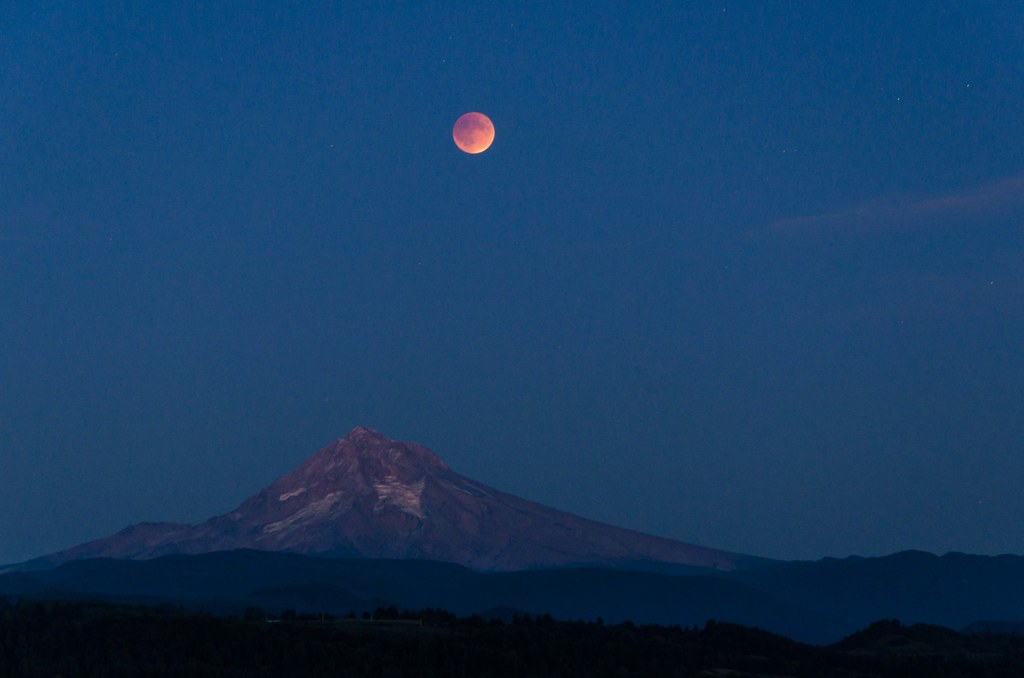
Lunar Eclipse over Mount Hood

[Originally published on Sept 29th; updated with version of photo published on Flickr]


Having invested a lot of time and energy to prepare for and take this shot of Mount Hood from Jonsrud View Point in Sandy, Oregon, I looked forward to checking out all the interesting shots other people were posting. However, two days later I am troubled by what I'm seeing online. 

While Photoshop and similar tools are valuable aids in fine-tuning photographs for display, it's easy to bend an image to something that could only have existed in the imagination of the photographer. In some cases, the changes are slight - the image is only slightly different than reality, reflecting a difference in tone, crop, etc. - but in other cases things are morphed beyond the realm of reality. 

In full disclosure, I used Photoshop on my tablet to retouch this image and remove a spot that resulted from a dust spec on the sensor of my camera.  Note that I haven't yet had time to do other edits, ones only possible once I am home and have access to my PC again such as reducing the noise (edits intended to make the image look more realistic, not less). At a later date, I'll post the edited version. 

Other photographers though have not only "cleaned up" their photographs, but they have gone to extreme lengths to transform the images captured in their cameras. In some cases, the moon is shown much larger than it actually was. In other cases, it's positioned differently - it's either lower in the sky, shown in different settings, etc. What they have all done is portray the moon in an very unrealistic manner. 

Many would say "that's just a case of poetic license... what's the problem with that?". I don't have an issue with poetic license - it's something I've exercised many times myself. What I do have an issue with though is presenting something of scientific interest, a natural astronomical event, in a way that may be difficult for someone who didn't personally observe the event and may not be familiar enough with similar natural phenomena to discern that what they are seeing is not what they would have seen standing out under the sky last Sunday night. 

Note that I'm not talking about the sequence shots that show multiple instances of the moon in a single image  (assuming they are proportionately sized and positioned). Those actually tell a useful story of the progression of the event and most people would understand that the image is a composite of multiple shots. To their credit, the photographers for most of the sequence images I've seen, even the ones who materially modify the position and size of the moon in such shots, point out that the image is a composite. 

I am not arguing against these images. In fact, I applaud the creativity of the people who produced them - there are several that I'd love to have as the wallpaper on my PC or perhaps even as a print hanging on my wall. For me, what's missing though is transparency about what the image represents, a factual explanation of how it differs from nature. While some people would skim right past a disclaimer that explains the moon image was enlarged to make a more interesting shot, at least all who view such a thing would have the opportunity to understand what they see isn't realistic and why.

Reaction of friends and family when I raised this issue was "good point, but who's going to pay any attention". They may be right but I'm a glass-half-full kind of guy so I'm posting this anyway, hoping that at least a few people pay attention. I'm also a big believer in civil discourse and not a fan of flaming so rather than post comments directly on the images I'm talking about, I'd rather explain the concern here where I'll then share it via social media. If it makes a few people looking at images from Sunday night's lunar eclipse (or other similar natural phenomena) pause and consider whether a given image is realistic or not, great. If this comes to the attention of the photographers responsible for such images, even better. If any of them take the point to heart and update captions to clarify what they changed, fantastic. 

If you agree or, more importantly, disagree with me on this, feel free to say so in the comments.