As covered in previous posts, late last year I discovered a product called the Solarcan, a pinhole camera created using an aluminum can with a small hole in the side and photographic paper inside, all to capture long-period exposures (weeks, months, years) of the Sun as it moves across the sky each day, images called solargraphs. I bought a five-pack of Solarcans in December and gave four to my grandkids as Christmas gifts .
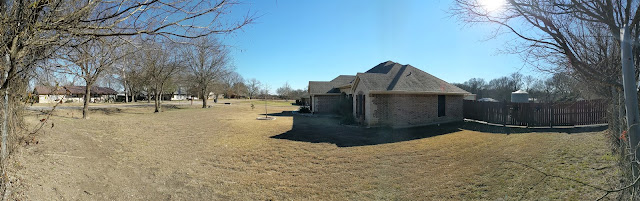
In the Phase 2 posts, I covered helping my grandkids set up their Solarcans. The plan for each one was to have them up about 6 months. For the ones Jack, Harper and I put up (see this post), the 6 months was up on July 17th. Here are views of the their Solarcans as we prepared to take them down on July 29th:
|
|


One of the things we noticed is that each of their Solarcan's were just a little bit crooked; they were straight when we put them out. More about this below.
Following the Solarcan instructions for developing solargraphs, we scanned each image.
|
|


The initial scans look a little odd... the sky and the arcs traced by the Sun are dark and the foreground is light. The reason is that the photographic paper reacts to light by darkening, resulting in a negative image. The bright spot on the sides of each image are the result of tabs on the inside of the Solarcan that hold the paper in place; because they overlap the paper, they block the light, preventing the paper from darkening.
The next step in the development process is to convert each image from negative to positive. After that, the goal processing is getting an image in which some of the details come out (e.g., adjusting exposure and contrast) and adjusting color and other variables to get something that looks interesting. Here is the final result.
|
|


As covered in the Phase 2 post, Jack's Solarcan was mounted in their back yard with the shop and chicken coop in the foreground while Harper's was mounted in their front yard with a view of the house in the foreground (though the chicken coop was visible over the fence). If you look closely, you can see all those details in these images.
As with other solargraphs (including Olivia's), the lines traced across the top of the image represent the path of the Sun each day. These solargraphs were started about a month after the winter solstice so the earliest lines are the lower ones, reflecting the low path across the sky of a winter Sun. As time passed, new lines appear higher and higher on the image. Gaps appear where there were days (or parts of days) in which the Sun was obscured by clouds. One reason there are differences in these two solargraphs (even though they were mounted relatively close together) has to do with another thing that blocked the sunlight: tree limbs. You can see the trees more prominently in Harper's solargraph. You can see in the first images above that there are trees closer to where it was mounted compared to Jack's.
The other unusual aspect of these images is the strange "double-exposure" appearance, most obvious on the right side of Jack's image where there is a second, lighter horizon above the darker horizon below and the lighter one is at an angle. As mentioned above, we installed each Solarcan vertically on a post but when we took them down, each was just a little crooked.
We aren't sure what happened but it seems clear that about 4 months (roughly 2/3rd of the way through the exposure) something knocked each can over a little. When that happened, effectively a "new exposure" was started. It's hard to tell but the effect even shows up in the lines traced by the Sun (the highest ones are a bit blurred where ones traced after the cans were knocked over overlap the earlier lines).
Although our initial reaction was that this was an error, that the solargraphs were "messed up", the more we talked about it, the more unique it seemed. Jack, Harper and I now consider these to be extra special, very unique!
As always, click on an image to see full screen.









 The journey continues beyond 2009... check it out!
