Showing posts with label annular eclipse. Show all posts

Sunday, October 15, 2023

October 14th Annular Eclipse as Viewed From Dallas

Did you get a chance to see the eclipse yesterday? Even though it was only a partial eclipse for us here in Dallas, Texas, it was still spectacular!

As lots of folks at the State Fair of Texas found, it's pretty amazing how easy it is to see what's going on (watching with appropriate eye protection, of course). Given that it isn't safe to look directly at the Sun and we may only even try during an eclipse, it's easy to forget that the Sun is about the same size in the sky as the Moon. That, of course, is why a total solar eclipse like the one next April is even possible. But it also means that putting on a pair of eclipse glasses and looking up yesterday during the eclipse, the piece of the Sun blocked out by the Moon was clearly obvious even without magnification. What about the view through a telescope? 

Here is a view from about an hour into the eclipse taken with my equipment which has an effective focal length of 714mm, resulting in a 12.38X view. At this level of magnification, besides the impact of the Moon being in the way you can also make out some of the many active sunspots. Click on the image to see full-size.


Seeing a point in time view of the eclipse is great but to show the changes over the course of the full eclipse, I put together this view containing a subset of all the images I shot to create the eclipse timelapse of my earlier post. These are each about a half-hour apart. 

When you click on this image to see it full-size, you'll also see another version labeled with the times throughout the eclipse when these were taken. 


Saturday, October 14, 2023

A Solar Eclipse at the State Fair of Texas

While my equipment at home was running on automatic, capturing images for a timelapse of the solar eclipse today (see my last post), we were at Fair Park in Dallas for the State Fair of Texas. Our granddaughter, Harper, was showing one of her rabbits in the stock show. Rabbits have been her first breed to manage and show since joining FFA but this was our first opportunity to see Harper showing her bunnies. 

If you know anything about showing at a stock show, it's a lot of hurry-up-and-wait. It turned out that judging for Harper's group wasn't until late afternoon. With all that time free, I wandered around the fair grounds checking out the eclipse and checking out people checking out the eclipse. Thanks to groups like the Texas Astronomical Society of Dallas handing out eclipse glasses for free, lots of folks were watching it. And doing so safely!

Of course, it wouldn't have been a trip to the fair without having a Fletcher's corny dog and a funnel cake! Have you been to the fair, yet? There's still time!

Here are views from the day. As always, click on an image to see full-size. Enjoy!


Folks being safe watching the eclipse with
appropriate eye protection. 

Big Tex holding up the Sun

Big Tex and the solar eclipse viewed through
eclipse glasses

Crescent shadows from tree leaves adorn a
Fair Park coupon booth during mid-eclipse


Congrats to Harper and Coconut!

October 14th, 2023 Annular Eclipse Timelapse


Unable to make it to a spot on the path of the annular eclipse today to view the Ring of Fire, I captured this timelapse of the partial eclipse view from my backyard. 

What's great about successfully capturing this eclipse that I wasn't even home! Since our granddaughter Harper was showing her rabbit at the State Fair of Texas stock show today, I had the equipment set up to run automatically. Months of preparation and practice paid off! BTW, more to come on the State Fair....

The shadows on the first few seconds are power lines which appear to move across the face of the Sun but it's the Sun's apparent motion across the sky, tracked by the telescope/camera, that accounts for the motion. 

This view was captured with a special solar filter, a Baader solar film filter. Without it, pointing my telescope and camera at the Sun would have damaged my equipment. 

As we are approaching "solar maximum", the Sun is pretty active so there are plenty of Sunspots across the face of the Sun right now. 

Here's what I used to create this timelapse. I set the internal intervalometer on the D750 to take shots every 30 seconds at 1/1000th shutter speed from just before till just after the eclipse, about 380 shots in all. Just to be sure I didn't have to worry about batteries in the camera and tracker lasting long enough, I ran everything off an external power pack stored under the tripod. You can see the equipment in action in my post on eclipse preparations

Equipment
Sky Watcher EvoStar 72ED Refractor
Sky Watcher 0.85 Flattener/Reducer
Sigma 2X Teleconverter
DeepSkyDad AF3 Autofocuser
Baader Solar Film Filter
Nikon D750 DSLR
Sky Watcher Star Adventurer 2 Tracker
Radian Carbon Fiber Tripod

Processed on Mac OS with 
Adobe Lightroom Classic
LRTimelapse
DaVinci Resolve

Music
"Eclipse"
by 1st Contact
Shared under Creative Commons License
Attribution-ShareAlike 4.0 International License

Friday, October 13, 2023

Preparations for the Annular, er, Partial Solar Eclipse!

Tomorrow's the day! As mentioned in my last post, tomorrow an annular solar eclipse is visible across a stretch of the western half of the North American continent. 

For the rest of the country - including Dallas where I live - we won't get to see the Ring of Fire but we'll still get to observe a partial solar eclipse. 

Screen shot from Stellarium
Here is what the Sun will look like at maximum eclipse for Dallas (about 11:52am local time). Although that area blocked by the Moon in this simulation looks blue, keep in mind that this is a new moon which means we don't see any illuminated lunar surface since the Moon is in between us and the Sun. 

While you would think that with this much of the Sun covered up the amount of light we see would be low enough to be safe to view without eye protection, it's not! Except during the totality phase of a total solar eclipse when the Moon is completely blocking the solar surface, it is not safe to look directly at the Sun. If you are interested in seeing the eclipse tomorrow, only do so if you have a set of solar eclipse viewing glasses from a reputable source. If you don't already have eclipse glasses it may be too late to get some but here is information from NASA on safe viewing resources

Personally, I am treating this eclipse as a trial run for the total solar eclipse that will pass over North Texas on April 8, 2024. I plan to capture the partial eclipse from start to finish using my Nikon D750 and EvoStar 72ED refractor telescope with solar filter mounted on my Star Adventurer tracker. I'll leave it running from well before the eclipse through past the end of the eclipse, capturing a couple of shots a minute. Hopefully, the result will be a handful of good shots of different stages of the eclipse and possibly a sequence of shots I can use to make a timelapse video of the eclipse from start to finish. 

A lot has to happen for this to be successful - a good polar alignment of the telescope the night before, being able to get a good focus of the Sun once it peeks above the trees, the weather forecast being accurate (i.e., no clouds) - but even if it doesn't work out as planned, it will still be good practice for April!

Here are shots of my equipment set up for a test run today. 

That solar filter is critical for
safely photographing the Sun!

The tracker keeps the telescope pointed
at the Sun as it moves across the sky.


I hope you get to see the eclipse, too. Just be sure to be safe when viewing the Sun!


Thursday, September 14, 2023

Countdown to Annular Eclipse

May 2012 Annular Eclipse from Albequerque
Sequence from 2012 Annular Solar Eclipse
Photo by Nathan Eaton

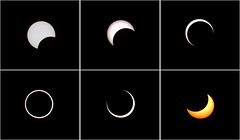
We are just a month away from the next solar eclipse! On October 14th, 2023, people from the upper west coast down across Texas and in parts of Central and South America will have the opportunity to see an annular solar eclipse. As with all solar eclipses, this one involves the Moon passing between the Earth and the Sun. This time, the Moon will be farther out in its orbit around the Earth, making its angular size just a bit smaller than that of the Sun. In such a case, the Moon doesn't quite cover the face of the Sun. Consequently, at mid-eclipse viewers along the centerline of the eclipse track will get to see the Ring of Fire, a view in which the Moon is centered over the Sun with a fraction of the solar surface showing all round the Moon. 

The image sequence above is one I took during an annular eclipse in 2012 when we were visiting Albuquerque, New Mexico. Shot with a Nikon D7000 DSLR through a telephoto lens and a Baader film white light filter, it shows the eclipse from near the start at top left as the Moon has begun to cover the Sun, progressing across and down to the Ring of Fire view at bottom left then on through near the eclipse end at bottom right. For that eclipse, the Sun set before the eclipse was over so I wasn't able to get any shots of the final phase. The reason for the yellow color in that last shot is partly because the Sun was close to sunset and partly due to heavy smoke in the atmosphere from fires west of Albuquerque. Basically, the image came out yellow for the same reason a sunset with heavy clouds to the west looks yellowish to reddish; the denser atmosphere with heavy particulates (in this case, smoke) filters out shorter wavelengths, only letting the longer (and redder) wavelengths through. 

To see how close the path of the eclipse comes to where you live and to see where and when you can view it in person, check out Xavier Jubier's interactive map for the eclipse. Click anywhere on the map and it will give you details of the eclipse for that location including when it starts and ends, how long it lasts and how much of the Sun will be eclipsed by the Moon. Note that the path of the eclipse on the map represents the areas where the annular form of the eclipse will be visible. In the Dallas area, we'll experience a partial eclipse since the Moon never moves completely over the face of the Sun from our vantage point. Unfortunately, we won't get to see the Ring of Fire here. 

Where will you be during the eclipse? 

See the NASA eclipse page for more information on this eclipse as well as the total solar eclipse next April

WARNING

Be sure to NEVER look directly at the sun without appropriate eye protection. Read up on safe viewing techniques before viewing the eclipse. 

Thursday, August 31, 2023

Geek Break: Calculating Elevation of Jet Transiting the Sun

IMG_4503 v2
Brandon Ghany on Flickr

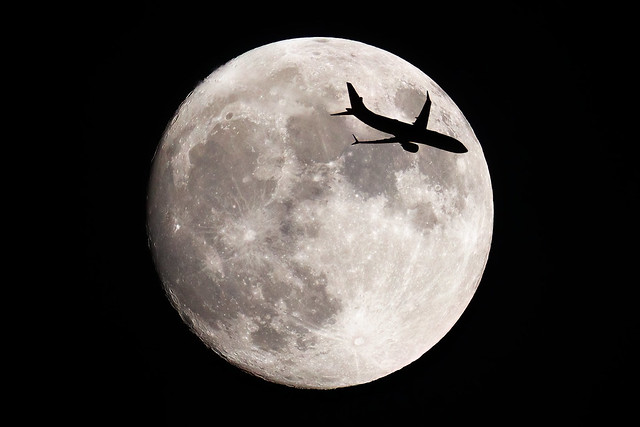
After my last post about capturing a jet flying in front of the Sun, I saw this image Brandon Ghany posted on Flickr of a jet crossing in front of the Moon and what caught my attention is how much smaller the jet is than in my video. 

From Brandon's description, this jet was flying at about 12,500 feet. Clearly, the jet I caught was flying much lower. But how low? I was curious enough to try figuring it out. 

The first factor to consider is that the Sun and Moon are similar but not exactly the same size from our viewpoint. Actually, the distance to the Moon varies a little at different points in its orbit so sometimes it is closer and thus a bit larger than the Sun (necessary to have a total solar eclipse) and sometimes it is farther away and thus a bit smaller than the Sun (leading to views like the Ring of Fire of an annular eclipse such as the one on October 14th this year). But in general terms, they are both roughly a half a degree across viewed from Earth. That means if Brandon had captured a jet at 12,500 feet passing in front of the Sun instead of the Moon, his image would have looked similar, at least in terms of the relationship between the size of the jet and the size of the celestial orb it passed in front of. 

The second factor is that while I know the angular size of the sun (reported by Stellarium as 31.68 arc minutes at the time of my video), for me to determine things like the jet's altitude, I need to know the jet's angular dimension, too. 

To calculate this, I captured a single frame from my video, cropped and rotated it then used drafting software (FreeCAD) to measure the relative difference between the width of the jet's fuselage and the width of the Sun. The ratio came out to 55.25% which means the width of the jet body is 17.5 arc minutes. 

So, how did you do in high school or college trig class? I muddled through but that was also so long ago, I just don't recall the exact formula to use. Thanks to Google, though, it was pretty easy to find what I needed.

d = ( w / θ ) * 60

Simple, right? Well, except I'm missing one variable: w, or width. Google to the rescue again. If I assume that this jet was something like a Boing 737 or an Airbus 320, both pretty common models used by airline companies flying out of DFW and Love Field, then the width of the fuselage is approximately 13 feet. Plugging that into the formula as w and converting arc seconds to degrees and using that as θ, that tells me that the jet was approximately 2,674 feet away when it passed over our neighborhood. 

But was that how high it was flying? Not exactly since it wasn't directly over my backyard. Again checking Stellarium, I found that the Sun's altitude (its angle above the horizon) was about 62.65 degrees.

Dusting off more trigonometry, that gives me two variables of a right triangle, the angle and the hypotenuse. From those, I can calculate the jet's elevation (the opposite side of the triangle) and the distance over ground to the jet's position when it transited the Sun. 

o = h * sin(θ)

a = h * cosin(θ)

Solving these is pretty straightforward with a modern calculator or using spreadsheet software like Google Sheets. Note that these formulas require the angle to be expressed in radians but spreadsheets have a function for that, too, so you don't have to remember the formula for converting degrees to radians:

θ radians = θ degrees * π / 180

So what's the answer? Based on the numbers above, at the time it passed in front of the Sun that jet was flying at an elevation of approximately 2,377 feet and its position over land was about 1,225 feet from my backyard, about a quarter of a mile to the southwest.

I would have thought the jets flying over East Dallas would be higher than that but the data and formulas say it has to be somewhere between 2,000 and 3,000 feet up. To see for yourself, make a copy of my spreadsheet and play around with what happens when you change the jet fuselage width (cell B7). Even if you change it to the size of a jumbo 747, 21.3 feet, the calculated elevation of the jet is still well under 4,000 feet.

Another interesting exercise would be to play around with the ratio of the jet fuselage width to the orb size to see what it has to be for the jet in Brandon's image to be flying at 12,500. Give it a try.

Remind you of one of those math word problems you hated solving in school?

Yeah, but pretty cool, huh?


Note
It's been decades since I was in school so if you find that I've made a mistake in my calculations, I'd be happy to hear about it in the comments.

Tuesday, May 22, 2012

May 2012 Annular Eclipse from Albequerque

Lots of stories to tell about this eclipse but for now I'll share this quick sequence I put to together using some of the shots I took with my D7000 and a Baader film filter and also share what happened to that filter.

I created the filter by mounting the Baader film on the lens hood for my 55-200mm lens. I also created filters for our Nikon binoculars by mounting the film on cardboard tubes that fit over the binocular objective lenses. After the eclipse, we were packing to travel and I wrapped all three filters in clothes packed in our suitcase. Unfortunately, I forgot to tell my wife and she washed the clothes, including the filters. Noing left of the cardboard or Baader film, though of course the lens hood is fine.

So, I get to create a new set for the Venus transit coming up up June 5th. Thankfully, we'll see that from home so I don't have to worry about the next set going through the wash...


Click the eclipse montage to see more information on what went into creating it.