UPDATE: Now that I've had time to work on some of my other images and videos, I went back and remixed this one to fix some things I rushed the first time around. In this edit the sky appears darker, closer to what we saw that day, so the coronal ring around the Sun stands out better.
Another total solar eclipse imaging projects I planned to do is a timelapse sequence of the eclipse. In 2017 I tried shooting the entire eclipse but this time I just focused on the 5 minutes before totality, the 4+ minutes of totality and the 5 minutes after. Unlike 2017, we had much clearer skies and this came out pretty much just as I planned. Thanks to Alan Dyer (amazingsky.net) for the tips in his book on shooting the eclipse, specifically the tips on shooting a wide-angle timelapse!
To capture this, I set up my son Brian's Nikon D750 with our Irix 15mm f/2.4 wide-angle lens on a tripod at the corner of my son Chris' yard where we were observing the eclipse. My D750 was in use on the telescope so a big thanks to Brian for the use of his camera!
The sequence was shot with the internal intervalometer set to capture an image every second for 15 minutes with the timer set to start it at 1:35pm so that I didn't have to remember to start it on time. I set exposure ramping on so the camera would automatically adjust the exposure as the sky got darker and brighter, then set the exposure compensation to +1.33 so that it wouldn't be heavily overexposed during the pre- and post-totality shots.
Once at home, I processed the 900 images in LRTimeLapse and Lightroom Classic to create a video clip from the images and then added titles, adjusted track speed and added music in DaVinci Resolve. This is the finished product!
A few things to watch for in the video:
At about the 18 second mark, look for the small star to lower right of the Sun. That's not a star, it is the planet Venus!
The contrail at lower center is probably a commercial aircraft, possibly one of the one flying along the eclipse path to prolong how long they could watch totality.
At about the 36 second mark, the "insect" flittering about above us in the drone landing after shooting the arrival and departure of the lunar umbra.
While the Internet and both digital and print media made a big to-do over the recent lunar eclipse, the January 2019 Super Blood Wolf Moon, I was actually a little disappointed in this one. Yes, it was big. Yes, it was red. Yes, it was, well, a Wolf Moon (the name used for a January full Moon for centuries, according to the Farmer's Almanac). But there's a problem... it was almost straight overhead.
Why would that matter? If your primary interest is being able to see the entire eclipse, start to finish, then there's no surer bet than a night like Sunday night. A great example is the wonderful composite by a fellow Texas Astronomical Society member, Jason Ware (you can see the original post for this on Facebook here).
Jason Ware Jan 2019
Another of my favorite shots from this latest eclipse was from a Canadian astrophotographer, Alan Dyer (below and here). Similar to Jason's shot above, I like how both are a composite that show the key points in the sequence.
Alan Dyer Jan 2019
However, for me the Moon is often more interesting seeing it juxtaposed against something earthly, whether man-made or natural. Here are a few examples from past lunar eclipses I've shot.
This first shot below was taken in September 2015, the day before my wife's birthday, while we were in the Northwest visiting friends who live in Vancouver, WA. Shot just east of Portland, that's a very bald Mt Hood below the Moon (snowfall had been pretty sparse that year). The eclipse was already in progress as the Moon rose that night so it was in totality by the time it was just above the mountain. What an incredible view!
Nathan Eaton Sept 2015
Of course, sometimes a lunar eclipse occurring when the Moon is close to the horizon is not a blessing. For example, the shot below was taken of the January 2018 Super Blood Blue Moon setting over downtown Dallas. It occurred during morning twilight so the sky brightened well before the eclipse was over and before the Moon had set, making it difficult to really get the full effect of the total eclipse.
Nathan Eaton Jan 2018
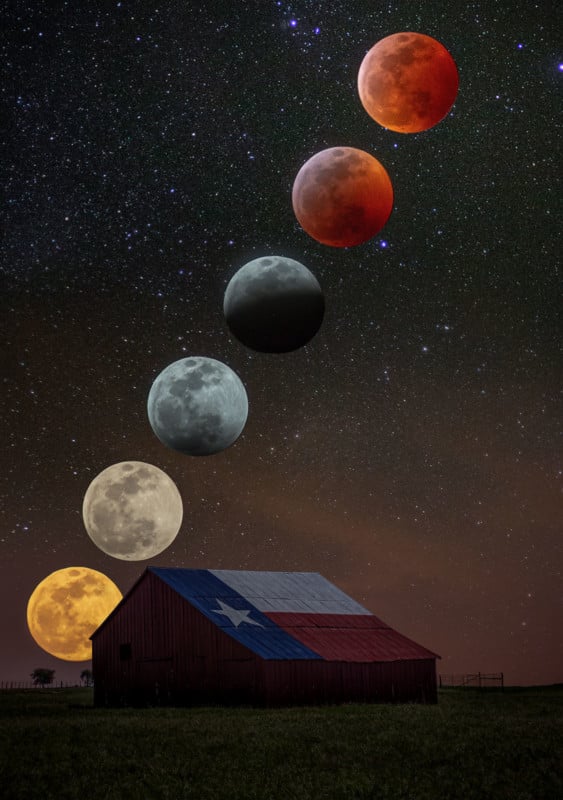
On the other hand, sometimes what you see in an image is not necessarily what it looked like in person. Whether you realized it or not, I bet you have seen a widely shared, simply amazing view of the Moon above a city skyline or similarly distinctive foreground, one where the Moon just jumps out at you! Often times, this is really a combination of two great shots, one of the foreground and one of the Moon but where the Moon had been altered by enlarging it and possibly moving it to strategically position it in relation to the foreground. I think many of these are really stunning and a joy to see. What bothers me is when it isn't made crystal clear that the photographer has taken poetic license, that it isn't a realistic portrayal of the Moon. Thanks to the Moon Illusion, we are used to to the idea that the Moon looks larger close to the horizon so it is not surprising that many people assume a shot where the Moon looks larger than normal is real.
A variation of this is composites similar to the ones above but where they are over a foreground subject. I am a big fan of these but, again, when the Moon is shown "larger than life" relative to the foreground, I think the photographer needs to call out the exaggeration. A great example of this done well, both the photograph and the photographer being upfront about what changed, is this shot by Jason Weingart that was highlighted in PetaPixel.
Jason Weingart Jan 2019
As another example of why it's important to be clear about when a shot has been materially changed, consider this post of a "larger than life" shot of the moon by Beau Rolfe on Facebook. In Beau's very cool shots, taken of the December 2018 full Moon, the lunar orb really is this big, but it's because it was shot with a really long lens (600mm), not because he edited the image in software to make the Moon look larger or shot the Moon with a longer lens than the foreground was shot with. Regardless, his shots still raised questions of "where can I go to see it that large?" and "was this Photoshopped?" (questions friends of mine brought these shots to my attention to ask about).
When you have a lunar eclipse like this month where the Moon is high in the sky, the focus (at least for photography) turns more to the Moon itself rather than the Moon and a foreground landscape. Here are examples of that, one from April 2014 when we were at the Perot museum into the middle of the night for an eclipse party and also a similar one at height of the latest eclipse, taken Sunday night from our backyard. Both were shot through our 10" Dobsonian telescope, captured with camera on my phone pointed through the eyepiece. Not ideal (see the lens flare in first one and the "field of view" in second) but I think they are still interesting shots.
Nathan Eaton April 2014
Nathan Eaton Jan 2019
As fun as it is to see all the different ways in which people shoot an eclipse, I also like the other ways in which people celebrate the eclipse. For example, I didn't make it there but one of our favorite watering holes, The Flying Saucer, had a unique way of celebrating, offering "Moon related" adult beverages.
One of the other fascinating aspects of this eclipse is the historic first sighting of a meteor strike during the eclipse. A key contributing factor to discovery of this event was that scientists were actually looking for it. It would have been pretty incredible to have been watching through my telescope just as the strike occurred!
To close, I'm including a couple of shots I took from the backyard Sunday night. First, a shot taken with my Nikon D750 using the longest lens I had handy, a 120mm Nikkor (actually, the D750 kit lens, a 24-120mm zoom). Image is cropped from an HDR stack of three bracketed shots.
Nathan Eaton Jan 2019
Finally, here is is a shot of the evening with us huddled around the fire pit trying to stay warm while watching the eclipse with our 8 month old Weimaraner, Luna. Not only is her given name take from the Moon, but her AKC registered name, suggested by our granddaughter Kai, is based on such an event: Runner's Lunar Eclipse. Seemed fitting to have her out with us while we were watching such a beautiful sight. I hope you were able to catch a glimpse of it, too!
It may seem hard to believe but solar eclipses are technically fairly common, at least one a year, many times two in a year. What makes them seem rare though has to do with the relatively small portion of the Earth over which they pass; for any given spot on the globe, solar eclipses are rare. For example, there hasn't been a solar eclipse crossing America since 1991, hasn't been one crossing any part of the contiguous United States since 1979 and there hasn't been a solar eclipse cross the entire continent since 1918.
On August 21st of this year, all three of those dates reset: a solar eclipse will cross from Oregon to South Carolina. Anyone along the centerline of the track will get to observe (weather permitting) the glory of a total eclipse. Everyone else in the country will see a partial eclipse (less of one the further from the centerline you are).
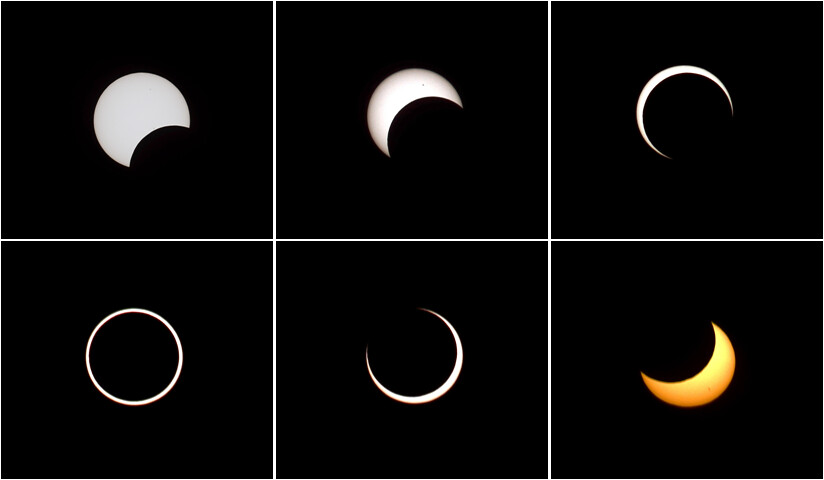
The last time I saw a solar eclipse was an annular eclipse in 2012 viewed from Albuquerque, New Mexico. The image included here is from my post on that event. For the 2017 total eclipse, I'm planning to observe from the centerline. More on that in future posts. In the meantime, here are a few links for more information on the event.










 The journey continues beyond 2009... check it out!


