Showing posts with label transit. Show all posts

Thursday, August 31, 2023

Geek Break: Calculating Elevation of Jet Transiting the Sun

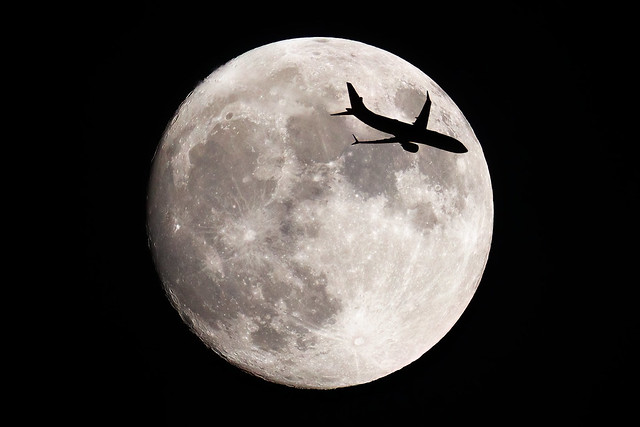
IMG_4503 v2
Brandon Ghany on Flickr

After my last post about capturing a jet flying in front of the Sun, I saw this image Brandon Ghany posted on Flickr of a jet crossing in front of the Moon and what caught my attention is how much smaller the jet is than in my video. 

From Brandon's description, this jet was flying at about 12,500 feet. Clearly, the jet I caught was flying much lower. But how low? I was curious enough to try figuring it out. 

The first factor to consider is that the Sun and Moon are similar but not exactly the same size from our viewpoint. Actually, the distance to the Moon varies a little at different points in its orbit so sometimes it is closer and thus a bit larger than the Sun (necessary to have a total solar eclipse) and sometimes it is farther away and thus a bit smaller than the Sun (leading to views like the Ring of Fire of an annular eclipse such as the one on October 14th this year). But in general terms, they are both roughly a half a degree across viewed from Earth. That means if Brandon had captured a jet at 12,500 feet passing in front of the Sun instead of the Moon, his image would have looked similar, at least in terms of the relationship between the size of the jet and the size of the celestial orb it passed in front of. 

The second factor is that while I know the angular size of the sun (reported by Stellarium as 31.68 arc minutes at the time of my video), for me to determine things like the jet's altitude, I need to know the jet's angular dimension, too. 

To calculate this, I captured a single frame from my video, cropped and rotated it then used drafting software (FreeCAD) to measure the relative difference between the width of the jet's fuselage and the width of the Sun. The ratio came out to 55.25% which means the width of the jet body is 17.5 arc minutes. 

So, how did you do in high school or college trig class? I muddled through but that was also so long ago, I just don't recall the exact formula to use. Thanks to Google, though, it was pretty easy to find what I needed.

d = ( w / θ ) * 60

Simple, right? Well, except I'm missing one variable: w, or width. Google to the rescue again. If I assume that this jet was something like a Boing 737 or an Airbus 320, both pretty common models used by airline companies flying out of DFW and Love Field, then the width of the fuselage is approximately 13 feet. Plugging that into the formula as w and converting arc seconds to degrees and using that as θ, that tells me that the jet was approximately 2,674 feet away when it passed over our neighborhood. 

But was that how high it was flying? Not exactly since it wasn't directly over my backyard. Again checking Stellarium, I found that the Sun's altitude (its angle above the horizon) was about 62.65 degrees.

Dusting off more trigonometry, that gives me two variables of a right triangle, the angle and the hypotenuse. From those, I can calculate the jet's elevation (the opposite side of the triangle) and the distance over ground to the jet's position when it transited the Sun. 

o = h * sin(θ)

a = h * cosin(θ)

Solving these is pretty straightforward with a modern calculator or using spreadsheet software like Google Sheets. Note that these formulas require the angle to be expressed in radians but spreadsheets have a function for that, too, so you don't have to remember the formula for converting degrees to radians:

θ radians = θ degrees * π / 180

So what's the answer? Based on the numbers above, at the time it passed in front of the Sun that jet was flying at an elevation of approximately 2,377 feet and its position over land was about 1,225 feet from my backyard, about a quarter of a mile to the southwest.

I would have thought the jets flying over East Dallas would be higher than that but the data and formulas say it has to be somewhere between 2,000 and 3,000 feet up. To see for yourself, make a copy of my spreadsheet and play around with what happens when you change the jet fuselage width (cell B7). Even if you change it to the size of a jumbo 747, 21.3 feet, the calculated elevation of the jet is still well under 4,000 feet.

Another interesting exercise would be to play around with the ratio of the jet fuselage width to the orb size to see what it has to be for the jet in Brandon's image to be flying at 12,500. Give it a try.

Remind you of one of those math word problems you hated solving in school?

Yeah, but pretty cool, huh?


Note
It's been decades since I was in school so if you find that I've made a mistake in my calculations, I'd be happy to hear about it in the comments.

Solar Transit of a Jet


UPDATE: I've replaced the previous video with a new version that includes the sound of the jet flyover from the original audio track. 

While out filming the sun to practice for the total solar eclipse next April, I was photo-bombed by a jet! 

The technical term is "transit", when an object crosses in front of an astronomical body. There is plenty of air traffic over our house with Love Field and DFW serving the area so I guess this shouldn't have surprised me but observing a transit (like this one, or this one) takes being in just the right place at just the right time so it's a pretty rare thing to have happen. 

One reason I happened to be shooting at this time is that I'm working out exactly what equipment I'm going to be shooting with for the total solar eclipse. This video was shot using:
  • Sky Watcher EvoStar 72ED refractor
  • Baader film solar filter
  • 2" mirror diagonal
  • Celestron 1.25" 2X Barlow
  • T2-ring
  • Nikon D750 DSLR
  • Focusing with DeepSkyDad AF3 autofocuser
  • Sky Watcher Star Adventurer 2 tracker
  • Radian carbon fiber tripod
I have a new 2" 2X Barlow and I plan to shoot straight-through (i.e., no diagonal) but I am still working out what combination of components will allow me to properly focus with the new Barlow. Once I have that worked out, I'll start working on automating my astrophotography workflow using a small computer (a Raspberry 4 running software called StellerMate).  

The quality of this video isn't great but that's basically because I was focusing (pun intended) more on getting the equipment working right than on the finer details. Next April may see a long ways off but it will be here in the blink of an eye and as I know from my experience in 2017, being ready to catch a full eclipse end-to-end, most importantly those few minutes of totality, takes an incredible amount of practice. So, I'll be shooting pretty regularly over the next few months to make sure I have everything working perfectly. 

Anyone have a way to ensure that April clouds don't spoil the eclipse for me, er, us?

Seriously, you'll notice from the video that the Sun is pretty active with quite a few sunspots showing. Over the next few weeks, if I can get a day with good "seeing" (i.e., where there is minimal air turbulence), I'll get some shots with lots of detail, everything in focus, and the sunspots should jump off the page at you. Stay tuned!

Warning 
NEVER look directly at the sun without proper protection. This video was shot using a telescope and camera equipped with a special solar filter.

Thursday, November 14, 2019

Mercury Transit 2019 - The Last One in North America for Thirty Years


Unlike the last Mercury transit in 2016 (see posts here and here), I didn't get a chance to photograph this latest one (November 11, 2019) as we were traveling and it wasn't feasible to drag all my gear with me. However, I did get a chance to watch part of the transit. That was a relief since the next one visible from North America doesn't occur until 2049.

What made viewing this transit particularly special is where we were and who we met.

As we were visiting New York City, I checked online and found a public viewing event, one that happened to be on an aircraft carrier, the USS Intrepid. Retired in 1974, the Intrepid has permanently moored dockside in NYC and was opened in 1982 as the Intrepid Sea, Air & Space Museum. Among other things, they have a space shuttle on display in a dedicated hanger, the Enterprise (the one used to prove the shuttle concept). If you are ever in New York, I highly recommend checking it out!

The host for this viewing was Joseph Martinez, better known on the streets of The Big Apple as the Joe of Jupiter Joe's Sidewalk Astronomy (here on the Web and here on Facebook). Joe is an avid amateur astronomer who loves sharing information on astronomy and views of the sky with people. Joe is also a JPL/NASA Solar System Ambassador. He and some friends had two telescopes equipped with solar filters set up on the Intrepid flight deck, sharing views of the transit with museum visitors.

My wife Linda and I checked out the view from each telescope and then struck up a conversation with Joe. As Linda has worked for many years as a planetarium educator, as I am a member of the Texas Astronomical Society and as we've both been involved in numerous viewing parties including past transits, we had a lot of common interests and activities to talk about with Joe.

When the discussion touched on the 2017 total solar eclipse and then the next eclipse in 2024, Linda suggested Joe should visit us in Dallas since we are in the path of totality. It turns out he is already making plans to be in Texas for the eclipse. Coincidentally, it also turns out he knows other planetarium educators in Texas whom Linda has worked with. Small world!

Joe, thanks again for the views of this transit! Perhaps will see you for the eclipse in 2024!

BTW, for some beautiful shots of this transit, check out ones posted on Earth Sky News.


Monday, May 9, 2016

2016 Mercury Transit: Video Clips

After starting the morning watching the transit online, there were finally a few breaks in the clouds, allowing me to capture portions of the transit myself, assembled into the video below. High wind also hampered things, making it tough to get a sharp focus and steady image, but it was still an incredible thing to watch.

Equipment:
60mm Parks refractor on German equatorial mount
Baader film solar filter from Kendrick Astro Instruments
Orion EQ-1M drive (for solar tracking)
Nikon D7000 (attached with T-adapter)
dslrDashboard on Nexus 9 tablet for remote viewing and camera control

Music: Mercury, the Winged Messenger from The Planets by Gustav Holst

Created with iMovie on a Macbook Pro


Astronomical event of the year: Mercury Transit 2016

In spite of clouds and windy conditions, I've managed to capture a few shots of Mercury crossing the face of the sun. It's a relatively rare occurrence, though not as rare as a Venus transit which I've also watched (see here). Very cool.

It's still in progress through 1:42pm Central today so you might still have a chance to check it out.

For information on the transit:

To watch online:
How to Watch Transit (Space.com)

Click on any image below to view large.

One of the better shots so far today. This is the sun with the planet Mercury (the dot at middle left) crossing it's face, an event called a transit. To the upper right of Mercury is a sunspot. Note that it's larger than the planet!


Our 60mm Parks refractor outfitted with a Baader film solar filter. My Nikon D7000 DSLR is attached to the telescope with a T-adapter. I'm remotely watching the live view from camera using an app on my tablet. The app also allows me to control the camera, taking the shot above and video (to be posted later today).


The makeshift wind screen I'm using to minimize how much wind shakes the telescope (which affects stability of images)

Wednesday, June 6, 2012

News Coverage of Venus Transit Event at Russell Planetarium


The viewing at the planetarium yesterday got a lot of media attention. There were trucks out from Channel 4 and Channel 23. Here is the coverage from Channel 4 which includes an interview with Gary Carter of the Texas Astronomical Society. You can see our equipment at about the 30-40 second mark (that's me in the light blue shirt and Tilley hat).

2012 Transit of Venus

Well, between the Texas heat and summer thunder storms, seeing Venus transit the sun was challenging but it was still an exciting event. A nice sized crowd turned out at the Russell Planetarium (West Mesquite High School) where we set up our 8" Dobsonian and shared our Canon image-stabilized binoculars for public viewing (both outfitted with Baader film filters).

I also set up our Parks 60mm refractor but instead of having people line up to view directly through it, I used a barlow to attach my Nikon D7000, tethered it to a laptop and displayed the transit full-screen on the laptop while capturing live high-def video. So, rather than a long line like the other telescopes, with this setup a small crowd could watch at once. When the clouds obscured the view, I could play back the video and still allow people to watch - handy for the few people who arrived during a cloudy period and had not yet been able to see the transit.

Did I mention it was hot? It was ironic that we were all out there anxious to see the sun but also wishing for shade. And with the sun so low and the heat in the 90s, the turbulence was pretty bad so pictures and video weren't as sharp as they could have been but, wow, it was still an amazing sight.

Thanks to Paul Ballou for hosting this event at the planetarium. Besides having Texas Astronomical Society on hand with telescopes and the Dallas Museum of Nature and Science present to help, he was showing the live NASA feed of the transit from Mauna Kea in the theater so during periods where it was cloudy, people who attended could go inside and cool off while continuing to watch the transit.

Only another 105 years till we get to do this again...

Here's the video:

Tuesday, May 15, 2012

June 5th, 2012: Venus Transit of the Sun

Venus Transit with the Sun
Originally uploaded by Paultyrrel
Get ready... on June 5th, last opportunity at a twice in a lifetime event, Venus passing in front of the Sun (called a transit). It happened in 2004 but after this one you'll have to wait another 105 years to see it happen again.

This photo is one I included in a Flickr gallery called Transit of Venus  that highlights a few interesting pictures of past transits on Flickr.

More to come after the 5th.