Showing posts with label Pixel 5. Show all posts

Saturday, July 9, 2022

First (and Second) Light with New Equipment

Earlier this year, we started on the journey to replace our older telescopes, a Parks 60mm refractor (currently for sale) and an Orion 8" Dobsonian reflector, with something lighter and smaller. The new telescope is a Sky Watcher Evostar 72mm ED apochromatic refractor. It is under 18" long and only weighs a touch over 4 lb so it's very portable. On a solid mount and using our Sky Watcher Star Adventurer tracker, it makes a very nice platform for both visual and photographic views of the sky. 

The telescope itself is optimized for viewing large but dim structures like galaxies and nebulae but with the right optics it works well for wide-field views of the planets, the Moon and the Sun. Of course, for solar viewing, it takes more special equipment. As with our other telescopes, I opted for one of the more affordable solutions, a filter made of Baader solar film. I had ordered Baader film from the Baader Planetarium but I needed a holder to fit the new Evostar. Instead of creating one from scratch out of cardboard as I did for the 2017 Total Solar Eclipse, I searched online and found a design on Thingiverse. Thanks to Dari Esfahani for creating it for me on his 3D printer. 

Here are shots of the finished filter and the new telescope.


On Friday, I set up the telescope and filter in the backyard. The view was great as there is plenty of sun spot activity right now (see SpaceWeather.com). I grabbed a shot through the eyepiece with my phone as it was too hot (105°) to take the time to mount my camera on the telescope. This morning before it got so hot, I tried again with the camera mounted on the Evostar. So, here are the "first light" and "second light" shots for the new solar filter. 

Taken with Pixel 5 cell phone through 
eyepiece on Evostar 72ED

Taken with Nikon D750 mounted on
Evostar 72ED

The shot taken with my phone isn't quite as clear and it has some odd artifacts from how the phone camera processed the image but otherwise, it isn't too bad. The shot through my Nikon D750 is sharper though I was a bit rushed and I think I can get even sharper focus the next time. As for the differences in the sun spots between the two images, it is in part because the orientation of the phone camera yesterday vs. the Nikon this morning plus a small difference in the size and location of each sunspot due to the time that had elapsed between each shot. 

With the new solar filter, I'll be spending more time watching and photographing the surface of the sun. Stay tuned!

As always, click on an image to see full-screen. 

Monday, May 30, 2022

A Night to Remember

When traveling to visit our friends who live in Palm Desert, CA, I packed the gear I could carry on a flight, opting for my travel tripod instead of a heavier Radian tripod and leaving the Star Adventurer tracker at home. My friend David had reserved a camp site for us for Mother's Day evening and his son-in-law Erik joined us. After setting up camp and enjoying the view as twilight ended, we hit the sack and set alarms.

My original plan was to do a multi-shot panorama of the full Milky Way arch. Unfortunately, when planning the shoot in PhotoPills (photo planning software), I had inadvertently scrolled forward a day so when my alarm went off instead of having a half-hour of moonlight to shoot the foreground and time enough to shoot the full arch while it was relatively low in the sky, I woke up up to a moonless sky and the arch already getting a bit too high for the shot I planned. Once I realized my mistake, I focused on just enjoying the view and getting a few decent shots including this one, taken with a Nikon D750 and an Irix Firefly 15mm f/2.4 wide angle lens.

My decision to go with B&W was in part because the sky colors were off and rather than do heavy edits to get a more natural look, I chose to take color out of the equation. My assumption about the colors I found when editing the raw image is that it perhaps had to do with the massive amount of dust in the air. That entire weekend, winds from San Bernadino south to the Salton Sea where blowing so hard that when we left Palm Desert Sunday afternoon headed to the campground, we couldn't see a mile down the road and could hardly see the mountains of Joshua Tree. At the campground at 3000 feet, the air was much clearer but the sunset that evening was orangish as was the light dome from Blythe that shows up in this image (which I also think was more prominent due to the amount of dust in the atmosphere).

The labels in this image were carried forward from a test shot done a few nights before taken at our friend's place above Palm Desert, an attempt to do some test shooting for the panorama that was thwarted by high, thin clouds. I had shared the one shot from that night where Scorpius was visible with friends, including similar labeling, so this version of this shot was labeled to relate the two images. See below for the unlabeled version plus a few other shots from the trip.

Click on any image to see enlarged.

The Milky Way over Joshua Tree National Park
(Light dome is Blythe, CA)

Low visibility leaving Palm Desert, CA

Sunset at Joshua Tree National Park

Cottonwood Campground Amphitheater

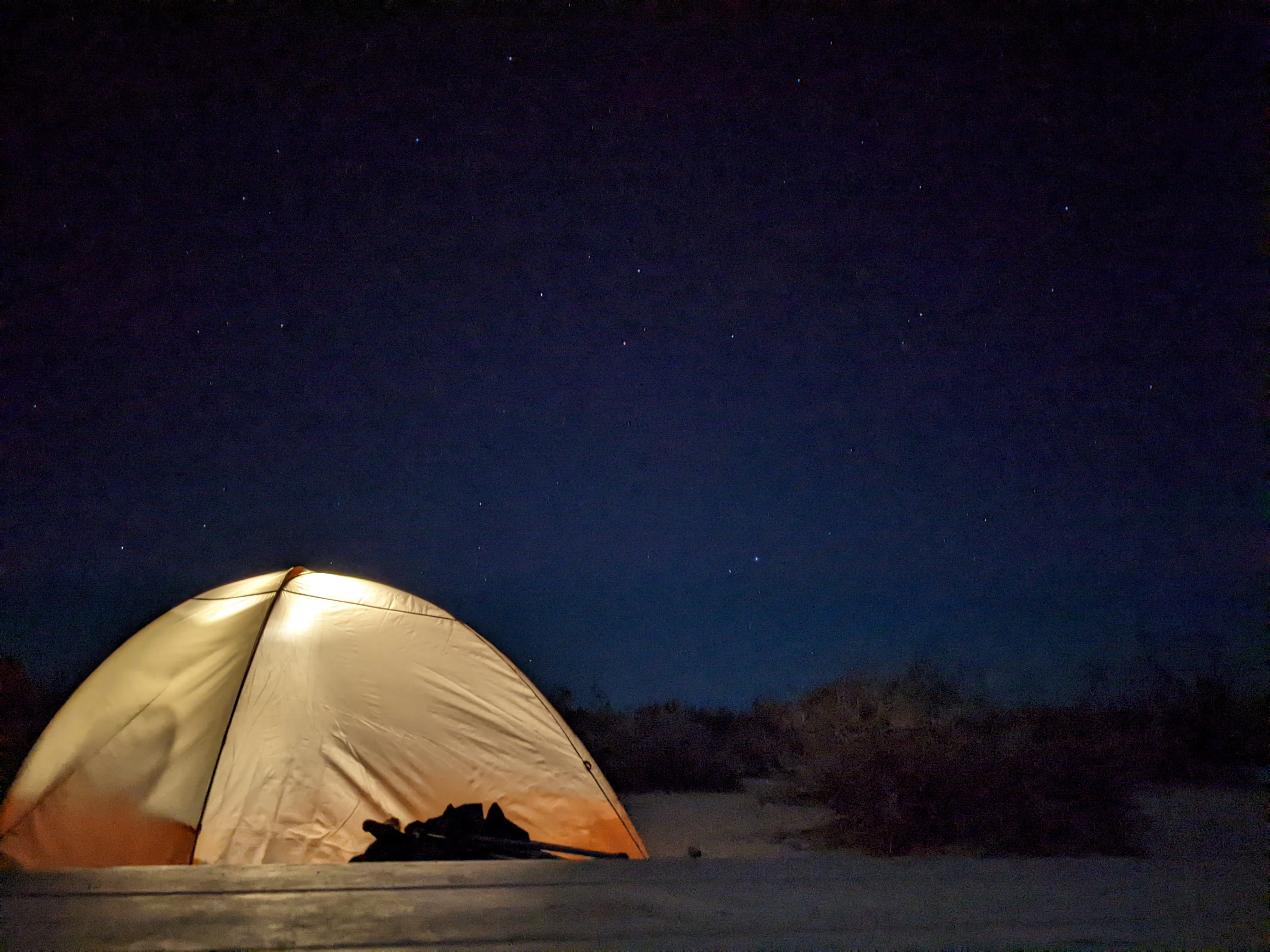
Campsite