Showing posts with label venus. Show all posts

Monday, September 30, 2024

Contest to Name a Quasi-Moon

Want a Zoozve Poster?
Click on the image to buy one from Alex
What's a Quasi-moon

Right? What the heck are they? A quasi-moon of a planet is an asteroid that remains in the general vicinity of its planet. Unlike a moon, a quasi-moon doesn't orbit the planet itself but orbits the Sun, just with a path similar to that of the planet. If you want to learn more about quasi-moons, check out the Wikipedia quasi-satellite article.

BTW, if you have seen the latest news reports about Earth having a mini-moon for two months as asteroid 2024 PT5 is captured by Earth's gravity, you might wonder about the difference between a mini-moon and a quasi-moon. See the Wikipedia quasi-satellite and temporary satellite articles for the details but basically quasi-moons have a (mostly) stable orbit and mini-moons don't. 

The Zoozve Story

I first learned about quasi-moons listening to a viral podcast episode about something called Zoozve. You should check out the Zoozve episode yourself, both for the full story and more details on this unique object, but the gist of it is that the co-host of Radiolab, Latif Nasser, was looking over a solar system poster bought for his son and noticed the name Zoozve, shown as a moon of Venus. Having never heard that Venus has a moon, he did his thing as an investigative reporter and learned that it was a quasi-moon. He also discovered that Alex Foster, the graphic artist who created the poster, had mistakenly shown the object's provisional designation, 2002VE (technically, 2002 VE68) on the poster as ZOOZVE. Latif eventually pitched the idea of submitting the name Zoozve as the official name of 2002 VE68 to Brian Skiff, the scientist who had discovered it. Brian submitted the name to the International Astronomical Union (IAU), the scientific body responsible for governing the names of astronomical objects,  and it was eventually approved. 

The Naming Contest

Orbital path for 2004 GU9
Click to enlarge

Inspired by the naming of Zoozve, Radiolab and the IAU kicked off a contest this past May to name one of Earth's quasi-moons, the asteroid 164207 (2004 GU9), as a way for the public to learn more about quasi-moons and the ways in which the naming process connects culture and science. You can read more about the contest here. There aren't many quasi-moons and only a few have official names, the rest just have a provisional designation, so it is pretty cool for the public to have an opportunity to suggest the name for one. 

The deadline for submissions is today so if you weren't already aware of the contest, there are only hours left if you want to make a submission. However, you can still participate as Radiolab and IAU will pick 10 finalists in October and then during November and December the public will be able to vote on which of these they think will be the best name for 2004 GU9. The winning name will be announced in January, 2025. 

Getting Involved
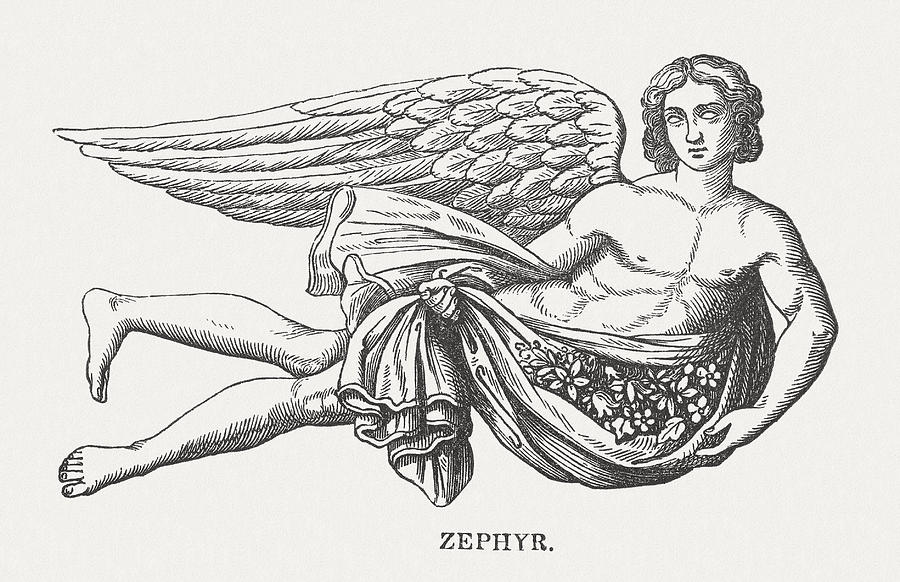
As an amateur astronomer and STEAM advocate, the opportunity to be involved in naming an astronomical object really intrigued me. I've spent time off and on over the past few months working on this. First I had to come up with a name. It had to be from a mythological source (excluding types of names used for things like planets) and it couldn't have already been used as the name of another celestial object. The name I selected is Zephyrus. 

After coming up with the name, I had to draft a citation, the official description that will be recorded with the name, and a justification, my case for why they should choose my submission. Drafting those involved numerous rewrites. In the course of this I did leverage some online resources, even using AI for idea generation and suggestions on improving the writing, but ultimately the end result is my own work.  See below for what I submitted.

Name: Zephyrus
Source: Greek Mythology
Citation: Zephyrus is the Greek god of the west wind, one of the four Anemoi, the wind gods. He symbolizes renewal, life, and the gentle forces of nature. This name was selected through a contest organized by the IAU and Radiolab to name a quasi-moon of Earth.
Rationale: Zephyrus, one of the four Anemoi of Greek mythology, was the god of the West wind. Although generally associated with gentle breezes, Zephyrus also had a wilder side, sometimes referred to as stormy or ill-tempered. This dual nature, a balance between gentle influence and untamed power, is also reflected in the unique orbital properties of quasi-moon 2004 GU9. Its orbital path has a subtle grace and beauty yet represents possible danger, reflected in its classification as a Potentially Hazardous Asteroid.

2004 GU9 is held in its orbit by the Sun, echoing Zephyrus' struggle with Apollo, the Sun god. Both the wind god and the asteroid have been subject to the pull of a more powerful force. Just as Apollo won the affections of Spartan prince Hyacinthus over Zephyrus, the Sun dominates the movements of 2004 GU9. These parallels illustrate a delicate balance between autonomy and influence, where smaller entities make their way under the sway of greater powers. Both cases reflect struggle and equilibrium.

Choosing the name Zephyrus for quasi-moon 2004 GU9 would pay tribute to the complexity and balance of Earth’s winds and of the movements of cosmic bodies. It would also honor the imaginative spirit of this naming contest. Just as the naming of quasi-moon Zoozve was the result of a creative spark flowing from discovery, Zephyrus is often associated with spring and growth, with the creation of the new.

If you're interested in learning more about Zephyrus, you can check out the Olympioi or Wikipedia articles on him for additional information.

Hopefully, my submission is selected as one of the finalists. If it does, I'll do a follow-up post with information on how to vote. I hope you'll consider voting for Zephyrus!

Whether or not Zephyrus ends up being chosen, it's exciting to be part of this naming process. 

I'd love to hear if you have an idea for a name for 2004 GU9, have feedback on Zephyrus as a name for it, if you have questions or comments on quasi-moons or if you have questions about how and why astronomical objects are named. Drop a note in the comments - let's chat! 


Wednesday, April 10, 2024

April 8th 2024 Total Solar Eclipse: Timelapse of Totality over Ellis County, Texas


UPDATE: Now that I've had time to work on some of my other images and videos, I went back and remixed this one to fix some things I rushed the first time around. In this edit the sky appears darker, closer to what we saw that day, so the coronal ring around the Sun stands out better. 

Another total solar eclipse imaging projects I planned to do is a timelapse sequence of the eclipse. In 2017 I tried shooting the entire eclipse but this time I just focused on the 5 minutes before totality, the 4+ minutes of totality and the 5 minutes after. Unlike 2017, we had much clearer skies and this came out pretty much just as I planned. Thanks to Alan Dyer (amazingsky.net) for the tips in his book on shooting the eclipse, specifically the tips on shooting a wide-angle timelapse!

To capture this, I set up my son Brian's Nikon D750 with our Irix 15mm f/2.4 wide-angle lens on a tripod at the corner of my son Chris' yard where we were observing the eclipse. My D750 was in use on the telescope so a big thanks to Brian for the use of his camera!

The sequence was shot with the internal intervalometer set to capture an image every second for 15 minutes with the timer set to start it at 1:35pm so that I didn't have to remember to start it on time. I set exposure ramping on so the camera would automatically adjust the exposure as the sky got darker and brighter, then set the exposure compensation to +1.33 so that it wouldn't be heavily overexposed during the pre- and post-totality shots. 

Once at home, I processed the 900 images in LRTimeLapse and Lightroom Classic to create a video clip from the images and then added titles, adjusted track speed and added music in DaVinci Resolve. This is the finished product! 

A few things to watch for in the video:
  • At about the 18 second mark, look for the small star to lower right of the Sun. That's not a star, it is the planet Venus!
  • The contrail at lower center is probably a commercial aircraft, possibly one of the one flying along the eclipse path to prolong how long they could watch totality. 
  • At about the 36 second mark, the "insect" flittering about above us in the drone landing after shooting the arrival and departure of the lunar umbra. 
Enjoy!

Tuesday, July 25, 2023

Jack and Papa Capturing Moon and Planets

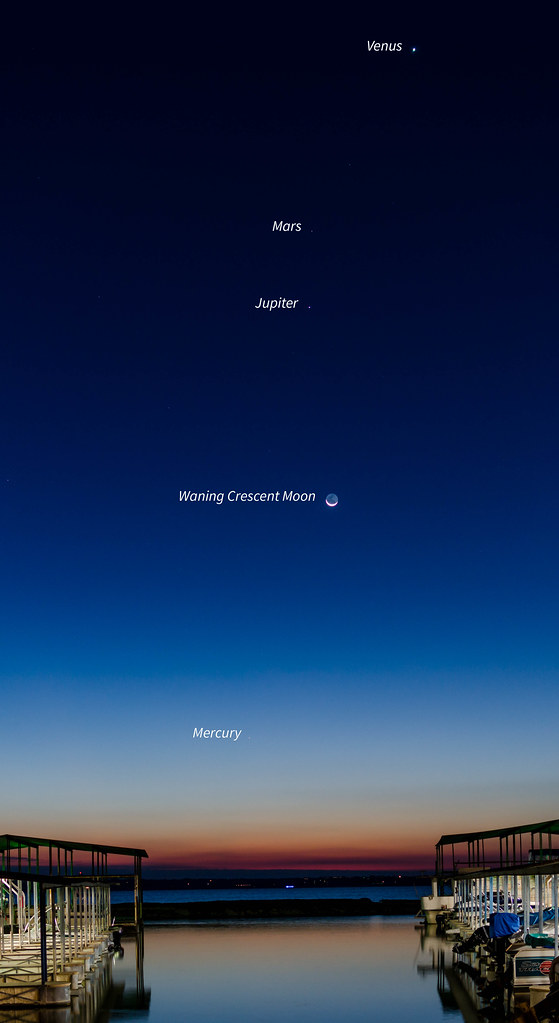
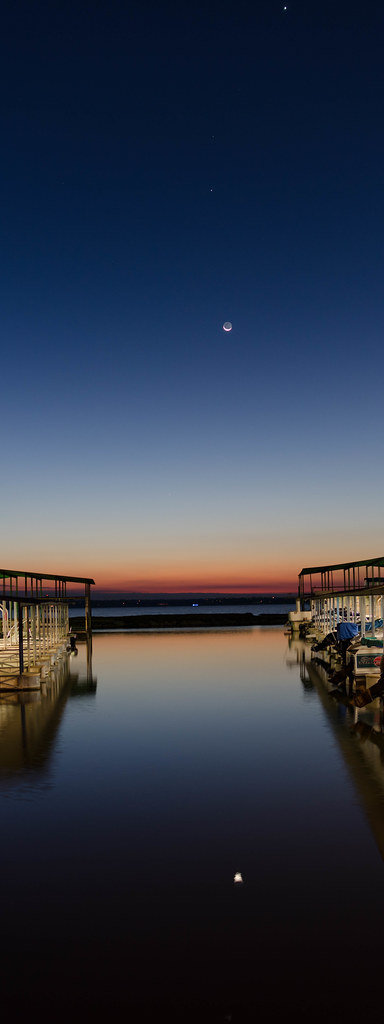
While our grandson Jack stayed with us last week, he and I went out one evening to take our Weimaraner, Luna, for a walk on the east shore of White Rock Lake and to try capturing the 3-day old crescent Moon, Mars, Venus and Mercury over the iconic Pump Station. 

We were partially successful. Jack got in a dozen or so shots with my Nikon D750, starting with some test shots and then bracketing to try and get both the properly exposed lunar crescent and also the rest of the lunar surface lit with Earthshine. As explained below we didn't quite get what we wanted. Had the mosquitoes not chased us off, we might have eventually got it but Luna was getting impatient anyway so we put the camera away and went for our walk. 

Unfortunately, the brackets didn't get us quite enough dynamic range to get both Earthshine and a lunar crescent that showed any detail. In the end, a single shot had the best overall exposure and detail that we were after. Although the lunar crescent is heavily over-exposed, the Earthshine-lit surface is still visible. And although Mercury is lost in the haze over Dallas, in addition to dim Mars and bright Venus you can just make out the stars of the "front-end" of the constellation Leo the Lion with it's brightest star, Regulus. 

Here is the final shot and below is a version that is labeled. Enjoy!

Photo by Jackson Eaton


Photo by Jackson Eaton


As always, click on image to view full-screen.

Tuesday, June 28, 2022

Moon and Five Planets over Downtown Dallas Skyline - This Time With the Pleiades


In my last post, I described my efforts to capture an interesting image with the Moon and all five naked-eye planets lined up in the order of their orbits out from the Sun. As the conditions on June 24th were not ideal and elusive Mercury was mostly lost in the haze over Downtown Dallas, I tried again on Sunday, June 26th. The sky was much clearer (at least over the Dallas skyline) and there was less haze. Thankfully, staying up almost all night a second time was definitely worth it!

In the image above, I've added an enlarged insert of each object and labeled them to give everyone a more clear idea of what they are looking at without having to click on the image to see it full screen and then zoom in to tell what each object is. The original, unlabeled image is also included below. 

While the surprise on Friday's outing was the ISS flyby (I'm still working on the timelapse videos from both Friday and Sunday), the surprise in these images is that I also captured the Pleiades star cluster (M45), which you may know as the Seven Sisters (immortalized in the Subaru logo)! 

Another difference between this image and the one from the 24th is that the Moon is "older", now 28 days through its cycle (vs. 26 days on the 24th). Just two days from being a New Moon, in this image it is a thin crescent, only 4% illuminated. However, thanks to the length of the exposure (2 seconds), the camera captured not just the sun-lit crescent but it also captured earthshine, the portion of the Moon not in sunlight but still lit but the sunlight reflected off of the Earth. 

For anyone interested in how this image was created, I started out by taking multiple shots with a Nikon D750 and the kit lens, a Nikkor 24-105mm f/4 lens set to it's widest at 24mm. Each of the 6 images used were taken in portrait orientation and, using a tripod, I started shooting to the left of Mercury, then moved the camera about 35 degrees to the right so that the next shot would be overlapped with the previous, continuing until I had the final shot including Saturn. Each image was taken at ISO 200, f/4 and as noted above, exposed for 2 seconds.  The screenshot to the right was my shooting plan from PhotoPills with the red dot representing my location on the west levee of the Trinity river and the black dot representing the Bank of America Plaza tower (the tallest building in Dallas, the one in the panorama with the bright green lights), about 1.6 miles away. The Margaret Hunt Hill Bridge, the white suspension bridge arch in the center of the panorama, crosses the Trinity.  The lighter dashed lines with black dots represent the left, center and right of the field of view in the panorama. 

Post-processing involved using software (Adobe Bridge and Adobe Camera Raw) to merge the 6 shots into one panorama, then crop and apply adjustments for exposure, sharpness, etc. Next, I edited that image in Photoshop to add the insets and labels. As the merged image exhibited some color banding in the morning twilight sky, I used a technique involving adding a little noise to the image to reduce the banding. Note that I also took some creative license with this shot, editing the inset of the Pleiades to emphasize the major stars so it would be more recognizable.

As always, click an image to view full-screen. Enjoy!


Friday, June 24, 2022

Moon and Five Planets over Downtown Dallas Skyline


Step outside this morning about 45 minutes before sunrise and you would have seen an incredible sight, a unique alignment of the visible planets along with a waning crescent Moon.  It's not all that rare to see some combination of planets before sunrise or after sunset but it's pretty rare for them to be aligned in the order that they occur extending out from the Sun: Mercury, Venus, Mars, Jupiter and Saturn. Even more so with the Moon in view.

There's nothing special or mysterious about this alignment. It just happens that the relationship between Earth and each of the other planets in their orbits around the Sun is such that they line up this way now. But isn't it beautiful! 

I had originally planned to go find a spot out in the countryside with dark skies to take this shot but just the Moon and planets on their own with nothing interesting in the foreground seemed a bit boring. I did a number of test shots over the past week and determined that even with the bright lights of downtown Dallas, they would still be visible in a shot like this. 

Unfortunately, the haze was just a bit too heavy this morning for Mercury to really show up. It's there but just hard to see without zooming in really close. Given how close the planet orbits the Sun, it is never that far above the horizon while the sky is still dark enough to see it. I have some other shots I still need to go through though so if I have another where it's more visible, I will post it. 

This image was created by taking four shots with a 15mm wide angle lens. Two were taken with the camera level (to avoid vertical distortion of buildings, bridges, etc.), one aimed just left of the Margaret Hunt Hill bridge (the brightly lit suspension bridge) and the other aimed towards the bright street light to the right. The other images were taken in the same directions but aimed high enough to capture Jupiter and Saturn. The four images were merged as a panorama in Adobe Lightroom. 

The panorama above is only part of what I was working on this morning. I also captured nearly 3000 shots over almost 3 hours that I plan to assemble into a timelapse video. The image to the left shows the shooting setup. The camera on the left is my Nikon D750 with a 14mm Rokinon lens; it's taking the timelapse sequence of images. The camera on the right is my son Brian's D750 with our Irix 15mm lens; it's what I used to take the shots for the panorama. 

Stay tuned for the timelapse! Besides the Moon and planets, it features a special guest appearance from the ISS. 

Click on images to view it full-screen. 

Saturday, May 7, 2022

Four Morning Planets, Part Duex

As mentioned in my last post, I am looking for additional opportunities to capture the parade of naked-eye planets across the morning skies this spring. Unfortunately, over the past two weeks, most mornings were overcast, whether in Dallas or Los Angeles, preventing me from seeing and shooting this unique event again. Sadly, that included even being able to see the close conjunction of Jupiter and Venus as they traded places in the parade. 

Thankfully, in Palm Desert things have been much clearer so a few days ago I was able to capture them again, this time with palm trees and Southern California mountains instead of oak trees and Lake Buchanan. I was also able to plan the shot, shooting earlier in the morning before the twilight glare made it so difficult to see them as in the prior post. 


Saturday, April 16, 2022

Four Morning Planets

After wrapping up my time shooting the Milky Way outside our room at the Canyon of the Eagles resort on Lake Buchanan (see my last post), I noticed a bright light through the trees and stepped across to the eastern view of the lake to check it out. Realizing it was Venus, I recalled the unique alignment happening this spring, a clear view of four of the five planets able to be seen with the naked eye in the morning skies: Jupiter, Venus, Mars and Saturn. I set up my equipment again and took a number of shots; below is the best of them with the planets aligned as in the Stellarium screen shot above. 

As this will progress into early summer with the planets jockeying for position relative to each other, the stars and occasionally the moon, I'll be looking for additional opportunities to capture this rare alignment including in late June when Mercury joins the other four. 

Click on image to view full screen.


Monday, March 28, 2022

The Moon Meets Venus, Mars and Saturn in Morning Sky

Living in a neighborhood full of old, tall trees, it takes getting out of the neighborhood to have a clear horizon. White Rock Lake is a favorite destination so I picked a spot on the west shore from which to shoot this beautiful conjunction between the crescent moon, brilliant Venus above with Saturn and Mars between the two. I think the reflection of the moon and reeds in the foreground made for a more interesting image.

Read more about the conjunction and see photos of it from around the world at EarthSky.org

Click to see full-sized


Sunday, October 11, 2015

Moon and Planets (labeled)

Moon and Planets Oct 2015 (labeled).jpg Another view of moon and four planets, this time labeled (inspired by Alan Dyer of AmazingSky.net).

Saturday, October 10, 2015

Moon and Planets


Moon and Planets with Reflection Oct 2015A view of the waning crescent moon (with reflection), Mercury, Jupiter, Mars, Venus before dawn on October 10th, 2015. Oh, and with Earth in the foreground!

Multiple shots stitched together.
f/2.5
1/2 sec
ISO 400
35mm
Nikon D7000

Wednesday, June 6, 2012

News Coverage of Venus Transit Event at Russell Planetarium


The viewing at the planetarium yesterday got a lot of media attention. There were trucks out from Channel 4 and Channel 23. Here is the coverage from Channel 4 which includes an interview with Gary Carter of the Texas Astronomical Society. You can see our equipment at about the 30-40 second mark (that's me in the light blue shirt and Tilley hat).

2012 Transit of Venus

Well, between the Texas heat and summer thunder storms, seeing Venus transit the sun was challenging but it was still an exciting event. A nice sized crowd turned out at the Russell Planetarium (West Mesquite High School) where we set up our 8" Dobsonian and shared our Canon image-stabilized binoculars for public viewing (both outfitted with Baader film filters).

I also set up our Parks 60mm refractor but instead of having people line up to view directly through it, I used a barlow to attach my Nikon D7000, tethered it to a laptop and displayed the transit full-screen on the laptop while capturing live high-def video. So, rather than a long line like the other telescopes, with this setup a small crowd could watch at once. When the clouds obscured the view, I could play back the video and still allow people to watch - handy for the few people who arrived during a cloudy period and had not yet been able to see the transit.

Did I mention it was hot? It was ironic that we were all out there anxious to see the sun but also wishing for shade. And with the sun so low and the heat in the 90s, the turbulence was pretty bad so pictures and video weren't as sharp as they could have been but, wow, it was still an amazing sight.

Thanks to Paul Ballou for hosting this event at the planetarium. Besides having Texas Astronomical Society on hand with telescopes and the Dallas Museum of Nature and Science present to help, he was showing the live NASA feed of the transit from Mauna Kea in the theater so during periods where it was cloudy, people who attended could go inside and cool off while continuing to watch the transit.

Only another 105 years till we get to do this again...

Here's the video:

Tuesday, May 15, 2012

June 5th, 2012: Venus Transit of the Sun

Venus Transit with the Sun
Originally uploaded by Paultyrrel
Get ready... on June 5th, last opportunity at a twice in a lifetime event, Venus passing in front of the Sun (called a transit). It happened in 2004 but after this one you'll have to wait another 105 years to see it happen again.

This photo is one I included in a Flickr gallery called Transit of Venus  that highlights a few interesting pictures of past transits on Flickr.

More to come after the 5th.

Friday, February 20, 2009

Spotting Venus in Daylight

I've been planning a post on how bright Venus has been in the evening sky lately, but it's turned into more of a research effort than I expected. I still plan on posting about that eventually but in the meantime let's talk about a side effect of how bright Venus is.

At its brightest, Venus is normally1 the third brightest object in the sky behind the Moon and the Sun. We don't typically see celestial objects during the day other than the Sun and, depending on its phase, the Moon. The reason has to do with contrast - the difference in brightness between two objects. To see an object in the sky, it has to be brighter than the background. That's why you can see stars at night but not during the day: the scattering of sunlight in the atmosphere makes the sky too bright compared to the stars. This is also why you can't see the Milky Way in urban areas. Light pollution increases the brightness of the sky, reducing the contrast between the Milky Way and the background sky until there isn't enough difference for the Milky Way to stand out.

So, if you can't see stars during the day then is it possible to see Venus? As bright as it gets (apparent magnitude -4.7), it is still not nearly as bright as the Moon (-12.6). As it turns out though, it is bright enough to see in broad daylight. You just have to know where to look.

As bright as Venus is right now and given how far it is above the Sun (its elongation), now is a great time to try spotting it during the day. To find it, it helps to have something else nearby to start your search from. A good candidate is the Moon. I checked using one of my favorite pieces of software (Planetarium) and found that over North Texas the Moon and Venus will be just a few degrees apart about 2:30 p.m. on February 27th. Although the Moon will be a thin crescent on that date, it should still be a good starting point for finding Venus. I plan to try this approach on the 27th but in the meanwhile there is another alternative that you can try tomorrow. 

First, find a building with an exterior wall that runs generally north and south. The next step is to know what time during the day Venus will be directly over head (it's transit time). To find that for your location, use this tool hosted by the U.S. Naval Observatory. Scroll down to Form A, enter the date, Venus as the object, your state and city and optionally your elevation above sea level, then click on the Compute button. The resulting data includes the time Venus rises and sets but more importantly its transit time and how high in degrees above the southern horizon it will be at that time (its altitude). 

With this information in hand, grab a pair of binoculars and stand next to your north/south wall shortly before the specified transit time. It needs to be a wall facing east so that as you stand next to it you're in shade (or, if viewing when Venus is in the morning skies, use a wall facing west as Venus would transit before the sun). This will avoid glare from the Sun as you search for Venus and also guard against accidentally looking at the Sun through the binoculars. Standing next to the building, search the sky just along the edge of the roof of the building, scanning back and forth at approximately the angle Venus should be above the southern horizon. 

I tried this yesterday and it worked great. Venus was to be straight overhead at 2:57 pm at an altitude of 67 degrees. Our house faces due south so all I had to do was step outside on my patio and stand next to the east-facing wall.  By scanning the sky along the edge of the roof overhead I was able to spot Venus easily through my Canon 8x25 binoculars (you don't need big, powerful binoculars - almost any decent pair will do). I got a great view of a crescent Venus. 

For something a little harder, once you've spotted Venus through binoculars try searching that same spot without them. It takes a bit more effort but once you know where to look and what you are looking for it is possible to spot it with the unaided eye. 

I'll post an update the next time I've spotted Venus during the day and include a photograph. In the meantime, once you've succeeded in spotting Venus in the daytime yourself, share the wealth and show it to your friends, family or neighbors. I bet they'll be amazed!


1 According to this Wikipedia article, objects (past and present) brighter than Venus include the Crab supernova of 1054 and Iridium satellite flares.

Tuesday, January 6, 2009

Moon, Venus and Photographers


Moon, Venus and Photographers, originally uploaded by neatonjr.


Here's my post for 2nd day of the IYA2009.

Back in December 1956, when my Mother was 5 months pregnant with me, she and my Dad climbed the levee on the south side of the Trinity River below downtown Dallas and took a shot of the city skyline. Having recently had all my Dad's slides digitally scanned, we ran across that shot and decided to recreate it. We went down to the same spot with a family friend to shoot the skyline at sunset and after dark. You can see one of the skyline shots here.

While my Dad and Steve took a break from shooting downtown, I turned my camera on the two of them with the Moon and Venus in the sky behind us.