Showing posts with label totality. Show all posts

Tuesday, April 8, 2025

2024 Total Solar Eclipse Anniversary

It's hard to believe it's already been a year since this incredible event. The pace of life has certainly changed. In the years, months, and especially days leading up to the eclipse, there was such a sense of urgency. So much to do to get ready and always the nagging feeling that something was being left undone, the worry if everything would go as planned, if the weather would cooperate. In some ways, it's a nice break to not live with that constant anticipation, but I would happily live with that again to be able to see another total eclipse! It's not all behind us, though. The journey continues as we process and learn from this astronomical marvel.
 
Copyright Nicolas Lefaudeux
Although I spent untold hours post-processing images of totality, I continue to run across information and examples of pulling out even more detail through advanced processing techniques. For example, although French optical engineer and amateur photographer Nicolas Lefaudeux doesn't publish his techniques, his images are great inspiration to delve even deeper into the science and art of eclipse image processing. I continue to experiment with new techniques on my own images so perhaps may have new versions to share some day.

On the science front, one of the activities I am the most proud of is having participated in the NASA-funded 2024 Eclipse Megamovie project. As with the 2017 project, the goal is to use images taken throughout totality, all along the eclipse track, to create a unique time lapse view of the Sun's corona - something we can only view from Earth during a total solar eclipse - to study its behavior. Unlike the 2017 eclipse where I got clouded out, this time I was able to capture all the images needed for the project. 

While the eclipse just lasted a few hours, the scientific analysis using the images and data collected that day will go on for years! You can read the one year anniversary update from principal investigator Dr. Laura Peticolas for more information on progress to date and what's still to come.
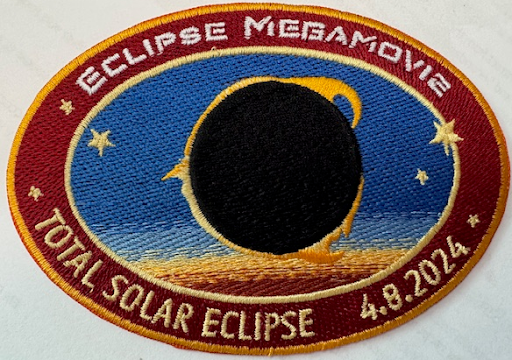
To mark the anniversary of the eclipse, the project sent each of the volunteers our own mission patch! Be sure to read the backstory of NASA mission patches and the EM2024 mission patch. We were also each recognized with credit for our contributions to the project on the Eclipse Megamovie web site. It's pretty cool to see my name on the list!

To revisit my stories from preparing for and experiencing the April 8, 2024 total solar eclipse, see the link under Quick Links in the sidebar. 

Below I've included a gallery of some of the highlights of my eclipse experience. 

Capturing fine detail in the corona and the lunar surface illuminated by Earthshine


Baily's Beads and Solar Prominences


Time lapse of totality


Lunar umbra (shadow) passing over landscape captured from drone

Friday, April 19, 2024

April 8th 2024 Total Solar Eclipse: Sungrazer Comet

Comet 12P/Pons-Brooks during Total Solar Eclipse
Click to enlarge

Some news headlines leading up to the total solar eclipse last week suggested we might be able to see the "Devil Comet" (12P/Pons-Brooks) during totality, though with binoculars or a telescope, not naked-eye. We didn't see it but then we even forgot to use our binoculars to look at the eclipsed sun during totality much less remembered to use them to look for the comet.

I was asked whether the comet might appear in the photos I was taking with my telescope and my answer was, unfortunately no, it was well outside the field of view of my equipment. 

However, I was excited to see an article in my news feed late last night describing a comet passing close enough to the sun to fit in a telescopic field of view. Called SOHO-5008, it was a sungrazer, a comet passing so close to the Sun it would appear in coronagraph images by the SOHO solar satellite. This one had been identified in SOHO images the morning of the eclipse and several people found that they had captured it in their eclipse images. Later that day, it had burned up in the Sun. 

This morning, I pulled up my own images from totality and found that I had captured it, too! It took bumping up the exposure far more than I usually would but, once I did that and made a few other adjustments to bring out more detail, there it was. Here is an edit with labels similar to an image from my last post, noting some of the brighter stars visible from constellation Pisces and adding an enlarged inset for the comet. 

I may do another edit later on to balance out the overall image but i wanted to go ahead and share this now. 

Pretty cool, huh?

Saturday, April 13, 2024

April 8th 2024 Total Solar Eclipse: Fine Detail in Corona


I went down a bit of a rabbit hole this week, assuming that to really get sharp detailed images of totality I needed to go through the rather involved process of using calibration frames to process all of the images I planned to stack before trying to stack, register and merge them. After spending a few evenings starting down that road, I took a break and in reviewing tutorials on processing solar eclipse images I ran across several that describe doing everything directly in Photoshop without the use of registration frames. 

Following the process described in this Sky & Telescope article, I created the image above using a set of images shot at 2 stop intervals from 1/4000th of a second to 1 second, all shot at f/5 and ISO 100 with my Nikon D750 through our Sky Watcher Evostar 72ED telescope. 

Click on it to enlarge and check out the incredible detail. You'll find features like:

  • Plenty of detail in the solar corona
  • Solar prominences
  • The lunar surface illuminated with light reflected from Earth (Earthshine)
  • Several stars from the constellation Pisces

This is just the first phase of edits described in the article so more to come. In the meantime, I did a separate version with features labeled. 


April 8th 2024 Total Solar Eclipse: Initial Telescopic Images

Fine details in the solar corona


One of my primary goals for this total solar eclipse was to capture a variety of telescopic views of the eclipse. The similar goal I had in 2017 was spoiled by overcast skies that resulted in a mad dash down the road with Beau Hartwig chasing clear skies. Seeing totality with my own eyes meant giving up on my photographic goal. I don't regret that for a minute but I was thrilled that this time the skies cleared for us just in time for the "Big Show". 

To avoid having to split my attention between experiencing totality and taking pictures, I used our old 2012 MacBook Pro running a software package called Solar Eclipse Maestro to control the camera, snapping pictures at pre-defined times and exposure settings. SEM worked flawlessly and had it not been for a user-error on my part (which I'll cover in a future post), I would have captured everything I planned for. As it is, I still was able to capture most of what I planned including:
Although the images captured were as good or better than I hoped, post-processing them to fully bring out the available detail is a rather complicated thing involving a variety of software tools. I am still working on that but I wanted to go ahead and share some initial edits. 

The image above is a blend of each of the 19 different shutter speeds used to capture images to submit to the Eclipse Megamovie project. They were taken during totality to capture as much fine detail of the solar corona as possible. The project team will use the calibration frames to pull out even more detail than appears in this image but, for my first pass at this I used some basic stacking techniques in Photoshop. Click on it to see enlarged... isn't the level of detail incredible?

I'm also including some cursory edits I've done of a few other images below including a partial phase image and a picture of Baily's Beads. What I am the most excited about though is the spectacular solar prominences that appear in the Baily's Beads shot. Wow! Even more incredible is that the largest one was visible naked-eye. 

Once I've had time to go through the rest of my images and finish some of the more complicated editing processes, I'll share more of these. I'll also do a follow-up post on my equipment and what went into capturing these images. 

I hope you got a chance to see totality for yourself but, if not, please enjoy my first pass at sharing the view with you. 

Late in the partial phase of the eclipse. Note the sunspot in the center!

  
Baily's Beads and Solar Prominences


Wednesday, April 10, 2024

April 8th 2024 Total Solar Eclipse: Timelapse of Totality over Ellis County, Texas


UPDATE: Now that I've had time to work on some of my other images and videos, I went back and remixed this one to fix some things I rushed the first time around. In this edit the sky appears darker, closer to what we saw that day, so the coronal ring around the Sun stands out better. 

Another total solar eclipse imaging projects I planned to do is a timelapse sequence of the eclipse. In 2017 I tried shooting the entire eclipse but this time I just focused on the 5 minutes before totality, the 4+ minutes of totality and the 5 minutes after. Unlike 2017, we had much clearer skies and this came out pretty much just as I planned. Thanks to Alan Dyer (amazingsky.net) for the tips in his book on shooting the eclipse, specifically the tips on shooting a wide-angle timelapse!

To capture this, I set up my son Brian's Nikon D750 with our Irix 15mm f/2.4 wide-angle lens on a tripod at the corner of my son Chris' yard where we were observing the eclipse. My D750 was in use on the telescope so a big thanks to Brian for the use of his camera!

The sequence was shot with the internal intervalometer set to capture an image every second for 15 minutes with the timer set to start it at 1:35pm so that I didn't have to remember to start it on time. I set exposure ramping on so the camera would automatically adjust the exposure as the sky got darker and brighter, then set the exposure compensation to +1.33 so that it wouldn't be heavily overexposed during the pre- and post-totality shots. 

Once at home, I processed the 900 images in LRTimeLapse and Lightroom Classic to create a video clip from the images and then added titles, adjusted track speed and added music in DaVinci Resolve. This is the finished product! 

A few things to watch for in the video:
  • At about the 18 second mark, look for the small star to lower right of the Sun. That's not a star, it is the planet Venus!
  • The contrail at lower center is probably a commercial aircraft, possibly one of the one flying along the eclipse path to prolong how long they could watch totality. 
  • At about the 36 second mark, the "insect" flittering about above us in the drone landing after shooting the arrival and departure of the lunar umbra. 
Enjoy!

April 8th 2024 Total Solar Eclipse: Preliminary Sensor Data

As I shared in an earlier post, one of the many projects I planned for the total solar eclipse involved doing data collection with a variety of sensors based on ESP32 microcontrollers. I haven't done any detailed analysis of the results yet but based on a quick review of some of the sensor data there are clear changes that are in line with what I expected. 

First up is the ambient air temperature measured with a BME280 sensor for temperature, relative humidity and air pressure. 

The air temperature certainly dropped which makes sense given the gradual and then sudden drop in UV sunlight. Interestingly, the drop lagged the eclipse by about 15 minutes with totality starting at 1:40pm local time and the lowest temperature being reached at about 1:55pm. The higher temperature in towards the end of the eclipse makes a little sense given before totality had been mostly cloudy and after totality was mostly clear. I am not yet sure what explains the dip at 2:55 or the temperature reaching over 110 at the end of the eclipse. It wasn't that hot where we were so I have some research to do. 

For air pressure, it appears there was a general trend down. Obviously, air pressure changes are related to broader atmospheric conditions. I suspect I needed to have data from a much longer period before and after the eclipse to have any chance of seeing any form of correlation.

As relative humidity generally has an inverse relationship to temperature (though it can be influenced by other factors), these results are what I would have expected. 

Next up is light level measurements. I used two sensors, an AS7341 color spectrum sensor and a TSL2591, a light level sensor. The AS7341 data will take more analysis to make sense of though it does show light levels in all frequencies it measures dropped to nearly zero during totality. The light levels in lux from the TSL2591 are pretty easy to understand. 

This completely aligns with totality which in the location in Ellis County, Texas, where we were started at 1:40pm and ended 4 minutes 16 seconds later. The left side of the graph makes sense as it was mostly overcast with the Sun occasionally poking through in the period prior to totality, hence the graph peaks and valleys before 1:40pm. The right side of the graph also makes sense. It was generally clear for about an hour after totality but with it turning partly cloudy again in the last half hour. Unlike the start of the eclipse, it was mostly clear skies with large clouds blocking the sun here and there. 

Although this is all very preliminary, just taking a glance at data results via the Home Assistant UI, these seem very much in line with changes expected during a total solar eclipse. If I find other meaningful results as I get time to do a more detailed analysis, particularly the sound level data and the color spectrum data, I'll post that, too. \

Click on a graph to see them enlarged. 

PS. 
As I expected, the magnetometer data collected with a QMC5883L doesn't appear to show any magnetic field changes that might correlate to the eclipse. I'll leave that science to the professionals!


April 8th 2024 Total Solar Eclipse: Lunar Umbra View from Drone


This is a aerial view of the arrival and departure of the Moon's shadow, the lunar umbra, over Ellis County Texas during the total solar eclipse on April 8th, 2024. 

We launched the drone just ahead of totality programmed to hover till the arrival of the lunar umbra and then orbit to film the horizon during totality. 

The sky got darker than I remembered from the 2017 total solar eclipse but the way things looked as the umbra arrived, growing darker first from one direction, and then as it departed, growing light first from the direction it had arrived, was the same as to 2017. 

Thankfully, we had relatively clear skies but the effect would have been similar even if it had been completely overcast. I had hoped that as the drone orbited it would capture the full 360 degree sunset effect along the horizon but it was too cloudy. You can get just a sense of it at the 58 second mark in the video. 

The total phase of the eclipse at this location was 4 minutes 16 seconds. However, as the focus for this video is on the visual experience of the sky getting dark with the arrival of the umbra and growing light again with its departure, the duration of totality is edited down to about 22 seconds. As the Sun was about 65 degrees above the horizon, it was not possible to include the eclipsed solar disk in this video. 

PS.
After posting this, I ran across a similar drone video from 2017 that doesn't show the lunar umbra arrival and departure but it does show the 360 degree sunset effect. Check it out here

Details:
Filmed from a DJI Mini 2 drone using DroneLink flightplan
Processed on Mac OS with DaVinci Resolve 

Music
"Eclipse"
by 1st Contact
Shared under Creative Commons License
Attribution-ShareAlike 4.0 International License

Monday, March 18, 2024

Countdown to April 8th: Sun Funnel Project

As I mentioned in my last post, I have a lot of irons in the fire for the April 8th 2024 total solar eclipse! One of those is all about viewing the overall eclipse: building a "Solar Funnel" or "Sun Funnel". 

Our old telescope,  a Parks 60mm refractor we bought about 30 years ago, happens to be on an equatorial mount and has a sidereal motor. All that means is that I can point it at something in the sky and the motor ensures that the object remains in the eyepiece (with only an occasional need to adjust the direction the telescope is aimed). 

Normally, we would never point a telescope at the Sun without a solar filter but in this case it is OK: we won't be looking directly into the eyepiece. Instead what would appear in the eyepiece is projected onto a piece of rear-projection screen material, allowing us to see it safely. Better yet, more than one person can watch at the same time!

We have used a similar approach in the past, projecting the Sun onto a white piece of poster board to check out sunspots but that was kind of cumbersome. This Sun Funnel design is much easier to use. 

Ironically, while the Sun Funnel does a great job of showing the solar disk including sunspots and the Moon taking a bigger and bigger "bite" out of the Sun during the partial phase of an eclipse, it won't be something we'll pay any attention to during the "Big Show"; it will be useless during totality since the Sun will have disappeared behind the Moon!

Still, the partial phase of the eclipse lasts hours compared to totality which only lasts minutes so the Sun Funnel will get a lot of use on the 8th. 

If you have a small telescope (even if it doesn't have a motorized mount) and you'd like to build your own Sun Funnel, they are pretty simple to make and don't cost much, either. One of the most commonly referenced sets of instructions is this one from American Astronomical Society, Nightwise.org and NASA:


It has full instructions on building it, how to use it and details like the calculations for how to determine the right size eyepiece for using a Sun Funnel on your telescope. 

I finished ours the other day but today was the first time the Sun was out long enough for me to test it. If you look closely at the second picture (click on it to see enlarged), you'll see that the bright circle in the middle is the Sun, pretty much filling the entire field of view. You'll also see a number of sunspots, several just above center and another one down at the bottom.

Whether you build your own Sun Funnel or not, I hope you will be someplace in the path of the eclipse on April 8th and wish us all "clear skies"!


Saturday, August 26, 2017

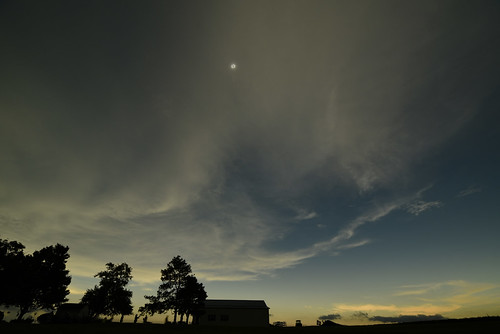
Cloudy Totality

Cloudy Totality

Due to the clouds, I didn't get the close-up shots of the sun that I'd prepared for, instead making a last minute dash 10 miles south for a spot with clear enough skies that we could at least see totality. While I'm disappointed in not capturing that view of the eclipse,  the experience of seeing totality with my own eyes was pretty incredible!

However, I did get a sequence of wide-angle shots for a time lapse. The first half is nothing but clouds and from about 15 minutes after totality until the end of the eclipse the sun was sitting in clear skies but the sequence still shows the movement of the umbra across the field of view and, as you can see in this shot from roughly the middle of totality, there is enough detail to be able to see the corona around the sun.

Still working on completing the time lapse... will post when it's complete.

Tuesday, August 22, 2017

Totality!!!

While my experience of the totality phase of this eclipse was watching, not photographing it, I'm thrilled to share this shot of it. It was taken by Kelcie Matousek, a photography major at University of Kansas who is here as part of the film crew documenting Project Stratoclipse. 

The film crew had the same idea that Beau and I had but they left about 10 minutes before us so she had the time to get set up for shooting the fully eclipsed sun. 

THIS is what I was after and while I didn't get it myself, I'm still hoping the time lapse turns out to be interesting. Regardless, it was still an incredible experience!

Click on image for large view. 


Late post, originally posted to Facebook.