Showing posts with label super moon. Show all posts

Wednesday, August 30, 2023

Blue Moon Rising Over White Rock Lake

UPDATE [August 20, 2024]:
If you have followed the news you know there was a Blue Super Moon yesterday. However, it was different from the one I wrote about below. The one last year was a monthly Blue Moon, while the one yesterday was a seasonal Blue Moon. A monthly Blue Moon is the second full moon in a calendar month, whereas a seasonal Blue Moon is the third full moon in an astronomical season with four full moons, occurring between an equinox and a solstice. Why is the 3rd instead of the 4th full Moon in a season the Blue Moon instead of the 4th? Good question! If you know why, share it in a comment.

As for being a Super Moon, that label applies to both the full Moon yesterday and the one for last August although last August the Moon was slightly closer to Earth (about 2,700 miles closer).

With the extreme Texas heat, lately I've been waiting till after sunset to take our Weimaraner, Luna, for a walk and we've been walking along the shore of White Rock Lake near where we live since it's often cooler with a little breeze coming off the water. 

I had not planned to shoot the Blue Moon tonight, but after my wife Linda asked if I would be, it occurred to me that it would be visible over the eastern shore of the lake when Luna and I were out walking. I decided to see if I could get a shot of the full Moon rising over the sailboats at Corinthian Sailing Club before our walk. I grabbed my small refractor (Sky Watcher EvoStar 72ED), my Nikon D750 and a tripod, loaded Luna in the car and headed to the lake. 

Apparently, so did everyone else. I guess the news of the Blue Super Moon got enough press that lots of other people showed up at the lake to watch it rise and traffic driving up the west shore was like rush hour. By the time I was parking the Moon was already well above the tree line. I hastily set up the scope and camera, got a reasonably good focus on the Moon and started shooting. All the while, Luna hung out with me, thankfully only wrapping her lead around the tripod as I was finishing up. 

Ironically, the shot below was the first shot I took. Of all the others, I could perhaps merge a few bracketed shots for something with a higher dynamic range but frankly this is pretty much the shot I had in mind when I left the house. 

Enjoy!

Blue Moon Rising Over White Rick Lake

As always, click on the image to see full-screen. 

Tuesday, October 13, 2015

BEWARE OF UNREALISTIC LUNAR ECLIPSE PHOTOGRAPHS

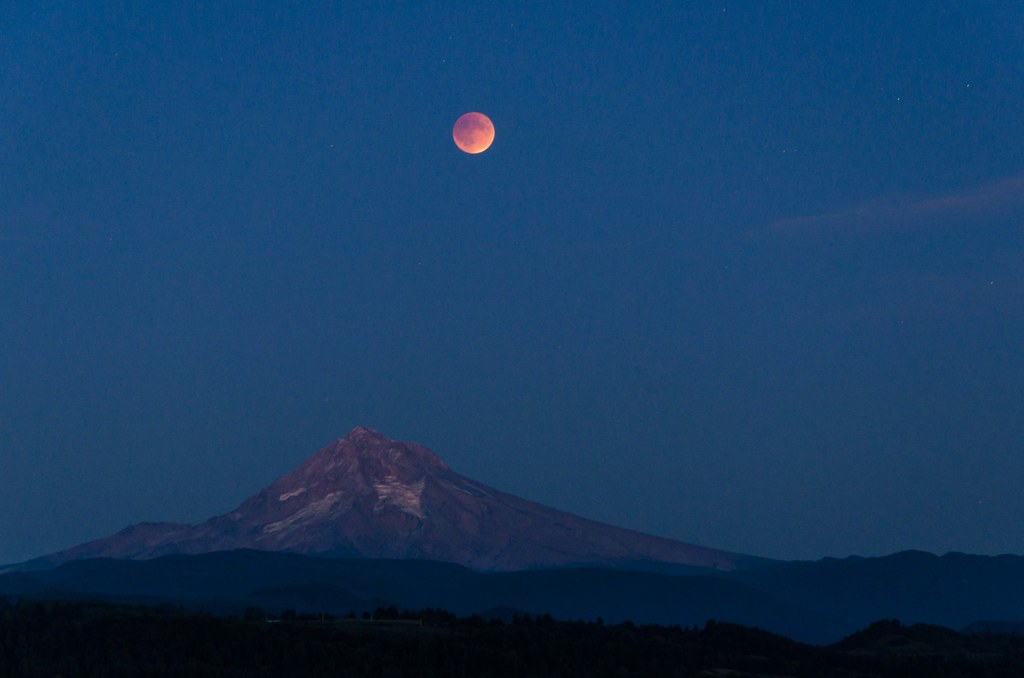
Lunar Eclipse over Mount Hood

[Originally published on Sept 29th; updated with version of photo published on Flickr]


Having invested a lot of time and energy to prepare for and take this shot of Mount Hood from Jonsrud View Point in Sandy, Oregon, I looked forward to checking out all the interesting shots other people were posting. However, two days later I am troubled by what I'm seeing online. 

While Photoshop and similar tools are valuable aids in fine-tuning photographs for display, it's easy to bend an image to something that could only have existed in the imagination of the photographer. In some cases, the changes are slight - the image is only slightly different than reality, reflecting a difference in tone, crop, etc. - but in other cases things are morphed beyond the realm of reality. 

In full disclosure, I used Photoshop on my tablet to retouch this image and remove a spot that resulted from a dust spec on the sensor of my camera.  Note that I haven't yet had time to do other edits, ones only possible once I am home and have access to my PC again such as reducing the noise (edits intended to make the image look more realistic, not less). At a later date, I'll post the edited version. 

Other photographers though have not only "cleaned up" their photographs, but they have gone to extreme lengths to transform the images captured in their cameras. In some cases, the moon is shown much larger than it actually was. In other cases, it's positioned differently - it's either lower in the sky, shown in different settings, etc. What they have all done is portray the moon in an very unrealistic manner. 

Many would say "that's just a case of poetic license... what's the problem with that?". I don't have an issue with poetic license - it's something I've exercised many times myself. What I do have an issue with though is presenting something of scientific interest, a natural astronomical event, in a way that may be difficult for someone who didn't personally observe the event and may not be familiar enough with similar natural phenomena to discern that what they are seeing is not what they would have seen standing out under the sky last Sunday night. 

Note that I'm not talking about the sequence shots that show multiple instances of the moon in a single image  (assuming they are proportionately sized and positioned). Those actually tell a useful story of the progression of the event and most people would understand that the image is a composite of multiple shots. To their credit, the photographers for most of the sequence images I've seen, even the ones who materially modify the position and size of the moon in such shots, point out that the image is a composite. 

I am not arguing against these images. In fact, I applaud the creativity of the people who produced them - there are several that I'd love to have as the wallpaper on my PC or perhaps even as a print hanging on my wall. For me, what's missing though is transparency about what the image represents, a factual explanation of how it differs from nature. While some people would skim right past a disclaimer that explains the moon image was enlarged to make a more interesting shot, at least all who view such a thing would have the opportunity to understand what they see isn't realistic and why.

Reaction of friends and family when I raised this issue was "good point, but who's going to pay any attention". They may be right but I'm a glass-half-full kind of guy so I'm posting this anyway, hoping that at least a few people pay attention. I'm also a big believer in civil discourse and not a fan of flaming so rather than post comments directly on the images I'm talking about, I'd rather explain the concern here where I'll then share it via social media. If it makes a few people looking at images from Sunday night's lunar eclipse (or other similar natural phenomena) pause and consider whether a given image is realistic or not, great. If this comes to the attention of the photographers responsible for such images, even better. If any of them take the point to heart and update captions to clarify what they changed, fantastic. 

If you agree or, more importantly, disagree with me on this, feel free to say so in the comments.