Showing posts with label D750. Show all posts

Friday, October 13, 2023

Preparations for the Annular, er, Partial Solar Eclipse!

Tomorrow's the day! As mentioned in my last post, tomorrow an annular solar eclipse is visible across a stretch of the western half of the North American continent. 

For the rest of the country - including Dallas where I live - we won't get to see the Ring of Fire but we'll still get to observe a partial solar eclipse. 

Screen shot from Stellarium
Here is what the Sun will look like at maximum eclipse for Dallas (about 11:52am local time). Although that area blocked by the Moon in this simulation looks blue, keep in mind that this is a new moon which means we don't see any illuminated lunar surface since the Moon is in between us and the Sun. 

While you would think that with this much of the Sun covered up the amount of light we see would be low enough to be safe to view without eye protection, it's not! Except during the totality phase of a total solar eclipse when the Moon is completely blocking the solar surface, it is not safe to look directly at the Sun. If you are interested in seeing the eclipse tomorrow, only do so if you have a set of solar eclipse viewing glasses from a reputable source. If you don't already have eclipse glasses it may be too late to get some but here is information from NASA on safe viewing resources

Personally, I am treating this eclipse as a trial run for the total solar eclipse that will pass over North Texas on April 8, 2024. I plan to capture the partial eclipse from start to finish using my Nikon D750 and EvoStar 72ED refractor telescope with solar filter mounted on my Star Adventurer tracker. I'll leave it running from well before the eclipse through past the end of the eclipse, capturing a couple of shots a minute. Hopefully, the result will be a handful of good shots of different stages of the eclipse and possibly a sequence of shots I can use to make a timelapse video of the eclipse from start to finish. 

A lot has to happen for this to be successful - a good polar alignment of the telescope the night before, being able to get a good focus of the Sun once it peeks above the trees, the weather forecast being accurate (i.e., no clouds) - but even if it doesn't work out as planned, it will still be good practice for April!

Here are shots of my equipment set up for a test run today. 

That solar filter is critical for
safely photographing the Sun!

The tracker keeps the telescope pointed
at the Sun as it moves across the sky.


I hope you get to see the eclipse, too. Just be sure to be safe when viewing the Sun!


Monday, May 30, 2022

A Night to Remember

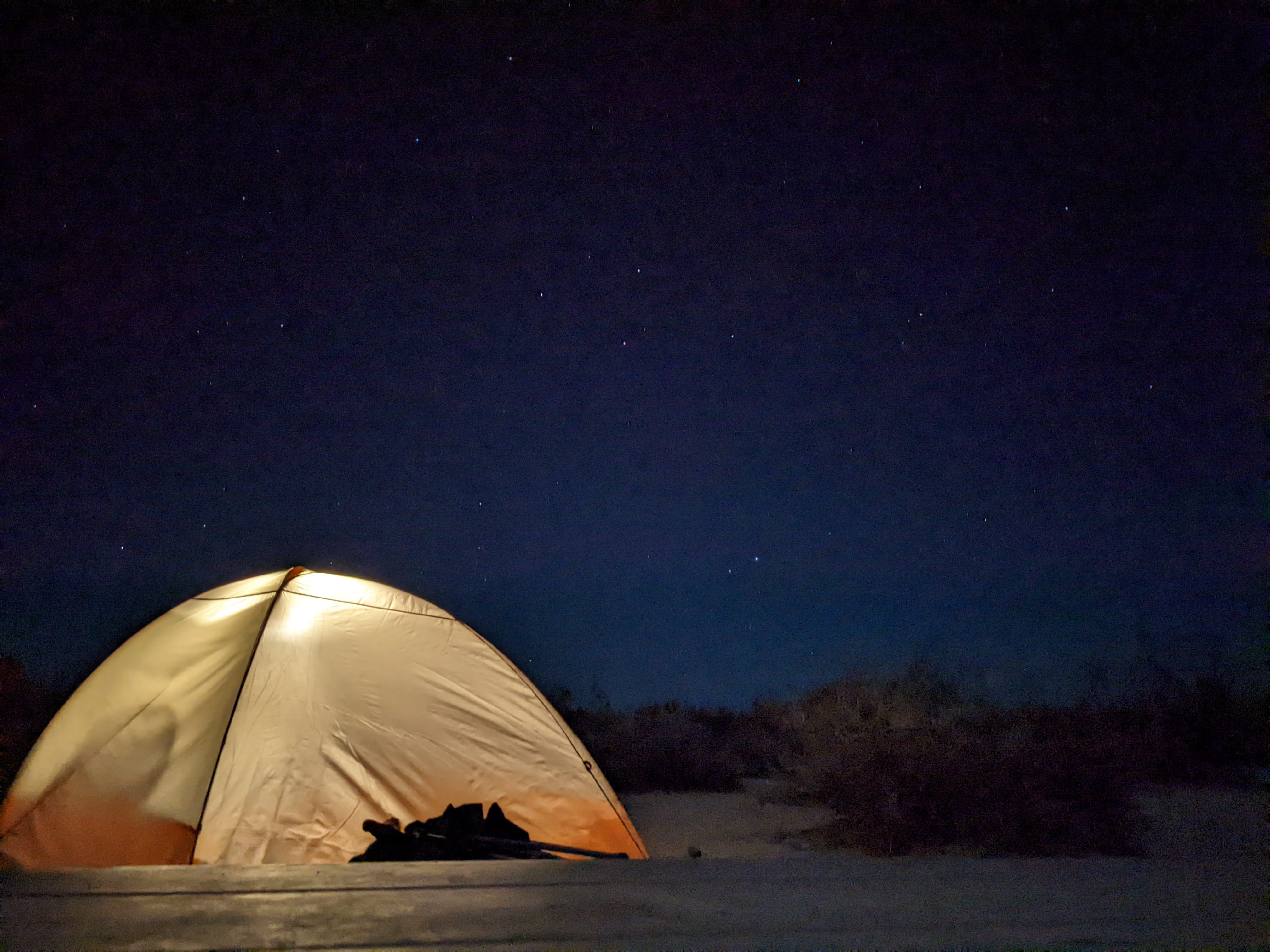
When traveling to visit our friends who live in Palm Desert, CA, I packed the gear I could carry on a flight, opting for my travel tripod instead of a heavier Radian tripod and leaving the Star Adventurer tracker at home. My friend David had reserved a camp site for us for Mother's Day evening and his son-in-law Erik joined us. After setting up camp and enjoying the view as twilight ended, we hit the sack and set alarms.

My original plan was to do a multi-shot panorama of the full Milky Way arch. Unfortunately, when planning the shoot in PhotoPills (photo planning software), I had inadvertently scrolled forward a day so when my alarm went off instead of having a half-hour of moonlight to shoot the foreground and time enough to shoot the full arch while it was relatively low in the sky, I woke up up to a moonless sky and the arch already getting a bit too high for the shot I planned. Once I realized my mistake, I focused on just enjoying the view and getting a few decent shots including this one, taken with a Nikon D750 and an Irix Firefly 15mm f/2.4 wide angle lens.

My decision to go with B&W was in part because the sky colors were off and rather than do heavy edits to get a more natural look, I chose to take color out of the equation. My assumption about the colors I found when editing the raw image is that it perhaps had to do with the massive amount of dust in the air. That entire weekend, winds from San Bernadino south to the Salton Sea where blowing so hard that when we left Palm Desert Sunday afternoon headed to the campground, we couldn't see a mile down the road and could hardly see the mountains of Joshua Tree. At the campground at 3000 feet, the air was much clearer but the sunset that evening was orangish as was the light dome from Blythe that shows up in this image (which I also think was more prominent due to the amount of dust in the atmosphere).

The labels in this image were carried forward from a test shot done a few nights before taken at our friend's place above Palm Desert, an attempt to do some test shooting for the panorama that was thwarted by high, thin clouds. I had shared the one shot from that night where Scorpius was visible with friends, including similar labeling, so this version of this shot was labeled to relate the two images. See below for the unlabeled version plus a few other shots from the trip.

Click on any image to see enlarged.

The Milky Way over Joshua Tree National Park
(Light dome is Blythe, CA)

Low visibility leaving Palm Desert, CA

Sunset at Joshua Tree National Park

Cottonwood Campground Amphitheater

Campsite


Tuesday, November 23, 2021

Rough Draft: Timelapse of Longest Lunar Eclipse in 1000 Years

As mentioned in my last post, I used my Nikon D750 DSLR mounted on a Sky-Watcher Star Adventurer tracker to capture about 5 hours of the partial lunar eclipse. Here is a preliminary time lapse video. 

This sequence is just from the shots exposed for the sunlight face of the moon. I'm working on another sequence with full lunar surface, blending shots exposed for sunlight and shadow. The blended shots will showcase the redness of the lunar surface at mid-eclipse. They will also include the Pleiades and a tighter crop. 

The movement of the moon in this sequence is not due to its movement across the sky but the moon drifting out of center-frame due to the polar alignment of tracker being a little bit off. I'm still working on a process to re-align the sequence and to rotate the view for a more natural orientation of the sky.

When watching the video, be patient as there are a few seconds in the middle where it goes black. The shots used in this video were taken at f/6.3, 2500th of a second, ISO 800. It turns out that was slightly underexposed for a sunlit lunar surface during the phase where the Moon was mostly eclipsed, I missed capturing the portion of its surface still reflecting sunlight so nothing shows up.  

More to come...


BTW, for a better view, select full screen (box icon, lower right) when playing the video. 


Monday, November 22, 2021

Chasing A Partial Lunar Eclipse and the Seven Sisters

In the early morning hours of November 19, 2021, a lunar eclipse began. As a partial eclipse, it normally might not have been noteworthy. What brought a lot of media attention about this one is that it lasted just a shade over 6 hours. It's been 1000 years since the last time a lunar eclipse lasted that long. 

The timing for this eclipse is such that the Moon was almost at apogee, the point where it is furthest from the Earth in its orbit, and since a body in orbit moves slower the further it is from the body it orbits, the Moon spent more time in Earth's shadow. It also meant that the Moon was smaller in appearance so this was the opposite of a "Super Moon". 

The other interesting thing about this lunar eclipse is that the Moon is within a few degrees of the collection of stars known as the Pleiades or the Seven Sisters. As both were high in the sky during most of the eclipse, the cold dry air we had in North Texas that night made for great viewing. 

Initially, my plan to capture the eclipse was to shoot with my Nikon D750 using the longest lens I have and the Star Adventurer sky tracker to capture shots of the lunar face throughout the night to create a timelapse video. However, given the close proximity of the Pleiades, I decided to shoot with a shorter lens and include it in the view. 

I won't go into the technical details but given this was really the first time I had used the Star Adventurer for tracking more than a few minutes, I shot a bit wider view than I probably needed to so the Moon is rather small in the frame. The bad news is that the tracker was a little off and so the Moon didn't stay centered in the frame. The good news is that with the wider view, both it and the Seven Sisters were in-frame throughout the 5 hours of the eclipse I captured. 

Here is a frame from about mid-eclipse. I'll post more as I get further through post-processing all the images.