Showing posts with label NASA. Show all posts

Saturday, April 13, 2024

April 8th 2024 Total Solar Eclipse: Initial Telescopic Images

Fine details in the solar corona


One of my primary goals for this total solar eclipse was to capture a variety of telescopic views of the eclipse. The similar goal I had in 2017 was spoiled by overcast skies that resulted in a mad dash down the road with Beau Hartwig chasing clear skies. Seeing totality with my own eyes meant giving up on my photographic goal. I don't regret that for a minute but I was thrilled that this time the skies cleared for us just in time for the "Big Show". 

To avoid having to split my attention between experiencing totality and taking pictures, I used our old 2012 MacBook Pro running a software package called Solar Eclipse Maestro to control the camera, snapping pictures at pre-defined times and exposure settings. SEM worked flawlessly and had it not been for a user-error on my part (which I'll cover in a future post), I would have captured everything I planned for. As it is, I still was able to capture most of what I planned including:
Although the images captured were as good or better than I hoped, post-processing them to fully bring out the available detail is a rather complicated thing involving a variety of software tools. I am still working on that but I wanted to go ahead and share some initial edits. 

The image above is a blend of each of the 19 different shutter speeds used to capture images to submit to the Eclipse Megamovie project. They were taken during totality to capture as much fine detail of the solar corona as possible. The project team will use the calibration frames to pull out even more detail than appears in this image but, for my first pass at this I used some basic stacking techniques in Photoshop. Click on it to see enlarged... isn't the level of detail incredible?

I'm also including some cursory edits I've done of a few other images below including a partial phase image and a picture of Baily's Beads. What I am the most excited about though is the spectacular solar prominences that appear in the Baily's Beads shot. Wow! Even more incredible is that the largest one was visible naked-eye. 

Once I've had time to go through the rest of my images and finish some of the more complicated editing processes, I'll share more of these. I'll also do a follow-up post on my equipment and what went into capturing these images. 

I hope you got a chance to see totality for yourself but, if not, please enjoy my first pass at sharing the view with you. 

Late in the partial phase of the eclipse. Note the sunspot in the center!

  
Baily's Beads and Solar Prominences


Thursday, September 14, 2023

Countdown to Annular Eclipse

May 2012 Annular Eclipse from Albequerque
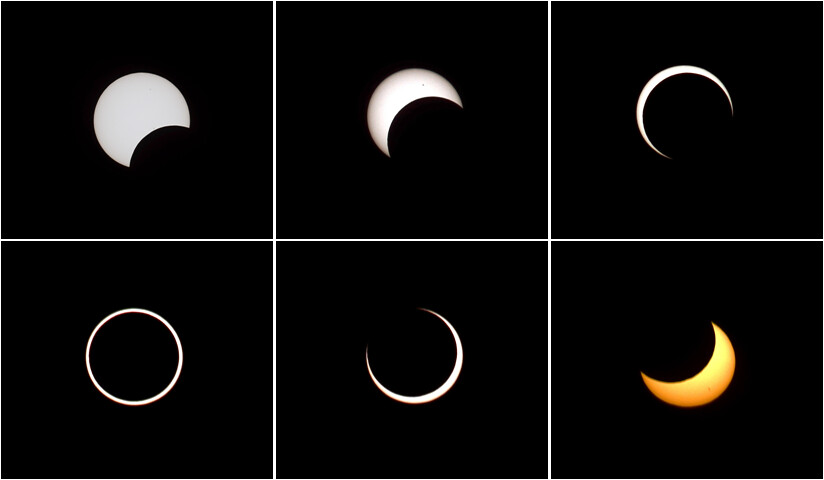
Sequence from 2012 Annular Solar Eclipse
Photo by Nathan Eaton

We are just a month away from the next solar eclipse! On October 14th, 2023, people from the upper west coast down across Texas and in parts of Central and South America will have the opportunity to see an annular solar eclipse. As with all solar eclipses, this one involves the Moon passing between the Earth and the Sun. This time, the Moon will be farther out in its orbit around the Earth, making its angular size just a bit smaller than that of the Sun. In such a case, the Moon doesn't quite cover the face of the Sun. Consequently, at mid-eclipse viewers along the centerline of the eclipse track will get to see the Ring of Fire, a view in which the Moon is centered over the Sun with a fraction of the solar surface showing all round the Moon. 

The image sequence above is one I took during an annular eclipse in 2012 when we were visiting Albuquerque, New Mexico. Shot with a Nikon D7000 DSLR through a telephoto lens and a Baader film white light filter, it shows the eclipse from near the start at top left as the Moon has begun to cover the Sun, progressing across and down to the Ring of Fire view at bottom left then on through near the eclipse end at bottom right. For that eclipse, the Sun set before the eclipse was over so I wasn't able to get any shots of the final phase. The reason for the yellow color in that last shot is partly because the Sun was close to sunset and partly due to heavy smoke in the atmosphere from fires west of Albuquerque. Basically, the image came out yellow for the same reason a sunset with heavy clouds to the west looks yellowish to reddish; the denser atmosphere with heavy particulates (in this case, smoke) filters out shorter wavelengths, only letting the longer (and redder) wavelengths through. 

To see how close the path of the eclipse comes to where you live and to see where and when you can view it in person, check out Xavier Jubier's interactive map for the eclipse. Click anywhere on the map and it will give you details of the eclipse for that location including when it starts and ends, how long it lasts and how much of the Sun will be eclipsed by the Moon. Note that the path of the eclipse on the map represents the areas where the annular form of the eclipse will be visible. In the Dallas area, we'll experience a partial eclipse since the Moon never moves completely over the face of the Sun from our vantage point. Unfortunately, we won't get to see the Ring of Fire here. 

Where will you be during the eclipse? 

See the NASA eclipse page for more information on this eclipse as well as the total solar eclipse next April

WARNING

Be sure to NEVER look directly at the sun without appropriate eye protection. Read up on safe viewing techniques before viewing the eclipse. 

Thursday, November 14, 2019

Mercury Transit 2019 - The Last One in North America for Thirty Years


Unlike the last Mercury transit in 2016 (see posts here and here), I didn't get a chance to photograph this latest one (November 11, 2019) as we were traveling and it wasn't feasible to drag all my gear with me. However, I did get a chance to watch part of the transit. That was a relief since the next one visible from North America doesn't occur until 2049.

What made viewing this transit particularly special is where we were and who we met.

As we were visiting New York City, I checked online and found a public viewing event, one that happened to be on an aircraft carrier, the USS Intrepid. Retired in 1974, the Intrepid has permanently moored dockside in NYC and was opened in 1982 as the Intrepid Sea, Air & Space Museum. Among other things, they have a space shuttle on display in a dedicated hanger, the Enterprise (the one used to prove the shuttle concept). If you are ever in New York, I highly recommend checking it out!

The host for this viewing was Joseph Martinez, better known on the streets of The Big Apple as the Joe of Jupiter Joe's Sidewalk Astronomy (here on the Web and here on Facebook). Joe is an avid amateur astronomer who loves sharing information on astronomy and views of the sky with people. Joe is also a JPL/NASA Solar System Ambassador. He and some friends had two telescopes equipped with solar filters set up on the Intrepid flight deck, sharing views of the transit with museum visitors.

My wife Linda and I checked out the view from each telescope and then struck up a conversation with Joe. As Linda has worked for many years as a planetarium educator, as I am a member of the Texas Astronomical Society and as we've both been involved in numerous viewing parties including past transits, we had a lot of common interests and activities to talk about with Joe.

When the discussion touched on the 2017 total solar eclipse and then the next eclipse in 2024, Linda suggested Joe should visit us in Dallas since we are in the path of totality. It turns out he is already making plans to be in Texas for the eclipse. Coincidentally, it also turns out he knows other planetarium educators in Texas whom Linda has worked with. Small world!

Joe, thanks again for the views of this transit! Perhaps will see you for the eclipse in 2024!

BTW, for some beautiful shots of this transit, check out ones posted on Earth Sky News.


Tuesday, November 27, 2018

Road Trip Highlight: Mars Insight Lander

Check out @NASAInSight’s Tweet: https://twitter.com/NASAInSight/status/1067244283688669184?s=09

On our annual trip to New Orleans for our anniversary, usually focused on fresh gulf oysters and other seafood, NOLA music scene and interesting/unique adult beverages, one of the highlights this year was geeking out on coverage of the successful landing of NASA'S Mars Insight Lander.

As it was getting time for the lander's descent into Mars atmosphere, we were next door to a Starbucks so we grabbed a few lattes and settled in to watch streaming video live from NASA. It would have been way cool if we could have found a bar that would tune in the landing on one of their TVs but it was still pretty exciting watching on the small screen.

Congrats, NASA!

Tuesday, August 21, 2018

365 Days After Totality Over Marshall, MO, 2057 Days till Totality Over Dallas, TX


One year ago, I stood in awe watching something I'd never seen before, a total eclipse of the sun. It was an awesome adventure - plenty of information on that in previous posts - but for that I had to travel all the way to Marshall, MO.

In a little less than 6 years, I will walk outside my back door and have the opportunity to see the same thing. As with the eclipse of August 21, 2017, the one on April 8, 2024, will cross a significant portion of North America, this time slicing north east from South Texas to Northern Maine, providing millions of people the opportunity to see such a rare sight.

Stay tuned...

Sunday, June 25, 2017

2017 Total Solar Eclipse - First to Cross Mainland USA Since 1979


It may seem hard to believe but solar eclipses are technically fairly common, at least one a year, many times two in a year. What makes them seem rare though has to do with the relatively small portion of the Earth over which they pass; for any given spot on the globe, solar eclipses are rare. For example, there hasn't been a solar eclipse crossing America since 1991, hasn't been one crossing any part of the contiguous United States since 1979 and there hasn't been a solar eclipse cross the entire continent since 1918.

On August 21st of this year, all three of those dates reset: a solar eclipse will cross from Oregon to South Carolina. Anyone along the centerline of the track will get to observe (weather permitting) the glory of a total eclipse. Everyone else in the country will see a partial eclipse (less of one the further from the centerline you are).

The last time I saw a solar eclipse was an annular eclipse in 2012 viewed from Albuquerque, New Mexico. The image included here is from my post on that event. For the 2017 total eclipse, I'm planning to observe from the centerline. More on that in future posts. In the meantime, here are a few links for more information on the event.

NASA 2017 Eclipse Site
Eclipse.org Site
Alan Dyer's Tips for the Solar Eclipse


Monday, April 26, 2010

Happy Belated Birthday, Hubble!


This birthday wish isn't for Edwin Hubble, the astronomer famous for determining that what people then called faint nebulae were really other galaxies like our own Milky Way and the fact that the universe is expanding, but his namesake, the Hubble Space Telescope. Twenty years ago yesterday, on April 24th, 1990, NASA launched Hubble into space. Although there were issues with it as initially launched, thanks to numerous repair and servicing missions over the years it has gone on to truly become our eyes into the depths of the universe. It has been the foundation for a lot of great science as well as inspiration and awe.

Check out celebrations around the web:

NASA Flash Hubble Gallery
NASA Hubble Mission Site
Hubble Site
Amazing Space - Hubble for Students and Teachers

Also, a very cool citizen science site called Galaxy Zoo, where people like you and me get to help astronomers in their research on galaxies, is also celebrating Hubble's birthday.

Friday, April 9, 2010

STS-131 Launch in Person


Originally uploaded by neatonjr
If you've never seen a shuttle launch in person but have always wanted to, you only have three more chances before the fleet is permanently retired after 30 years of service.

That was the incentive for me to get up at 2am last Monday morning and drive all the way across Florida to see the pre-dawn launch of Discovery in person. We were in New Port Richey visiting our oldest son Josh and his family, so when I heard about the launch I couldn't resist.

I won't bore you with the details of the trip other than to say it was worth everything... the lack of sleep, the hour standing on the edge of a retaining wall waiting, the hours of driving there and back, even the 2 hours in traffic between Titusville and Orlando on the way home. If you have any opportunity to go, I highly recommend it.

Check out my Flickr set for more pictures. You can also see more pictures here and news about the launch here.

Oh, and thanks to Josh for joining me... that was a great birthday present!

Wednesday, February 18, 2009

Geek's Night Out

Man, it was hard to get up this morning. Didn't even budge when the dog jumped on the bed around sunrise. Understandable after not getting to sleep until about 1:30. No, I wasn't up late out under the stars with the telescope. Last night was more like the last time I went to a rock concert...
  • I quit work early
  • Linda and I had an early dinner and drove all the way across town
  • Showed up an hour and a half before the doors opened to be sure we got good seats
  • Sat in rapt attention throughout a show that was supposed to last about 2 hours but went on for over 3 hours
  • Stood in line afterwards for 45 minutes to get an autograph
  • Didn't get home until well after midnight
...but this wasn't a rock concert. It was all to see an astrophysicist!

As mentioned in my last post, we'd heard last week that Dr. Neil deGrasse Tyson was scheduled to speak at University of Texas at Arlington last night. Thankfully, we also got a reminder email that mentioned they expected a large turnout. It was good we got there early as, by the time Dr. Tyson took the stage, Texas Hall was completely packed, all 2700 some odd seats. Although the long wait could have been boring, we ran into RCYC friends - Burt and Mary Scott - and had a great time visiting. Burt teaches Astronomy at Eastfield College and is also an avid amateur astronomer - I enjoyed hearing about the new telescope he is building while we waited for the show to start.

If you've ever seen Dr. Tyson on PBS, the Tonight Show, the Daily Show or any of his other appearances on TV, you understand what a dynamic speaker he is. And while many people know him as one of the most vocal advocates for the idea that Pluto is not the 9th planet but instead the first Kuiper Belt object discovered, that wasn't what he was in town to talk about. Instead, he was here to talk about science illiteracy in America and to explain his ideas on what to do about it.

Before getting down to business, Dr. Tyson first got comfortable, unloading his pockets of wallet and cell phone and even shedding his cowboy boots. Although he was born and raised in New York, he spent 6 years working on a Masters Degree at University of Texas in Austin and obviously picked up on our local fashion sense and attitudes towards casual attire.

Dr. Tyson then illustrated and described the history of commitment to science by various countries and cultures, starting with a series of diagrams based on the Periodic Table of Elements. This wasn't anything like the PTE you dreaded in high school - it was more of a map and timeline, showing things like which countries discovered (and named) each element, when they were discovered, etc. In the end, the picture he painted was that until recently the U.S. has been a dominent force in scientific discovery but that the new trend is diminishing emphasis on (and investment in) science. He then went on to cover numerous examples of our cultural scientific ignorance including our fear of the number 13 (most buildings still don't have a 13th floor) and celebration of Groundhog Day (when you didn't have advanced computer models to tell you what to expect of the weather, you might as well let a ground hog decide but why do we still bother?).

There were two other key points from Dr. Tyson's presentation. First, that significant investment in science most frequently stems from war or, in the past, colonial expansion. Examples include the influence the Cold War had on the Space Race between the U.S. and Russia and the failure to fund completion of the Super Conducting Super Collider as the Cold War ended. Second, that there is no better way to ensure economic growth and prosperity than through scientific innovation. The bottom line? It's that our future depends on changing the trend, finding ways to increase interest in science education, bring about cultural change such that we celebrate and embrace science and scientific advancement rather than shun it, and to stimulate investment in scientific research. Preferably without another war.

Many of the ideas he proposed centered on NASA. In speaking on NASA's role in American science, he suggested that instead of continuing to invest resources in "going where hundreds have gone before" - sending men into low earth orbit - NASA should leave that to commercial companies and go back to pushing the boundaries of space exploration, pursuing lofty goals such as sending men to Mars or mining asteroids for natural resources. Besides facilitating accomplishments for which there is not yet a viable business model, NASA would be continuing its historical role of achieving the seemingly impossible and, in doing so, inspire new generations of scientists. Of course, that sort of thing isn't cheap but Dr. Tyson stressed how little it would take citing that NASA's entire budget is currently only 6 tenths of a cent out of every tax dollar. Imagine what they could do if we spent just another 6 tenths of a cent per tax dollar to double NASA's budget...

Dr. Tyson ended his talk with a mathmatical progression, starting with 1 and ending with one quadrillion, using each step to relate the number to something concrete such as the number of grains of sand on a beach (having fun with dimmed lights and the number Sextillion along the way). While some people look at images such as the densely packed starfield projected behind Dr. Tyson to illustrate septillion (the number of stars in the observable universe) and feel small, he said that he prefers to look at it in a different way. Knowing that we are made of the same elements as the cosmos and that, in spite of how little we understand about the universe, the human mind was capable of building the Hubble Space Telescope and discovering just how vast the universe is gives him a feeling of connection to the cosmos and an appreciation of its majesty.

After his presentation Dr. Tyson conducted an extended Q&A session, finally wrapping up over 3 hours after he started. It's late now (need to catch up on the sleep I didn't get last night) so I won't get into details on his responses other than to highlight one of the last and most amusing. A 10 year old boy stepped up to the microphone to ask what Dr. Tyson would do with a black hole if he could control one. After asking why the boy was up so late (answer: he's home schooled and was there on a field trip with his parents), he explained how hard it would be to control a black hole but that, if you could, what a great trash dump it would make!

By the way, if there is any question of who the Geek is in the title of this post, who do you think surprised Dr. Tyson by bringing an article on the Pluto debate from the December issue of Sky and Telescope for him to sign? I guess that makes me almost as big a geek as the guy who brought in a telescope eyepiece for him to sign.

Another great way to celebrate IYA2009!

Related links
UTA article on Dr. Tyson's apperance
News video on WB 33 TV
Interview on KERA program Think
The Pluto Files

Wednesday, January 28, 2009

Help Choose Where to Point Hubble

If you're like me, you've enjoyed seeing some of the really amazing photographs produced over the years by the Hubble Space Telescope like this one of the Cat's Eye Nebula. Whether your interest is in the scientific advances associated with its imaging or just the sheer beauty, I think most all of us find the Hubble images uniquely fascinating.

Well, now you can have a say in where Hubble will point next. In conjunction with the International Year of Astronomy 2009, NASA has created a site - You Decide Hubble's Next Discovery - where you can vote for one of six possible targets.

Votes can be cast through March 1st, after which Hubble will image the winning object. It will be released during the IYA 100 hours of Astronomy held April 2nd through 5th. After casting your vote, you can also register to win one of 100 prints of the released image. If you are a teacher or educator, NASA has also developed special classroom activities so your kids can participate in the event.

So get over there now to cast your vote... I have. We'll see who's favorite shows up in April!