Wednesday, July 3, 2024
Star Trails over Georgia Strait, Vancouver Island
Saturday, April 13, 2024
April 8th 2024 Total Solar Eclipse: Fine Detail in Corona
I went down a bit of a rabbit hole this week, assuming that to really get sharp detailed images of totality I needed to go through the rather involved process of using calibration frames to process all of the images I planned to stack before trying to stack, register and merge them. After spending a few evenings starting down that road, I took a break and in reviewing tutorials on processing solar eclipse images I ran across several that describe doing everything directly in Photoshop without the use of registration frames.
Following the process described in this Sky & Telescope article, I created the image above using a set of images shot at 2 stop intervals from 1/4000th of a second to 1 second, all shot at f/5 and ISO 100 with my Nikon D750 through our Sky Watcher Evostar 72ED telescope.
Click on it to enlarge and check out the incredible detail. You'll find features like:
- Plenty of detail in the solar corona
- Solar prominences
- The lunar surface illuminated with light reflected from Earth (Earthshine)
- Several stars from the constellation Pisces
This is just the first phase of edits described in the article so more to come. In the meantime, I did a separate version with features labeled.
Wednesday, April 10, 2024
April 8th 2024 Total Solar Eclipse: Timelapse of Totality over Ellis County, Texas
- At about the 18 second mark, look for the small star to lower right of the Sun. That's not a star, it is the planet Venus!
- The contrail at lower center is probably a commercial aircraft, possibly one of the one flying along the eclipse path to prolong how long they could watch totality.
- At about the 36 second mark, the "insect" flittering about above us in the drone landing after shooting the arrival and departure of the lunar umbra.
Saturday, March 23, 2024
ISS Lunar Transit Mesquite Texas: Composite Image
As I shared in my last post, I was up in the very early hours this morning to catch a unique event, the International Space Station (ISS) passing in front of the Moon, a lunar transit. What I didn't share in that post is why I used the video mode on my Nikon D750 instead of taking individual photos.
The D750 is a great camera with some powerful capabilities. It has a top capture speed of 6.5 frames per second. Unfortunately, it can't sustain that speed for long. After about a dozen shots, the buffer fills up and the camera slows to closer to 1 frame per second or even 1 every two seconds. With an event that only lasts about 6 tenths of a second, since the camera only shoots at 6.5 frames per second for about 2 seconds, it would take perfect timing to be able to capture any part of the transit. If I started shooting 4 or 5 seconds too soon or too late, I might miss it all together.
However, with a video mode of 60 frames per second, I just had to start recording well before the start of the transit and then let it run long enough to be sure the transit was over before stopping the camera. Thankfully, when I was scrambling to finish focusing this morning and realized it was almost time for the transit, starting the video and letting it record for a few minutes was enough to capture the transit and capture far more frames with the ISS than I could have even if the D750 could capture images at 6.5 frames per second indefinitely. Using video has its drawbacks, e.g., things in motion (and the ISS moves incredibly fast) inherently have a little blur, even with a really fast shutter speed, but capturing more images with the ISS in them and having a bit more flexibility in starting/stopping the capture was worth it. Perhaps someday I'll get another chance to do this and will try capturing it with images instead of video.
To create the image above, I went through the video with Lightroom, selecting each frame with the ISS and exporting it as a JPEG file. I then took these files and opened them in Photoshop as levels. By using auto-align and auto-blend, Photoshop produced a single composite image showing the track the ISS took across the Moon. I decided that the first draft was a bit busy so I did it over again just using every other ISS frame to produce this photo. I also applied some intelligent sharpening to make up for the camera being a little out of focus. It's not great but I am satisfied with it.
Click on the image to see enlarged. Enjoy!
ISS Lunar Transit Mesquite Texas
- A location on the Earth where the ISS passes directly in between that location and the Sun or Moon.
- The ISS has to be close enough to the Earth for its angular size (how big it appears in the sky) to stand out. My sources indicate it's best when the ISS has an angular size of at least 42 arc seconds.
- A time of day or night when there will be enough contrast for the ISS to stand out against the given object. For the Sun, this is pretty straightforward but a transit in front of the Moon when it's up during daylight makes for a more challenging capture.
- And, of course, you have to be able to see the event so that means little or no clouds.
Saturday, October 14, 2023
October 14th, 2023 Annular Eclipse Timelapse
Thursday, August 31, 2023
Solar Transit of a Jet
- Sky Watcher EvoStar 72ED refractor
- Baader film solar filter
- 2" mirror diagonal
- Celestron 1.25" 2X Barlow
- T2-ring
- Nikon D750 DSLR
- Focusing with DeepSkyDad AF3 autofocuser
- Sky Watcher Star Adventurer 2 tracker
- Radian carbon fiber tripod
Wednesday, August 30, 2023
Blue Moon Rising Over White Rock Lake
UPDATE [August 20, 2024]:
If you have followed the news you know there was a Blue Super Moon yesterday. However, it was different from the one I wrote about below. The one last year was a monthly Blue Moon, while the one yesterday was a seasonal Blue Moon. A monthly Blue Moon is the second full moon in a calendar month, whereas a seasonal Blue Moon is the third full moon in an astronomical season with four full moons, occurring between an equinox and a solstice. Why is the 3rd instead of the 4th full Moon in a season the Blue Moon instead of the 4th? Good question! If you know why, share it in a comment.
As for being a Super Moon, that label applies to both the full Moon yesterday and the one for last August although last August the Moon was slightly closer to Earth (about 2,700 miles closer).
With the extreme Texas heat, lately I've been waiting till after sunset to take our Weimaraner, Luna, for a walk and we've been walking along the shore of White Rock Lake near where we live since it's often cooler with a little breeze coming off the water.
I had not planned to shoot the Blue Moon tonight, but after my wife Linda asked if I would be, it occurred to me that it would be visible over the eastern shore of the lake when Luna and I were out walking. I decided to see if I could get a shot of the full Moon rising over the sailboats at Corinthian Sailing Club before our walk. I grabbed my small refractor (Sky Watcher EvoStar 72ED), my Nikon D750 and a tripod, loaded Luna in the car and headed to the lake.
Apparently, so did everyone else. I guess the news of the Blue Super Moon got enough press that lots of other people showed up at the lake to watch it rise and traffic driving up the west shore was like rush hour. By the time I was parking the Moon was already well above the tree line. I hastily set up the scope and camera, got a reasonably good focus on the Moon and started shooting. All the while, Luna hung out with me, thankfully only wrapping her lead around the tripod as I was finishing up.
Ironically, the shot below was the first shot I took. Of all the others, I could perhaps merge a few bracketed shots for something with a higher dynamic range but frankly this is pretty much the shot I had in mind when I left the house.
Enjoy!
As always, click on the image to see full-screen.
Sunday, August 13, 2023
2023 Perseids and Mesquite Tree
In the wee hours of this morning, my mother Doris' birthday, I drove out east of Dallas looking for dark(er) skies to view and capture the 2023 Perseid meteor shower. The first spot I had planned to try turned out to have more brightness in the sky than I hoped for so I went a little farther out and found a quiet spot on a country road in College Mound just southeast of Terrell. Parking well off the road in front of a pasture gate, I set up two cameras shooting east across the pasture with a mesquite tree in the foreground. I'm still going through all the images and may eventually post a composite similar to the one I did in 2016 but this image has the best and brightest of the ones I captured.
This was taken with a Nikon D750 using an Irix Firefly 15mm f/2.4 wide angle lens. It's a 20 second exposure taken at f/2.8 and IS) 6400. I processed it in Lightroom to adjust brightness, contrast and color temperature.
Not an ideal composition given the streaking speck of comet dust is right at the edge of the frame and cut off midflight but it's still a beauty. And it's not alone. Besides the Pleiades and Jupiter, look close and you'll find at least one other Perseid and at least one satellite. Even with the comparatively dark Bortle 4.5 class skies, there are still light domes on the horizon from towns further east like Wills Point to the left. The yellowish glow towards the center is from the rising crescent moon not yet visible above the treeline.
I'll share more once I have time to go through the rest of the images from both cameras. In the meantime, enjoy!
Click the image to enlarge.
Friday, August 4, 2023
Olivia and Papa Chase the ISS and More
Last month, my granddaughter Harper and I went out to capture an image of the International Space Station (ISS) flying over Dallas. As described in my post about that effort, we were only partially successful, foiled by clouds. This past Tuesday evening, granddaughter Olivia and I headed up to the north shore of White Rock Lake to try again. In spite of being a little late getting to the lake and rushing to set up cameras, we managed to catch the last 90 seconds or so of the ISS flyover as it traveled from the northwest, overhead and down to the southeast. Here is the result.
Tuesday, July 25, 2023
Jack and Papa Capturing Moon and Planets
While our grandson Jack stayed with us last week, he and I went out one evening to take our Weimaraner, Luna, for a walk on the east shore of White Rock Lake and to try capturing the 3-day old crescent Moon, Mars, Venus and Mercury over the iconic Pump Station.
We were partially successful. Jack got in a dozen or so shots with my Nikon D750, starting with some test shots and then bracketing to try and get both the properly exposed lunar crescent and also the rest of the lunar surface lit with Earthshine. As explained below we didn't quite get what we wanted. Had the mosquitoes not chased us off, we might have eventually got it but Luna was getting impatient anyway so we put the camera away and went for our walk.
Unfortunately, the brackets didn't get us quite enough dynamic range to get both Earthshine and a lunar crescent that showed any detail. In the end, a single shot had the best overall exposure and detail that we were after. Although the lunar crescent is heavily over-exposed, the Earthshine-lit surface is still visible. And although Mercury is lost in the haze over Dallas, in addition to dim Mars and bright Venus you can just make out the stars of the "front-end" of the constellation Leo the Lion with it's brightest star, Regulus.
Here is the final shot and below is a version that is labeled. Enjoy!
Friday, July 21, 2023
Bedroom Camera Obscura Timelapse
Wednesday, July 19, 2023
Olivia, Jack and Papa Build a Camera Obscura Out of a Bedroom!
Last week, our granddaughter Harper stayed with us (see previous post). This week, it is her brother Jack and cousin Olivia. They are also attending Dallas Parks & Recreation Outdoor Adventure Camp during the day and in the evening we're having other adventures with them. While Harper's camp was focused on photography, this week the focus at camp is on archery. Linda and I don't have a lot of archery experience so our evening adventures are things that are more in our wheelhouse. One of those is photography. :-)
![]() |
| Optics: the principle of the camera obscura. Engraving, 1752. Wellcome Collection |
There are various tutorials available online on how to create a camera obscura out of a room in your house and capture the image on a camera. We used this one from the George Eastman Museum. It's very clear and easy to follow.
![]() |
| Outside view of Camera Obscura |
![]() |
![]() |
![]() |
Next, we finished prepping the bedroom. Initially, we just used towels on the floor to block light coming in through doors and a towel hung over the bathroom door since it had a bigger gap, let more light through. Later, we tried painter's tape.
As I mentioned, the image in even a darkened room is a bit dim. Given that it takes about a half-hour for our eyes to become dark-adapted after being in a brightly lit room, it wasn't really practical to stay locked up in the bedroom for that long given the kids still needed to get showers after a hot day at camp and we hadn't yet had dinner. Not to mention the impatience of a 12 year-old and a 10 year-old. :-D
Instead, I pulled out my Nikon D750 with a wide angle lens and we captured the view with exposures ranging from 30 to 55 seconds. Of the images below, the first was taken before dinner while it was still pretty bright outdoors; you can see there is still direct sunlight on the fence. It was also taken with Jack's pinhole lens with it's slightly larger aperture so the image is nice and bright. The other two were taken after dinner so it was getting a bit darker outside; there is only a sliver of direct sunlight on the fence. The first one is with Olivia's pinhole lens, the second with Jack's.
These images have been inverted vertically to emphasize the "normal" view of the backyard but that means everything in the room is upside down with the bed on top (lit blue by the sky) and the ceiling fan down "in the grass". Also, notice that the entire inside of the room is the "camera". Pretty cool!
![]() |
| Shot early evening with larger aperture |
![]() |
| Shot later in evening with smaller aperture |
![]() |
| Shot later in evening with larger aperture |
We have a few other ideas for the camera obscura, interesting alternatives to explore, so stay tuned... we might have more to share soon!
As always, click on an image to see it large.
Friday, July 14, 2023
Harper and Papa Chasing the ISS
UPDATE: Keep reading for the "rest of the story" but here is the same image as below but cropped vertically to focus attention more on the ISS trail. Enjoy!
Our granddaughter Harper stayed with us this week. During the day, she was attending Dallas Parks & Recreation Outdoor Adventure Camp and the theme this week was photography. As I am an avid shutterbug I also spent a little time each evening with her, messing around with cameras, talking about how to take good pictures, etc.
As I was checking to see what the evening weather would be with the idea that we could maybe take some night sky shots, I noticed that Tuesday evening the International Space Station (ISS) was going to be passing over. Even better, it would be rising just over downtown when seen from up by White Rock Lake. That night around 9:00 pm, we headed up to Winfrey Point and set up my Nikon D750 with an Irix 15mm wide angle lens. Once the camera was set up on the tripod, I let Harper take all the test shots and then we set the camera to shoot a sequence of 20 second shots. ISS was going to be visible for about 7 minutes, only 3 of which would be visible to the camera facing due west. After it passed overhead, we also tried capturing shots to the northeast but lights and trees were in the way.
The next day we loaded the captured images into Lightroom and I did some basic edits for exposure, contrast, etc. and then we loaded them as layers in a single image in Photoshop. As each layer contained a section of the ISS flyover, our goal was to follow instructions from this online article to stack all the images to end up with one image with a full track of the ISS, from when it was first visible (about 10 degrees above the horizon) until it passed out of the camera frame.
Unfortunately, while the weather report had been for clear skies, there was actually a lot of haze on the horizon and clouds across the path of the ISS. Here is the result of just stacking all the images.Friday, June 9, 2023
Chasing the Strawberry Moon Over Downtown Dallas - Remix
Wednesday, June 7, 2023
Chasing the Strawberry Moon Over Dallas
Monday, May 1, 2023
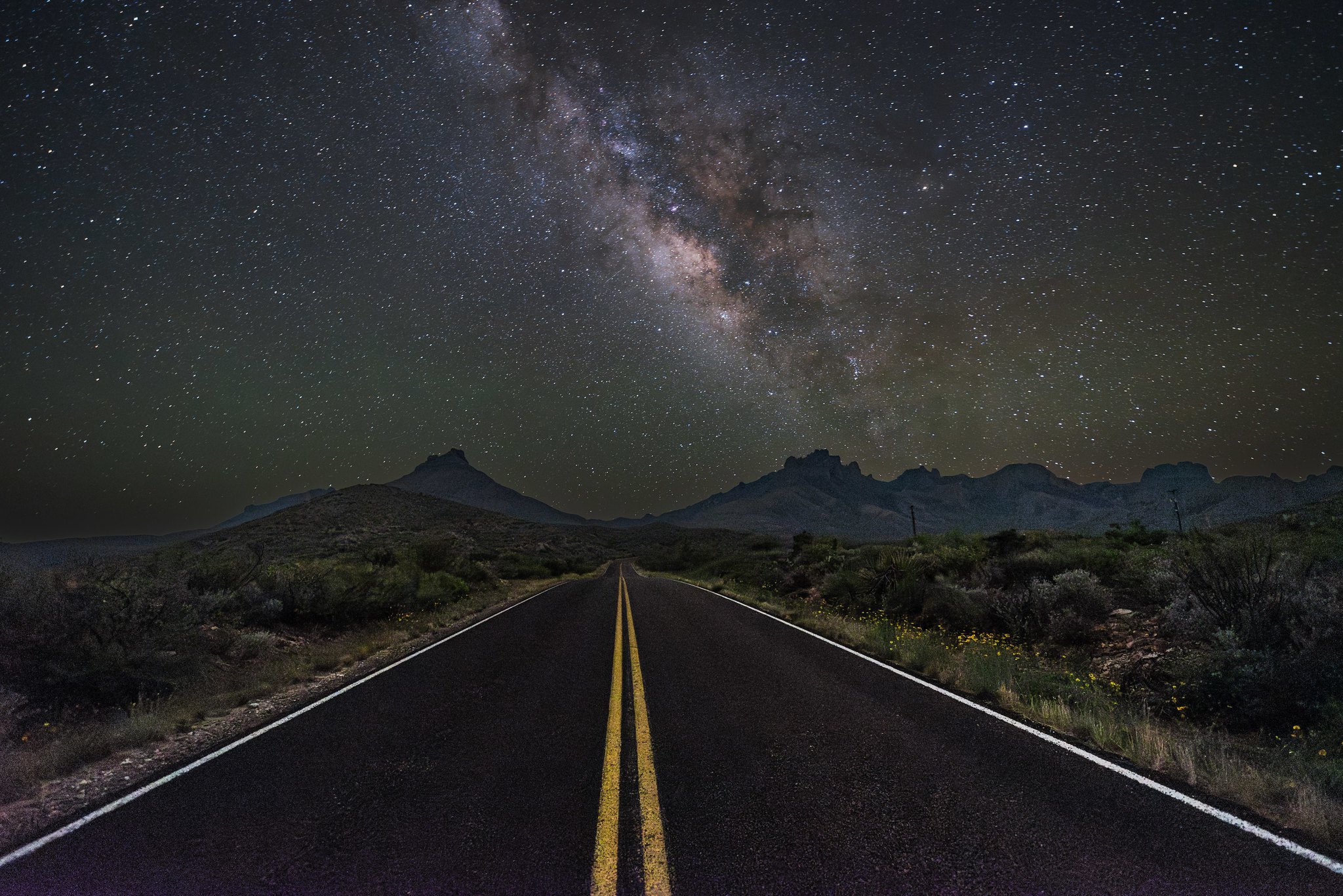
The Road to the Stars
![]() |
| The Road to the Stars neatonjr @ Flickr |
After a long session capturing images of the Milky Way in Big Bend National Park for time lapse, my son Brian and I headed back to the Chisos Basin, stopping along the way at a spot I had mapped out in PhotoPills to capture a shot with a perspective view of the road ahead with the Milky Way beyond.
Initially the plan had been to capture a sequence of relatively short exposure images with separate foreground and sky shots at different ISO, then stacking registration frames to get the highest quality result possible. Unfortunately, just as I was setting up, we saw headlights down below. With such dark skies, the headlights were obvious while the car was still on Gano Springs Road and about 4 miles away so we knew we had 5-6 minutes but that wasn't enough to capture the planned sequence, just enough to get the composition framed and focused using test shots. I went for one 30 second shot knowing I'd get a little star trailing, then we threw everything back in the car and headed to the lodge. We had finished with enough time that the other car was still a mile or more behind us.
To pull out detail in the foreground, I did initial adjustments to the sky such as exposure, curves, white balance, etc. and then used the Lightroom sky masking tool to mask the sky, inverted it and then made adjustments to lighten the foreground. After touching up some noise spots with the healing brush, this is the end result.
Image details:
Nikon D750 on Radian tripod
Irix Firefly f/2.4 15mm lens
ISO 6400
30 seconds @ f/2.8
Click on the image to see large on Flickr.
Enjoy!
Monday, March 27, 2023
The Moon and the Pleiades
There are plenty of interesting sights in the night sky each year. Headlines right now are touting the 5 planets that'll be visible this week, unique because it will be easier than usual to spot Uranus (though you might still need binoculars for it and possibly for Mercury). Unfortunately, I don't expect to see that given the current forecast for cloudy weather in North Texas.
A sight that didn't get much press but that I looked forward to was a conjunction this past Saturday evening (March 25th) between the Moon and a star cluster called the Pleiades, also known as the Seven Sisters, or Messier 45, or Subaru in Japan or many other names across time and cultures. If you ever stared up into the night sky on a winter or spring night and saw what looked like the Big Dipper but almost so small you weren't sure that's what you were seeing, that was probably the Pleiades.
The Pleiades is located in the sky just shy of 5 degrees off the ecliptic. As that's the path that the Sun, planets and the Moon generally follow across the sky, it's not uncommon for the Moon to pass near this star cluster. But many times it occurs during the daytime, or when the Moon is full or nearly full or the Moon doesn't pass close enough to the Pleiades to appear in the same telescopic view. So seeing a conjunction of the Moon as a crescent (just five days after its New phase) and the Pleiades is not that common. I've been told this occurs about every 12 years though I haven't been able to find a concrete source for that.
To capture this event, I drove out to Terry Park on the east shore of Lake Ray Hubbard so I would have less light pollution to deal with than at home and so that I had a clear western horizon to allow the longest amount of time to shoot between the end of twilight and when the Moon set. For this session, I used my Evostar 72ED refractor telescope, Nikon D750 camera and Star Adventurer star tracker.
Here is a raw, unprocessed image from my session on Saturday night.
![]() |
| 5 day old waxing crescent Moon with Earthshine passing near the Pleiades |
This is not entirely what I had in mind but it's just one of the many shots I captured. I'm working with the full set of images to come up with a shot that addresses the challenges in taking this shot.
- In this image, the sunlit side of the Moon is overexposed. I also have shots with the sunlit side properly exposed but the shutter speed for those shots was too fast to capture the stars of the Pleiades. I am working on a blend of this shot and the other one. It's a tough edit so wish me luck.
BTW, the shutter speed for this shot was 2 seconds while the shot with the sunlit side properly exposed had a shutter speed of 1/160th of a second. That's a huge difference, over 9 f/stops apart. Although our eyes can see such a broad dynamic range, most cameras cannot, hence the need to blend multiple images. - I still want the final image to have the rest of the Moon also dimly illuminated. This is called Earthshine because, well, it is the result of sunshine reflected off the Earth lighting up the part of the Moon that's not lit by the Sun.
- I want to bring out the stars of the Pleiades better so that they aren't washed out by the Moonlight. However, it will just be a matter of the individual stars being a bit brighter.
If you have seen images of the Seven Sisters like this one with lots of blue nebulosity surrounding them, it wasn't possible to capture the reflection nebulae that surrounds the stars of the Pleiades with the bright glare of the Moon so close by.
PS. Here is my EarthSky community photo post of this image.
Tuesday, February 7, 2023
The Green Comet
Well, the first thing that came to mind seeing news headlines about The Green Comet was a flashback to the 60s TV show The Green Hornet staring Bruce Lee. :-)
Seriously, this has been a newsworthy comet. While it wasn't bright enough to be seen except under very dark skies and/or with optical assistance like a telescope, as you know if you've followed the news, it is a singularly unique solar system visitor. Check out sites like EarthSky.org for more details and some of the more interesting images.
For my part, I had hoped to capture comet C/2022 E3 (ZTF) with my rig (Evostar 72ED on a Star Adventurer tracker, using a Nikon D750). Unfortunately, the North Texas weather hasn't cooperated. Last week when it was at its closest to Earth (and at its brightest magnitude), we were in the throes of a winter storm. By the time we had a night with relatively clear skies on Friday night, we also had a nearly full Moon. It was also still very cold outside. If it had been a moonless night, I'd have packed things up and headed out east of town to darker skies to shoot but since I knew the Moon was going to make it hard to get really good shots, I just set up in my backyard. At least I could duck inside from time to time to warm up.
Here is the result. See below for more on how it was created.
![]() |
| Comet C/2022 E3 (ZTF) captured in my backyard February 3rd, 2023 |
Between the light pollution and the glare of the Moon, it was hard for me to pull out much detail but you can at least see the dim fuzzball of the comet's core. The comet was in a region of the sky without any bright stars but the few brighter ones on the right side of the image are in the constellation Camelopardalis.
Still, it was time well spent. It was the first time I've gone through the process of capturing what are called calibration frames (bias, darks, flats), additional shots taken to improve astrophotography images by accounting for things like sensor noise and dust. It is also the first time I have processed using calibration frames; I took 100 images (20 seconds each) and post-processed them and the calibration frames using a software tool called Siril and then finished in Photoshop.
Capturing a comet is often tricky since it is moving at a different rate than the stars. Using a star tracker (vs. a telescope mount), my only choice was to track the stars and hope to be able to post-process the comet and stars separately then combine them afterwards. I did that but it took a long time and many tries just to get the results above. I wish I had more data but longer exposures weren't possible since the histogram showed that any longer than 20 seconds at ISO 3200 would have resulted in clipping (i.e., the blue was almost lost to the right side at 30 seconds). On top of that, the comet would have blurred if I used too long an exposure given how fast it was moving.
One of the other tools I learned how to use is Astrometry.net which can do something called plate solving, taking an image and finding where in the sky it is a view of. Here is the results of plate solving using one of the images used to create the shot above. I find this raw, astrometrically-labeled view an interesting alternative version of my night's labors since the comet (though not green) stands out a bit more.
![]() |
| The three dots and labels represent stars in the constellation Camelopardalis identified using plate solving on astrometry.net |
Anyway, the next time I am shooting a dim fuzzy (hopefully without the Moon up and away from city light pollution), I'll have had some practice and expect to be able to produce much better results.
Stay tuned...
Click on an image to see full-screen.
Monday, November 14, 2022
Total Lunar Eclipse from Florida Keys
Home from our trip, I finally got a chance to go through the shots I took last Tuesday morning (November 8, 2022) of the total lunar eclipse from my brother- and sister-in- law's house in Islamorada, Florida on Lower Matecumbe Key. This view is looking to the west over Florida Bay.
I shot from about 4:30am EST until about 6:15am EST when morning twilight washed out the eclipsed Moon. I would have started earlier as the eclipse started at 3:03am EST but the view was obscured by the clouds when I went out to shoot, finally clearing about 4:20am EST.
I've shot lunar eclipses where the Moon appeared larger than this but for this project I needed a wide angle view, allowing me to capture individual lunar disks reflecting the changes in the Moon's appearance through each phase of the eclipse. My goal is to create a composite shot with multiple lunar images spaced across a shot like this. The individual lunar disks will run in an arc from near the top of the image, right down between these two palm trees, each lower than the previous as the Moon got closer and closer to the horizon. I used the Stellarium sky app and the PhotoPills planning app with its augmented reality view to plan where to set up for this shot and confirm it would look like I had in mind.
Creating the composite image is going to take a little work (combining data from about 15 shots taken once every 7 minutes) so stay tuned and I'll post when it is finished.
In the meantime, I was pleased with this image taken near the beginning of morning twilight so thought I'd go ahead and share it now. It's also highlighted on EarthSky.org here.
Enjoy!
Click on image to view full screen.
Equipment Details:
Nikon D750, Nikkor 24-120mm lens at 24mm, Peak travel tripod, camera control with qDSLRDashboard app on Pixel 5, planning with PhotoPills and Stellarium apps on Pixel Slate
Post-processing Details:
Lightroom: minor exposure adjustment, applied lens profile and chromatic aberration adjustment, transform to correct distorted perspective, crop
Photoshop: burning to reduce brightness of dock lights, dodging to slightly increase brightness of moon against twilight sky, use sky mask and a noise filter to reduce color banding when saving to PNG file format


.jpg)
.jpg)
.jpg)
.png)


.png)