Showing posts with label Eclipse Megamovie. Show all posts

Tuesday, April 8, 2025

2024 Total Solar Eclipse Anniversary

It's hard to believe it's already been a year since this incredible event. The pace of life has certainly changed. In the years, months, and especially days leading up to the eclipse, there was such a sense of urgency. So much to do to get ready and always the nagging feeling that something was being left undone, the worry if everything would go as planned, if the weather would cooperate. In some ways, it's a nice break to not live with that constant anticipation, but I would happily live with that again to be able to see another total eclipse! It's not all behind us, though. The journey continues as we process and learn from this astronomical marvel.
 
Copyright Nicolas Lefaudeux
Although I spent untold hours post-processing images of totality, I continue to run across information and examples of pulling out even more detail through advanced processing techniques. For example, although French optical engineer and amateur photographer Nicolas Lefaudeux doesn't publish his techniques, his images are great inspiration to delve even deeper into the science and art of eclipse image processing. I continue to experiment with new techniques on my own images so perhaps may have new versions to share some day.

On the science front, one of the activities I am the most proud of is having participated in the NASA-funded 2024 Eclipse Megamovie project. As with the 2017 project, the goal is to use images taken throughout totality, all along the eclipse track, to create a unique time lapse view of the Sun's corona - something we can only view from Earth during a total solar eclipse - to study its behavior. Unlike the 2017 eclipse where I got clouded out, this time I was able to capture all the images needed for the project. 

While the eclipse just lasted a few hours, the scientific analysis using the images and data collected that day will go on for years! You can read the one year anniversary update from principal investigator Dr. Laura Peticolas for more information on progress to date and what's still to come.
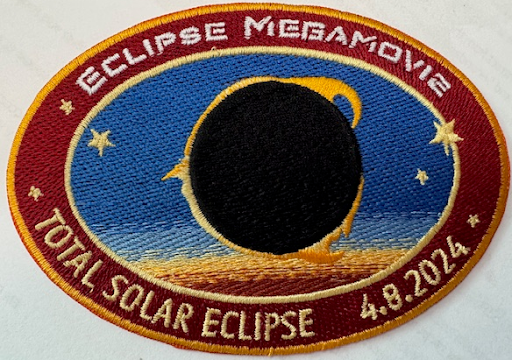
To mark the anniversary of the eclipse, the project sent each of the volunteers our own mission patch! Be sure to read the backstory of NASA mission patches and the EM2024 mission patch. We were also each recognized with credit for our contributions to the project on the Eclipse Megamovie web site. It's pretty cool to see my name on the list!

To revisit my stories from preparing for and experiencing the April 8, 2024 total solar eclipse, see the link under Quick Links in the sidebar. 

Below I've included a gallery of some of the highlights of my eclipse experience. 

Capturing fine detail in the corona and the lunar surface illuminated by Earthshine


Baily's Beads and Solar Prominences


Time lapse of totality


Lunar umbra (shadow) passing over landscape captured from drone

Saturday, April 13, 2024

April 8th 2024 Total Solar Eclipse: Initial Telescopic Images

Fine details in the solar corona


One of my primary goals for this total solar eclipse was to capture a variety of telescopic views of the eclipse. The similar goal I had in 2017 was spoiled by overcast skies that resulted in a mad dash down the road with Beau Hartwig chasing clear skies. Seeing totality with my own eyes meant giving up on my photographic goal. I don't regret that for a minute but I was thrilled that this time the skies cleared for us just in time for the "Big Show". 

To avoid having to split my attention between experiencing totality and taking pictures, I used our old 2012 MacBook Pro running a software package called Solar Eclipse Maestro to control the camera, snapping pictures at pre-defined times and exposure settings. SEM worked flawlessly and had it not been for a user-error on my part (which I'll cover in a future post), I would have captured everything I planned for. As it is, I still was able to capture most of what I planned including:
Although the images captured were as good or better than I hoped, post-processing them to fully bring out the available detail is a rather complicated thing involving a variety of software tools. I am still working on that but I wanted to go ahead and share some initial edits. 

The image above is a blend of each of the 19 different shutter speeds used to capture images to submit to the Eclipse Megamovie project. They were taken during totality to capture as much fine detail of the solar corona as possible. The project team will use the calibration frames to pull out even more detail than appears in this image but, for my first pass at this I used some basic stacking techniques in Photoshop. Click on it to see enlarged... isn't the level of detail incredible?

I'm also including some cursory edits I've done of a few other images below including a partial phase image and a picture of Baily's Beads. What I am the most excited about though is the spectacular solar prominences that appear in the Baily's Beads shot. Wow! Even more incredible is that the largest one was visible naked-eye. 

Once I've had time to go through the rest of my images and finish some of the more complicated editing processes, I'll share more of these. I'll also do a follow-up post on my equipment and what went into capturing these images. 

I hope you got a chance to see totality for yourself but, if not, please enjoy my first pass at sharing the view with you. 

Late in the partial phase of the eclipse. Note the sunspot in the center!

  
Baily's Beads and Solar Prominences


Thursday, July 4, 2019

Total Solar Eclipse Revisted

Almost two years ago, I experienced my first total solar eclipse. My plans for capturing the eclipse were a bit of a bust but I was able to get to clear skies and witness totality with my own eyes which was, in a word, awesome!

One of several citizen-scientist experiments I planned to participate in was Eclipse Megamovie, a partnership between Google and Berkeley in which photographers along the path of totality would submit their photos to be stitched into a movie that would give scientists a view of changes in the solar atmosphere throughout the eclipse. Since I was not able to capture any suitable photos during totality, I didn't have anything to submit. Still, the movie was cool to see when it came out as was the promise of the scientific discoveries to which it might contribute.

This past week there have been two new solar eclipse-related events. At the end of June, the Eclipse Megamovie project released a new version of the movie. This one has the advantage of all images being synced using the star Regulus which was visible near the sun during the eclipse. They also used a false-color technique that brings out a lot of interesting detail. Check it out below.

Next, on July 2nd, there was a total solar eclipse that crossed Chile. One thing that was special about this eclipse is that the path of totality went right over the ESO La Silla Observatory on the edge of the Atacama desert. Early reports indicate observers had a very successful eclipse viewing. See video below.

New Megamovie


2019 Total Solar Eclipse on Chile

Monday, August 21, 2017

Here for the eclipse...

This was my live reporting from on-site in Missouri during the early phase of the Great American Eclipse, waiting for totality (and worried about the clouds).


Late post from the day of the eclipse, originally posted live on Facebook.