Showing posts with label ISS. Show all posts

Tuesday, October 15, 2024

Is it a Meteor? Maybe not!

AI generated graphic with question mark, meteors, satellites and planes
Created with Dall-E
If you've taken a photo of the night sky, whether with a camera or your phone, you may find it contains a few unexpected streaks. Think you captured a meteor? Or that comet you've read about in the news lately? While it could be one of those, it might also be something else. 

People post questions about this so often in places like Facebook that I wrote about it last year. Now, I'm posting an update, focusing on how to quickly identify what you've captured; the details of why are in the earlier post.

Length?

First, how long was your exposure? If it was just a few seconds or even a fraction of a second, any streak will be relatively short, and its length may not be much help in identifying what caused it. However, if it was a long exposure—5 seconds, 10, or even longer—a short streak may be a meteor as they only last a fraction of a second, but a long streak is more likely an airplane or a satellite.

Dots?

Next, is the streak solid, or is it a line with dots? If there are dots, it is most likely an airplane. If there are multiple parallel lines with dots, the aircraft is flying at a relatively low altitude.

Shape?

No dots? What do the ends look like? If both ends are blunt, then what you've captured is most likely a satellite. Larger satellites (like the ISS) will leave a thicker trail. If only one end is blunt but the other is tapered, or both ends are tapered, you might have caught a satellite passing in or out of Earth's shadow, fading into or out of view. 

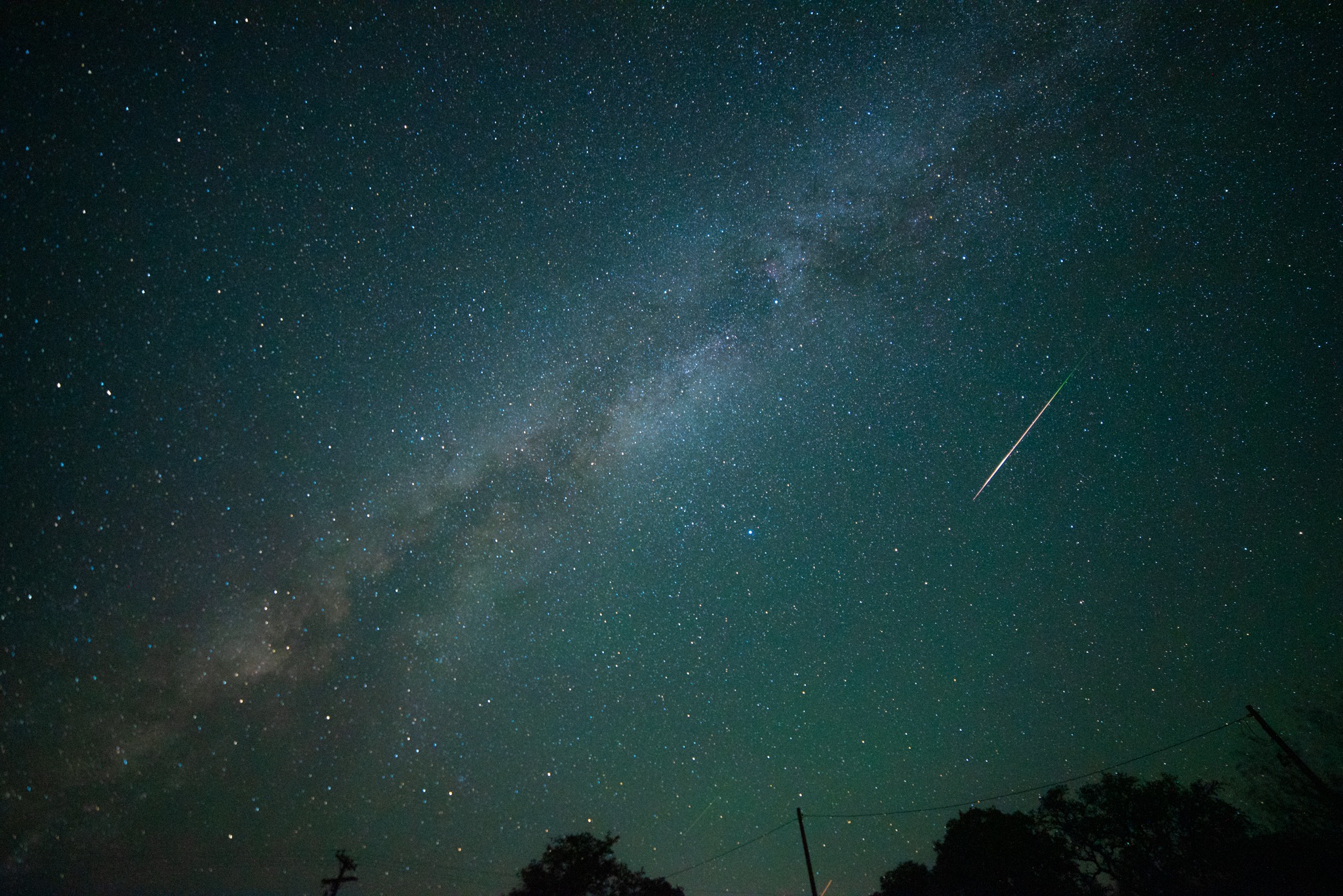
Meteors generally also have tapered ends though usually starting very thin, getting gradually thicker and then quickly coming to a point at the end of its journey. 

Frames?

If you took multiple, successive photos and the streak only appears in one frame, that's another sign it is probably a meteor. If it shows up in more than one image, then it's either an airplane (any dots?) or it is a satellite. 

Color?

If the streak has noticeable color, especially different colors along its length, then it is probably a meteor. With aircraft there may be colors but the streaks are a constant color and the dots generally differ in color from the streaks. With satellites, there's usually no discernible color as they just reflect sunlight. 

Fuzzy?

What if the streak is not so much a line as something cloudy with a bright spot at the lower end? Then maybe you did capture that comet!

For a deeper dive on these and more, go here.

Saturday, March 23, 2024

ISS Lunar Transit Mesquite Texas: Composite Image


As I shared in my last post, I was up in the very early hours this morning to catch a unique event, the International Space Station (ISS) passing in front of the Moon, a lunar transit. What I didn't share in that post is why I used the video mode on my Nikon D750 instead of taking individual photos. 

The D750 is a great camera with some powerful capabilities. It has a top capture speed of 6.5 frames per second. Unfortunately, it can't sustain that speed for long. After about a dozen shots, the buffer fills up and the camera slows to closer to 1 frame per second or even 1 every two seconds. With an event that only lasts about 6 tenths of a second, since the camera only shoots at 6.5 frames per second for about 2 seconds, it would take perfect timing to be able to capture any part of the transit. If I started shooting 4 or 5 seconds too soon or too late, I might miss it all together. 

However, with a video mode of 60 frames per second, I just had to start recording well before the start of the transit and then let it run long enough to be sure the transit was over before stopping the camera. Thankfully, when I was scrambling to finish focusing this morning and realized it was almost time for the transit, starting the video and letting it record for a few minutes was enough to capture the transit and capture far more frames with the ISS than I could have even if the D750 could capture images at 6.5 frames per second indefinitely. Using video has its drawbacks, e.g., things in motion (and the ISS moves incredibly fast) inherently have a little blur, even with a really fast shutter speed, but capturing more images with the ISS in them and having a bit more flexibility in starting/stopping the capture was worth it. Perhaps someday I'll get another chance to do this and will try capturing it with images instead of video. 

To create the image above, I went through the video with Lightroom, selecting each frame with the ISS and exporting it as a JPEG file. I then took these files and opened them in Photoshop as levels. By using auto-align and auto-blend, Photoshop produced a single composite image showing the track the ISS took across the Moon. I decided that the first draft was a bit busy so I did it over again just using every other ISS frame to produce this photo. I also applied some intelligent sharpening to make up for the camera being a little out of focus. It's not great but I am satisfied with it. 

Click on the image to see enlarged. Enjoy!


ISS Lunar Transit Mesquite Texas


I have captured images of the International Space Station (ISS) passing overhead before but I've never captured an ISS transit. Until now!

Every few weeks I check transit-finder.com to see whether there are solar or lunar transits happening nearby. Earlier this week I found that there would be one early AM this morning. 

Lots of things have to come together just right to see the ISS cross in front of the Sun or the Moon. 
  • A location on the Earth where the ISS passes directly in between that location and the Sun or Moon.
  • The ISS has to be close enough to the Earth for its angular size (how big it appears in the sky) to stand out. My sources indicate it's best when the ISS has an angular size of at least 42 arc seconds. 
  • A time of day or night when there will be enough contrast for the ISS to stand out against the given object. For the Sun, this is pretty straightforward but a transit in front of the Moon when it's up during daylight makes for a more challenging capture. 
  • And, of course, you have to be able to see the event so that means little or no clouds. 
The last few times there's been one in the area, the weather didn't cooperate but this time it was pretty clear. The location was within 15 minutes of home and the ISS was forecast to have an angular size of 59.72 arc seconds. 

A little before midnight, I packed up my equipment and Luna in the car and headed to the area where Linda, Lexie and I used to take walks when we lived in Mesquite. With a tripod, mount, telescope, camera and other gear, I needed a spot where I could set up next to the car so I had to scout a few spots looking for a place without too much bright light, on public property, and with a clear view of Polaris (to align the mount) and the Moon. I finally settled on the parking lot at the Palos Verdes Lake Park. Unfortunately, that chewed up enough time that I was still trying to get a sharp focus on the Moon when I realized it was time for the transit. I went ahead and started video rolling, let it go for a few minutes and then packed things up and headed home. 

Today, sitting down with the video I was thrilled to find I had captured it! The focus is not great but it is clear enough to be able to see the ISS moving across the face of the Moon. The entire event was just over a half a second so shooting at 60 fps I caught about 30 frames of the ISS. 

I'm sharing the video for now. Later, I'll work on putting together a photo that captures the entire event in one image.

Be sure to watch full-screen for the best view of the transit. 

In the meantime, here are the technical details:
SkyWatcher Evostar 72ED
0.85 Focal Reducer/Flattener
2X Teleconverter
Nikon D750 (DX mode)
Deep Sky Dad AF3 focusing motor
60fps video at ISO 3200 1/4000th second shutter speed
SkyWatcher Star Adventurer GTi mount
Radian Carbon Fiber tripod
Edited in DaVinci Resolve 

Event details:
See transit-finder.com screenshot below. The centerline crossed the trail just north of Northwest Drive. I captured this video from the park parking lot (not shown in this diagram but it's at the northwest tip of the lake).


Friday, September 8, 2023

Demystifying Light Streaks in Night Sky Images: Meteor, Plane, Satellite, or Space Station?

Updated January 6, 2025 (new content). 

Long exposure night sky photography can capture the beauty of the cosmos, whether it depict stars, solar system objects, the Milky Way or deep sky objects such as galaxies and nebulae. Sometimes though, such images include streaks of light that were unexpected. In some cases, we’ve luckily captured a speck of dust streaking through Earth’s upper atmosphere, glowing as it burns up, what we know as meteors. But often that streak across the photo is something else. For example, what about this one?

Photo by Nathan Eaton

Well, this one is more of a smudge than a streak. A shot of Comet NeoWise (C/2020 F3), it's not likely to be mistaken for a meteor but I'm sharing it both because comets do trace a path across our night sky images but also as I was up at 5:00 a.m. this morning, out by the lake trying to capture a shot of Comet Nishimura (C/2023 P1) just as I am sure so many other people were. Also, of all the things I could think of that leave streaks of light across night sky images, comets seemed at least worth a mention. I'll leave UAPs for someone else to cover. 👽

Anyway, below I’ll share examples of other types of objects that may show up in night sky images and ways to tell when you’re seeing them.

First, a distinction to make. My focus here is on things that appear in night sky images taken with exposures at least a few seconds long. Obviously, when viewing the night sky directly, if you see a streak of light across the sky it’s typically going to be a meteor while the other objects I’ll discuss would appear to the eye as a relatively slowly moving point (or points) of light. It’s when these things are photographed over the length of seconds or minutes that they appear as a streak of light. 

Meteors

A bright meteor passing below the Milky Way
Photo by Martha Dean via EarthSky.org

Although many streaks of light on long exposure images are taken for a meteor at first glance, there are a few key characteristics that can help confirm if that’s what you’re looking at. Generally, meteors in photographs (individually or from a meteor shower) usually:

Of course there are exceptions. You might find that a streak that otherwise appears to meet the characteristics listed above for a meteor but has a blunt end. In this case, your exposure may have started or ended during a meteor mid-flight. Another possibility is when the meteor is a bolide or a fireball. In this case, the streak will grow much larger and brighter at one end. It may also last long enough to appear in more than one frame of a sequence.  

Aircraft

Stack of 8 second exposures capturing DFW-area aircraft
Photo by Nathan Eaton

Of all the things that might be mistaken for a meteor in a night sky photo, aircraft are usually the easiest to exclude. We have a number of things going for us in identifying when that streak of light is an aircraft:

  • they most often have multiple lights so on close inspection the streak is actually multiple streaks,
  • the different lights on aircraft are different colors, usually a combination of white, red and green,
  • the navigation lights (red on left wing, green on right) are constantly on so will appear in a long exposure image as solid streaks,
  • the red beacon lights and white anti-collision strobe lights flash at different intervals so they will appear in a long exposure image as a series of dashes or dots,
  • if flying at high altitude where you're unable to distinguish separate streaks, there will still be dots as the navigation lights blink on and off in flight,
  • in image sequences, an aircraft will appear in multiple, consecutive images (though as in the image above, not always in a consistent direction). 
The image above was taken with a wide-angle lens but aircraft (and other objects described here) may also appear in telescopic images which have a much narrower field of view. The image below was taken by photographer Bill Brownlie while imaging the Andromeda Galaxy (M31) with his Williams Optics GT71. As he reviewed the images, he found that in one the galaxy was photo-bombed by a commercial jet.

Photo by Bill Brownlie

The various aircraft lights are clearly visible:
  • Green navigation light on the right wingtip
  • Red navigation light on the left wingtip
  • Red beacon lights on the aircraft's centerline (top and bottom) that flash periodically - in this case the bottom beacon is illuminating the engine cowlings on each wing
  • White anti-collision strobes outboard of the navigation lights on each wing, appearing as intermittent white streaks
The position of the red and green navigation lights indicates the jet was flying from left to right across the frame.

Bill shared this image in a private Facebook group, Astrophotography. If you belong to the group or decide to join it, you can see his original post here

Satellites

Starlink Satellites
Photo by Jason Parnell-Brookes

With the dramatic increase in satellites launched into Earth orbit in recent years (nearly 38% between early 2022 and mid-2023), capturing a satellite in a long-exposure photograph of the night sky is becoming more and more likely. Although they vary in speed, altitude and direction, they often appear as solid streaks of light having a consistent brightness and color front end to end and the ends appear blunt rather than tapered like a meteor. As with aircraft, in image sequences a satellite will typically appear in multiple, consecutive images (though in a consistent direction). 

Satellites show up to us on the ground not because they have their own lights (like aircraft) but because they reflect sunlight. Sometimes, as a satellite passes over, the angle of its reflective surfaces may change, causing a brightening along part of the streak it leaves in your photograph.

Another characteristic of satellites: when they move into or out of the Earth's shadow, they no longer reflect sunlight. Instead of having a blunt end (caused by the abrupt start or end of your exposure), the end may taper. This can happen on either or both ends. Although this may look similar to the tapered ends of a meteor, a satellite trail will typically be longer, appear in multiple frames, and lack the distinctive color associated with meteors. 

These days, that brightening is likely to be relatively minor. Prior to 2019, a constellation of 66 Iridium satellites were still in operation. Having highly reflective surfaces they commonly produced a streak of light in the sky called an Iridium flare, visible not just in photos but to viewers on the ground, much like a meteor. Often occurring shortly after sunset, they were bright enough to be visible even in the twilight sky. Since the last Iridium satellite was decommissioned in 2019 (burning up in the Earth’s atmosphere), there aren’t any other satellites that produce streaks of light across the sky quite so brightly. 

That said, today there is a new type of satellite that may make a big appearance in your night sky images: Starlink. Although individual Starlink satellites would appear as any other satellite once on-station 342 miles up, two factors make Starlink more likely to show up:

  • sheer numbers - as of last month, there are over 5000 of them in low Earth orbit (out of a grand total of about 12,000 total satellites in orbit, active or inactive),
  • the number launched at once, usually about 20 or so at a time - within the days after a launch and before they achieve full orbit, all of a group of Starlink satellites launched together are flying in a line, appearing in the sky as a series of dots, often referred to as a “train”.
These same points are also part of the reason Starlink is of particular concern for astronomers as are other new satellites now being deployed such as BlueWalker 3

The good news is that there are tools that can help identify whether that streak in your photo is a satellite.  My favorite is Stellarium (available as free open source software for Windows, Mac and Linux or as paid software for iOS,  Android and Symbian). By setting the location where your shot was taken and the date/time of the image in Stellarium, you can zoom in on the area where the streak appears in your image and increase the time rate then watch for what crosses the same section of the sky. Sometimes it’s difficult to find what it was but I can usually confirm there was a satellite and which one it was. Another useful tool is Heavens Above.

While those tools are great for looking back in time at when/where a satellite was visible or for looking ahead at when they might be visible, another tool you can try if your goal is finding when you can see a Starlink satellite, give the SpaceX Starlink Satellites Tracker a try. Thanks to Stephen Buck for his comment on the Facebook group Astrophotography for Beginners for that link. 

Space Stations

Stack of 8 second exposures of ISS fly-over
Photo by Nathan Eaton

For the most part, craft like the International Space Station (ISS) would appear in a long exposure night sky image as a long streak similar to any other satellite. In the case of the ISS and eventually the China space station Tiangong, given their large size relative to other satellites they can sometimes appear brighter and result in a wider streak across your photo. Similar to other satellites, as a space station passes overhead it may pass into the Earth’s shadow before reaching the horizon. When this is captured in an image such as the one above, it may appear to fade out, perhaps even with a tapered appearance, rather than the light streak having a blunt end representative of your camera’s shutter closing. 

Another similarity space stations have to other satellites is that their orbits are well understood. This makes their appearance predictable. There are many tools available to forecast these appearances including NASA's Spot the Station. One of my favorites is Heavens Above. With it, you can see when various satellites and space stations are expected to be visible from your location.

Variation on a Theme: Solar and Lunar Transits

ISS Transiting the Moon
Photo by Andrew McCarthy

If having the ability to tell where satellites and space stations are in the sky piques your interest beyond just figuring out what that light streak across your long exposure night sky photo is, if you ever take solar or lunar photos, then another tool you should check out is Transit Finder. With it, you can identify when the ISS, the Hubble Space Telescope (HST) and other large craft in space will fly across the face of the Sun or Moon, giving you a chance to try your hand catching them in a photograph. Follow the link of the image above for information on what's involved. 


Friday, August 4, 2023

Olivia and Papa Chase the ISS and More

Last month, my granddaughter Harper and I went out to capture an image of the International Space Station (ISS) flying over Dallas. As described in my post about that effort, we were only partially successful, foiled by clouds. This past Tuesday evening, granddaughter Olivia and I headed up to the north shore of White Rock Lake to try again. In spite of being a little late getting to the lake and rushing to set up cameras, we managed to catch the last 90 seconds or so of the ISS flyover as it traveled from the northwest, overhead and down to the southeast. Here is the result.


This is a composite image created by stacking 9 images taken with a Nikon D750 and a Rokinon 14mm wide angle lens mounted on a tripod. Each shot was 8 seconds long with 2 seconds between each shot. What Olivia and I saw was an incredibly bright "star" moving across the sky, too steady and too fast to be an airplane. It appears as a streak in this image due to the long exposure of each original image; the gaps are due to the delay between each shot while the camera saved the image files. 

This photo demonstrates an interesting aspect of ISS flyovers. We can see the ISS fly by only at certain times and places, its visibility due to the viewer being in a position to see sunlight reflected off of the ISS. For this flyover, as it was traveling "away" from the sun (which had set just over an hour earlier) its orbit carried it into the Earth's shadow. Notice how the lowest trail fades off and disappears. 

Another interesting object in the sky that night was the Sturgeon Moon, the first of two "supermoons" this month. It was cloaked in clouds until just as we were getting in the car to head home so it just appears in this image as a bright glow to the lower left. Note all the people on the dock though; there was quite a crowd out that night with people all up and down the shoreline to watch the full moon rising. I wonder how many of them also realized they were getting a chance to see the ISS, too.

We also tried to capture a flyover of a satellite, BlueWalker 3, which passed over this same view looking south across the lake about a half-hour before the ISS flyover. Unfortunately, even having two cameras shooting during its flyover, we didn't capture it. I'm not sure whether it was due to its lower elevation, the haze to the south east or a miscalculation on my part about where and when we would see it. That'll be a target to try for another night. 

Thanks to the long exposures taken, the composite includes more than just the ISS and the Moon. Stars of the constellation Sagittarius (the Archer) and Scorpio (the Scorpion) are visible including Antares, the red super-giant star that is known as the Heart of the Scorpion. Here is a labeled version of the image above. 


The images above were edited to remove all the other stuff we saw in the sky that night: aircraft. The following is a composite of 12 images stacked "as is" in Photoshop. It shows not only the ISS but all the aircraft trails captured. Having simply stacked the images, stars appear as streaks and headlights and taillights of cars on the far shore of the lake appear as streaks. 


One final image, this time an edited stack of all the images, showing not only the ISS but all the aircraft trails captured. Unlike the unedited stack, in this view the sky (Moon and stars), lake and even the car headlights on the far shore are all from a single image. The aircraft and ISS trails from the other 11 images were masked to overlay that single image.


As always, click on an image to see large. 

Friday, July 14, 2023

Harper and Papa Chasing the ISS

UPDATE: Keep reading for the "rest of the story" but here is the same image as below but cropped vertically to focus attention more on the ISS trail. Enjoy!

Our granddaughter Harper stayed with us this week. During the day, she was attending Dallas Parks & Recreation Outdoor Adventure Camp and the theme this week was photography. As I am an avid shutterbug I also spent a little time each evening with her, messing around with cameras, talking about how to take good pictures, etc. 

As I was checking to see what the evening weather would be with the idea that we could maybe take some night sky shots, I noticed that Tuesday evening the International Space Station (ISS) was going to be passing over. Even better, it would be rising just over downtown when seen from up by White Rock Lake. That night around 9:00 pm, we headed up to Winfrey Point and set up my Nikon D750 with an Irix 15mm wide angle lens. Once the camera was set up on the tripod, I let Harper take all the test shots and then we set the camera to shoot a sequence of 20 second shots. ISS was going to be visible for about 7 minutes, only 3 of which would be visible to the camera facing due west. After it passed overhead, we also tried capturing shots to the northeast but lights and trees were in the way.

The next day we loaded the captured images into Lightroom and I did some basic edits for exposure, contrast, etc. and then we loaded them as layers in a single image in Photoshop. As each layer contained a section of the ISS flyover, our goal was to follow instructions from this online article to stack all the images to end up with one image with a full track of the ISS, from when it was first visible (about 10 degrees above the horizon) until it passed out of the camera frame. 

Unfortunately, while the weather report had been for clear skies, there was actually a lot of haze on the horizon and clouds across the path of the ISS. Here is the result of just stacking all the images.

Harper thinks this version is kind of cool and I agree. The streaks of the clouds are pretty surreal and the airplane trails and the few star trails convey a lot of action.  The problem is that you can only get glimpses of the ISS trail as it is mostly obscured by the clouds. Even where it might have been clearly visible in one frame, once we stack all the other frames on that then some or all of it is obscured by the clouds. 

That led us to research other ways to achieve what we were after. With the help of ChatGPT, we learned some Photoshop techniques that allowed us to selectively mask out everything but the ISS trail, stack those and combine them with a base image that included the foreground with the lake and downtown Dallas and in which most of the clouds were to the right. We also removed a couple of airplane trails so that the ISS trail is the "star" of the image.

Here is the end result. It's not exactly what we intended to shoot - the ISS trail is spotty and the gaps don't always match the cloud gaps in the base image - but we are pretty happy with it. 


This was just the start, though. Now we are watching out for other nights when the ISS will fly overhead where the skies are clear and it will pass over an interesting foreground like the lake and downtown in this image. More to come!

If you are interested in finding out when the ISS flies overhead where you live, there are many resources but one of my favorites is the Heavens Above. Here is the ISS Visible Passes chart and here are the details for the flyover we captured

As always, click on an image to enlarge. Clear skies, y'all!

Friday, August 5, 2022

HST Transit Attempt: Failure is How We Learn

I camped out in Chris and Katie's backyard last night with my Nikon D750 and telescope (Sky Watcher Evostar 72ED) to try and capture a transit of the Hubble Space Telescope (HST) across the face of the Moon. Unfortunately, I didn't capture it. I'm not too surprised... stories from people who have captured a lunar transit of the International Space Station (ISS) often describe making 4-5 attempts before success and the ISS is about 10 times as large as HST in the sky (between HST being both physically smaller and about half again further away). 

This was my second attempt at a lunar satellite transit. I'd done a test shot of a transit of the Chinese Space Station (Tiangong) a few weeks ago. For that one, I had tried shooting a rapid series of shots but with the transit only lasting about a few seconds, I just was not shooting fast enough to capture it. That led to my plan for last night to try shooting 60 frame per second video with the goal of using individual frames to create a composite image. Assuming I had captured anything. Which I didn't. :-(

The evening wasn't a total bust though. On the one hand, I got useful information about trying to shoot video to capture something like a lunar transit. The high ISO I used resulted in far too much noise, so much so that I suspect the HST is there in my video but lost in the noise. I need to do some night time Moon video test shots to see how low I can set the ISO and still get decent video. I also learned that trying this when the moon is so close to the horizon (it was at only about 11 degrees, just above the trees along the back of their property) just makes it tougher since with it that low means shooting through more atmosphere and there is also more air turbulence. 

The end result of the evening (besides the things I learned) is this hazy shot of a first quarter moon, created with some editing in Photoshop to merge two images; one with the Moon properly exposed and the other with the high, thin clouds showing (but in which the Moon was completely washed out). 

Learning something new every day! 


Friday, June 24, 2022

Moon and Five Planets over Downtown Dallas Skyline


Step outside this morning about 45 minutes before sunrise and you would have seen an incredible sight, a unique alignment of the visible planets along with a waning crescent Moon.  It's not all that rare to see some combination of planets before sunrise or after sunset but it's pretty rare for them to be aligned in the order that they occur extending out from the Sun: Mercury, Venus, Mars, Jupiter and Saturn. Even more so with the Moon in view.

There's nothing special or mysterious about this alignment. It just happens that the relationship between Earth and each of the other planets in their orbits around the Sun is such that they line up this way now. But isn't it beautiful! 

I had originally planned to go find a spot out in the countryside with dark skies to take this shot but just the Moon and planets on their own with nothing interesting in the foreground seemed a bit boring. I did a number of test shots over the past week and determined that even with the bright lights of downtown Dallas, they would still be visible in a shot like this. 

Unfortunately, the haze was just a bit too heavy this morning for Mercury to really show up. It's there but just hard to see without zooming in really close. Given how close the planet orbits the Sun, it is never that far above the horizon while the sky is still dark enough to see it. I have some other shots I still need to go through though so if I have another where it's more visible, I will post it. 

This image was created by taking four shots with a 15mm wide angle lens. Two were taken with the camera level (to avoid vertical distortion of buildings, bridges, etc.), one aimed just left of the Margaret Hunt Hill bridge (the brightly lit suspension bridge) and the other aimed towards the bright street light to the right. The other images were taken in the same directions but aimed high enough to capture Jupiter and Saturn. The four images were merged as a panorama in Adobe Lightroom. 

The panorama above is only part of what I was working on this morning. I also captured nearly 3000 shots over almost 3 hours that I plan to assemble into a timelapse video. The image to the left shows the shooting setup. The camera on the left is my Nikon D750 with a 14mm Rokinon lens; it's taking the timelapse sequence of images. The camera on the right is my son Brian's D750 with our Irix 15mm lens; it's what I used to take the shots for the panorama. 

Stay tuned for the timelapse! Besides the Moon and planets, it features a special guest appearance from the ISS. 

Click on images to view it full-screen.