In my last post, I described my efforts to capture an interesting image with the Moon and all five naked-eye planets lined up in the order of their orbits out from the Sun. As the conditions on June 24th were not ideal and elusive Mercury was mostly lost in the haze over Downtown Dallas, I tried again on Sunday, June 26th. The sky was much clearer (at least over the Dallas skyline) and there was less haze. Thankfully, staying up almost all night a second time was definitely worth it!
In the image above, I've added an enlarged insert of each object and labeled them to give everyone a more clear idea of what they are looking at without having to click on the image to see it full screen and then zoom in to tell what each object is. The original, unlabeled image is also included below.
While the surprise on Friday's outing was the ISS flyby (I'm still working on the timelapse videos from both Friday and Sunday), the surprise in these images is that I also captured the Pleiades star cluster (M45), which you may know as the Seven Sisters (immortalized in the Subaru logo)!
Another difference between this image and the one from the 24th is that the Moon is "older", now 28 days through its cycle (vs. 26 days on the 24th). Just two days from being a New Moon, in this image it is a thin crescent, only 4% illuminated. However, thanks to the length of the exposure (2 seconds), the camera captured not just the sun-lit crescent but it also captured earthshine, the portion of the Moon not in sunlight but still lit but the sunlight reflected off of the Earth.
For anyone interested in how this image was created, I started out by taking multiple shots with a Nikon D750 and the kit lens, a Nikkor 24-105mm f/4 lens set to it's widest at 24mm. Each of the 6 images used were taken in portrait orientation and, using a tripod, I started shooting to the left of Mercury, then moved the camera about 35 degrees to the right so that the next shot would be overlapped with the previous, continuing until I had the final shot including Saturn. Each image was taken at ISO 200, f/4 and as noted above, exposed for 2 seconds. The screenshot to the right was my shooting plan from PhotoPills with the red dot representing my location on the west levee of the Trinity river and the black dot representing the Bank of America Plaza tower (the tallest building in Dallas, the one in the panorama with the bright green lights), about 1.6 miles away. The Margaret Hunt Hill Bridge, the white suspension bridge arch in the center of the panorama, crosses the Trinity. The lighter dashed lines with black dots represent the left, center and right of the field of view in the panorama.
Post-processing involved using software (Adobe Bridge and Adobe Camera Raw) to merge the 6 shots into one panorama, then crop and apply adjustments for exposure, sharpness, etc. Next, I edited that image in Photoshop to add the insets and labels. As the merged image exhibited some color banding in the morning twilight sky, I used a technique involving adding a little noise to the image to reduce the banding. Note that I also took some creative license with this shot, editing the inset of the Pleiades to emphasize the major stars so it would be more recognizable.
As always, click an image to view full-screen. Enjoy!
Step outside this morning about 45 minutes before sunrise and you would have seen an incredible sight, a unique alignment of the visible planets along with a waning crescent Moon. It's not all that rare to see some combination of planets before sunrise or after sunset but it's pretty rare for them to be aligned in the order that they occur extending out from the Sun: Mercury, Venus, Mars, Jupiter and Saturn. Even more so with the Moon in view.
There's nothing special or mysterious about this alignment. It just happens that the relationship between Earth and each of the other planets in their orbits around the Sun is such that they line up this way now. But isn't it beautiful!
I had originally planned to go find a spot out in the countryside with dark skies to take this shot but just the Moon and planets on their own with nothing interesting in the foreground seemed a bit boring. I did a number of test shots over the past week and determined that even with the bright lights of downtown Dallas, they would still be visible in a shot like this.
Unfortunately, the haze was just a bit too heavy this morning for Mercury to really show up. It's there but just hard to see without zooming in really close. Given how close the planet orbits the Sun, it is never that far above the horizon while the sky is still dark enough to see it. I have some other shots I still need to go through though so if I have another where it's more visible, I will post it.
This image was created by taking four shots with a 15mm wide angle lens. Two were taken with the camera level (to avoid vertical distortion of buildings, bridges, etc.), one aimed just left of the Margaret Hunt Hill bridge (the brightly lit suspension bridge) and the other aimed towards the bright street light to the right. The other images were taken in the same directions but aimed high enough to capture Jupiter and Saturn. The four images were merged as a panorama in Adobe Lightroom.
The panorama above is only part of what I was working on this morning. I also captured nearly 3000 shots over almost 3 hours that I plan to assemble into a timelapse video. The image to the left shows the shooting setup. The camera on the left is my Nikon D750 with a 14mm Rokinon lens; it's taking the timelapse sequence of images. The camera on the right is my son Brian's D750 with our Irix 15mm lens; it's what I used to take the shots for the panorama.
Stay tuned for the timelapse! Besides the Moon and planets, it features a special guest appearance from the ISS.
While the Internet and both digital and print media made a big to-do over the recent lunar eclipse, the January 2019 Super Blood Wolf Moon, I was actually a little disappointed in this one. Yes, it was big. Yes, it was red. Yes, it was, well, a Wolf Moon (the name used for a January full Moon for centuries, according to the Farmer's Almanac). But there's a problem... it was almost straight overhead.
Why would that matter? If your primary interest is being able to see the entire eclipse, start to finish, then there's no surer bet than a night like Sunday night. A great example is the wonderful composite by a fellow Texas Astronomical Society member, Jason Ware (you can see the original post for this on Facebook here).
Jason Ware Jan 2019
Another of my favorite shots from this latest eclipse was from a Canadian astrophotographer, Alan Dyer (below and here). Similar to Jason's shot above, I like how both are a composite that show the key points in the sequence.
Alan Dyer Jan 2019
However, for me the Moon is often more interesting seeing it juxtaposed against something earthly, whether man-made or natural. Here are a few examples from past lunar eclipses I've shot.
This first shot below was taken in September 2015, the day before my wife's birthday, while we were in the Northwest visiting friends who live in Vancouver, WA. Shot just east of Portland, that's a very bald Mt Hood below the Moon (snowfall had been pretty sparse that year). The eclipse was already in progress as the Moon rose that night so it was in totality by the time it was just above the mountain. What an incredible view!
Nathan Eaton Sept 2015
Of course, sometimes a lunar eclipse occurring when the Moon is close to the horizon is not a blessing. For example, the shot below was taken of the January 2018 Super Blood Blue Moon setting over downtown Dallas. It occurred during morning twilight so the sky brightened well before the eclipse was over and before the Moon had set, making it difficult to really get the full effect of the total eclipse.
Nathan Eaton Jan 2018
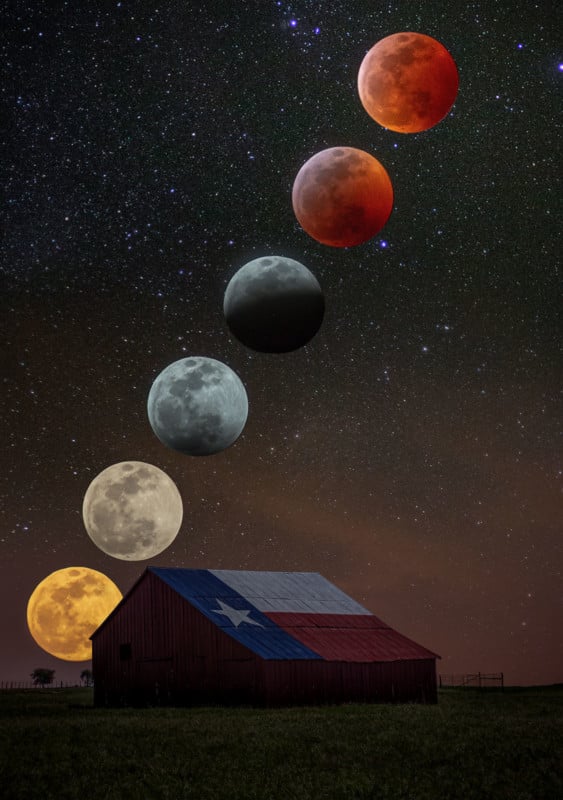
On the other hand, sometimes what you see in an image is not necessarily what it looked like in person. Whether you realized it or not, I bet you have seen a widely shared, simply amazing view of the Moon above a city skyline or similarly distinctive foreground, one where the Moon just jumps out at you! Often times, this is really a combination of two great shots, one of the foreground and one of the Moon but where the Moon had been altered by enlarging it and possibly moving it to strategically position it in relation to the foreground. I think many of these are really stunning and a joy to see. What bothers me is when it isn't made crystal clear that the photographer has taken poetic license, that it isn't a realistic portrayal of the Moon. Thanks to the Moon Illusion, we are used to to the idea that the Moon looks larger close to the horizon so it is not surprising that many people assume a shot where the Moon looks larger than normal is real.
A variation of this is composites similar to the ones above but where they are over a foreground subject. I am a big fan of these but, again, when the Moon is shown "larger than life" relative to the foreground, I think the photographer needs to call out the exaggeration. A great example of this done well, both the photograph and the photographer being upfront about what changed, is this shot by Jason Weingart that was highlighted in PetaPixel.
Jason Weingart Jan 2019
As another example of why it's important to be clear about when a shot has been materially changed, consider this post of a "larger than life" shot of the moon by Beau Rolfe on Facebook. In Beau's very cool shots, taken of the December 2018 full Moon, the lunar orb really is this big, but it's because it was shot with a really long lens (600mm), not because he edited the image in software to make the Moon look larger or shot the Moon with a longer lens than the foreground was shot with. Regardless, his shots still raised questions of "where can I go to see it that large?" and "was this Photoshopped?" (questions friends of mine brought these shots to my attention to ask about).
When you have a lunar eclipse like this month where the Moon is high in the sky, the focus (at least for photography) turns more to the Moon itself rather than the Moon and a foreground landscape. Here are examples of that, one from April 2014 when we were at the Perot museum into the middle of the night for an eclipse party and also a similar one at height of the latest eclipse, taken Sunday night from our backyard. Both were shot through our 10" Dobsonian telescope, captured with camera on my phone pointed through the eyepiece. Not ideal (see the lens flare in first one and the "field of view" in second) but I think they are still interesting shots.
Nathan Eaton April 2014
Nathan Eaton Jan 2019
As fun as it is to see all the different ways in which people shoot an eclipse, I also like the other ways in which people celebrate the eclipse. For example, I didn't make it there but one of our favorite watering holes, The Flying Saucer, had a unique way of celebrating, offering "Moon related" adult beverages.
One of the other fascinating aspects of this eclipse is the historic first sighting of a meteor strike during the eclipse. A key contributing factor to discovery of this event was that scientists were actually looking for it. It would have been pretty incredible to have been watching through my telescope just as the strike occurred!
To close, I'm including a couple of shots I took from the backyard Sunday night. First, a shot taken with my Nikon D750 using the longest lens I had handy, a 120mm Nikkor (actually, the D750 kit lens, a 24-120mm zoom). Image is cropped from an HDR stack of three bracketed shots.
Nathan Eaton Jan 2019
Finally, here is is a shot of the evening with us huddled around the fire pit trying to stay warm while watching the eclipse with our 8 month old Weimaraner, Luna. Not only is her given name take from the Moon, but her AKC registered name, suggested by our granddaughter Kai, is based on such an event: Runner's Lunar Eclipse. Seemed fitting to have her out with us while we were watching such a beautiful sight. I hope you were able to catch a glimpse of it, too!








 The journey continues beyond 2009... check it out!


