Showing posts with label mercury. Show all posts

Tuesday, July 25, 2023

Jack and Papa Capturing Moon and Planets

While our grandson Jack stayed with us last week, he and I went out one evening to take our Weimaraner, Luna, for a walk on the east shore of White Rock Lake and to try capturing the 3-day old crescent Moon, Mars, Venus and Mercury over the iconic Pump Station. 

We were partially successful. Jack got in a dozen or so shots with my Nikon D750, starting with some test shots and then bracketing to try and get both the properly exposed lunar crescent and also the rest of the lunar surface lit with Earthshine. As explained below we didn't quite get what we wanted. Had the mosquitoes not chased us off, we might have eventually got it but Luna was getting impatient anyway so we put the camera away and went for our walk. 

Unfortunately, the brackets didn't get us quite enough dynamic range to get both Earthshine and a lunar crescent that showed any detail. In the end, a single shot had the best overall exposure and detail that we were after. Although the lunar crescent is heavily over-exposed, the Earthshine-lit surface is still visible. And although Mercury is lost in the haze over Dallas, in addition to dim Mars and bright Venus you can just make out the stars of the "front-end" of the constellation Leo the Lion with it's brightest star, Regulus. 

Here is the final shot and below is a version that is labeled. Enjoy!

Photo by Jackson Eaton


Photo by Jackson Eaton


As always, click on image to view full-screen.

Tuesday, June 28, 2022

Moon and Five Planets over Downtown Dallas Skyline - This Time With the Pleiades


In my last post, I described my efforts to capture an interesting image with the Moon and all five naked-eye planets lined up in the order of their orbits out from the Sun. As the conditions on June 24th were not ideal and elusive Mercury was mostly lost in the haze over Downtown Dallas, I tried again on Sunday, June 26th. The sky was much clearer (at least over the Dallas skyline) and there was less haze. Thankfully, staying up almost all night a second time was definitely worth it!

In the image above, I've added an enlarged insert of each object and labeled them to give everyone a more clear idea of what they are looking at without having to click on the image to see it full screen and then zoom in to tell what each object is. The original, unlabeled image is also included below. 

While the surprise on Friday's outing was the ISS flyby (I'm still working on the timelapse videos from both Friday and Sunday), the surprise in these images is that I also captured the Pleiades star cluster (M45), which you may know as the Seven Sisters (immortalized in the Subaru logo)! 

Another difference between this image and the one from the 24th is that the Moon is "older", now 28 days through its cycle (vs. 26 days on the 24th). Just two days from being a New Moon, in this image it is a thin crescent, only 4% illuminated. However, thanks to the length of the exposure (2 seconds), the camera captured not just the sun-lit crescent but it also captured earthshine, the portion of the Moon not in sunlight but still lit but the sunlight reflected off of the Earth. 

For anyone interested in how this image was created, I started out by taking multiple shots with a Nikon D750 and the kit lens, a Nikkor 24-105mm f/4 lens set to it's widest at 24mm. Each of the 6 images used were taken in portrait orientation and, using a tripod, I started shooting to the left of Mercury, then moved the camera about 35 degrees to the right so that the next shot would be overlapped with the previous, continuing until I had the final shot including Saturn. Each image was taken at ISO 200, f/4 and as noted above, exposed for 2 seconds.  The screenshot to the right was my shooting plan from PhotoPills with the red dot representing my location on the west levee of the Trinity river and the black dot representing the Bank of America Plaza tower (the tallest building in Dallas, the one in the panorama with the bright green lights), about 1.6 miles away. The Margaret Hunt Hill Bridge, the white suspension bridge arch in the center of the panorama, crosses the Trinity.  The lighter dashed lines with black dots represent the left, center and right of the field of view in the panorama. 

Post-processing involved using software (Adobe Bridge and Adobe Camera Raw) to merge the 6 shots into one panorama, then crop and apply adjustments for exposure, sharpness, etc. Next, I edited that image in Photoshop to add the insets and labels. As the merged image exhibited some color banding in the morning twilight sky, I used a technique involving adding a little noise to the image to reduce the banding. Note that I also took some creative license with this shot, editing the inset of the Pleiades to emphasize the major stars so it would be more recognizable.

As always, click an image to view full-screen. Enjoy!


Friday, June 24, 2022

Moon and Five Planets over Downtown Dallas Skyline


Step outside this morning about 45 minutes before sunrise and you would have seen an incredible sight, a unique alignment of the visible planets along with a waning crescent Moon.  It's not all that rare to see some combination of planets before sunrise or after sunset but it's pretty rare for them to be aligned in the order that they occur extending out from the Sun: Mercury, Venus, Mars, Jupiter and Saturn. Even more so with the Moon in view.

There's nothing special or mysterious about this alignment. It just happens that the relationship between Earth and each of the other planets in their orbits around the Sun is such that they line up this way now. But isn't it beautiful! 

I had originally planned to go find a spot out in the countryside with dark skies to take this shot but just the Moon and planets on their own with nothing interesting in the foreground seemed a bit boring. I did a number of test shots over the past week and determined that even with the bright lights of downtown Dallas, they would still be visible in a shot like this. 

Unfortunately, the haze was just a bit too heavy this morning for Mercury to really show up. It's there but just hard to see without zooming in really close. Given how close the planet orbits the Sun, it is never that far above the horizon while the sky is still dark enough to see it. I have some other shots I still need to go through though so if I have another where it's more visible, I will post it. 

This image was created by taking four shots with a 15mm wide angle lens. Two were taken with the camera level (to avoid vertical distortion of buildings, bridges, etc.), one aimed just left of the Margaret Hunt Hill bridge (the brightly lit suspension bridge) and the other aimed towards the bright street light to the right. The other images were taken in the same directions but aimed high enough to capture Jupiter and Saturn. The four images were merged as a panorama in Adobe Lightroom. 

The panorama above is only part of what I was working on this morning. I also captured nearly 3000 shots over almost 3 hours that I plan to assemble into a timelapse video. The image to the left shows the shooting setup. The camera on the left is my Nikon D750 with a 14mm Rokinon lens; it's taking the timelapse sequence of images. The camera on the right is my son Brian's D750 with our Irix 15mm lens; it's what I used to take the shots for the panorama. 

Stay tuned for the timelapse! Besides the Moon and planets, it features a special guest appearance from the ISS. 

Click on images to view it full-screen. 

Thursday, November 14, 2019

Mercury Transit 2019 - The Last One in North America for Thirty Years


Unlike the last Mercury transit in 2016 (see posts here and here), I didn't get a chance to photograph this latest one (November 11, 2019) as we were traveling and it wasn't feasible to drag all my gear with me. However, I did get a chance to watch part of the transit. That was a relief since the next one visible from North America doesn't occur until 2049.

What made viewing this transit particularly special is where we were and who we met.

As we were visiting New York City, I checked online and found a public viewing event, one that happened to be on an aircraft carrier, the USS Intrepid. Retired in 1974, the Intrepid has permanently moored dockside in NYC and was opened in 1982 as the Intrepid Sea, Air & Space Museum. Among other things, they have a space shuttle on display in a dedicated hanger, the Enterprise (the one used to prove the shuttle concept). If you are ever in New York, I highly recommend checking it out!

The host for this viewing was Joseph Martinez, better known on the streets of The Big Apple as the Joe of Jupiter Joe's Sidewalk Astronomy (here on the Web and here on Facebook). Joe is an avid amateur astronomer who loves sharing information on astronomy and views of the sky with people. Joe is also a JPL/NASA Solar System Ambassador. He and some friends had two telescopes equipped with solar filters set up on the Intrepid flight deck, sharing views of the transit with museum visitors.

My wife Linda and I checked out the view from each telescope and then struck up a conversation with Joe. As Linda has worked for many years as a planetarium educator, as I am a member of the Texas Astronomical Society and as we've both been involved in numerous viewing parties including past transits, we had a lot of common interests and activities to talk about with Joe.

When the discussion touched on the 2017 total solar eclipse and then the next eclipse in 2024, Linda suggested Joe should visit us in Dallas since we are in the path of totality. It turns out he is already making plans to be in Texas for the eclipse. Coincidentally, it also turns out he knows other planetarium educators in Texas whom Linda has worked with. Small world!

Joe, thanks again for the views of this transit! Perhaps will see you for the eclipse in 2024!

BTW, for some beautiful shots of this transit, check out ones posted on Earth Sky News.


Monday, May 9, 2016

2016 Mercury Transit: Video Clips

After starting the morning watching the transit online, there were finally a few breaks in the clouds, allowing me to capture portions of the transit myself, assembled into the video below. High wind also hampered things, making it tough to get a sharp focus and steady image, but it was still an incredible thing to watch.

Equipment:
60mm Parks refractor on German equatorial mount
Baader film solar filter from Kendrick Astro Instruments
Orion EQ-1M drive (for solar tracking)
Nikon D7000 (attached with T-adapter)
dslrDashboard on Nexus 9 tablet for remote viewing and camera control

Music: Mercury, the Winged Messenger from The Planets by Gustav Holst

Created with iMovie on a Macbook Pro


Astronomical event of the year: Mercury Transit 2016

In spite of clouds and windy conditions, I've managed to capture a few shots of Mercury crossing the face of the sun. It's a relatively rare occurrence, though not as rare as a Venus transit which I've also watched (see here). Very cool.

It's still in progress through 1:42pm Central today so you might still have a chance to check it out.

For information on the transit:

To watch online:
How to Watch Transit (Space.com)

Click on any image below to view large.

One of the better shots so far today. This is the sun with the planet Mercury (the dot at middle left) crossing it's face, an event called a transit. To the upper right of Mercury is a sunspot. Note that it's larger than the planet!


Our 60mm Parks refractor outfitted with a Baader film solar filter. My Nikon D7000 DSLR is attached to the telescope with a T-adapter. I'm remotely watching the live view from camera using an app on my tablet. The app also allows me to control the camera, taking the shot above and video (to be posted later today).


The makeshift wind screen I'm using to minimize how much wind shakes the telescope (which affects stability of images)

Sunday, October 11, 2015

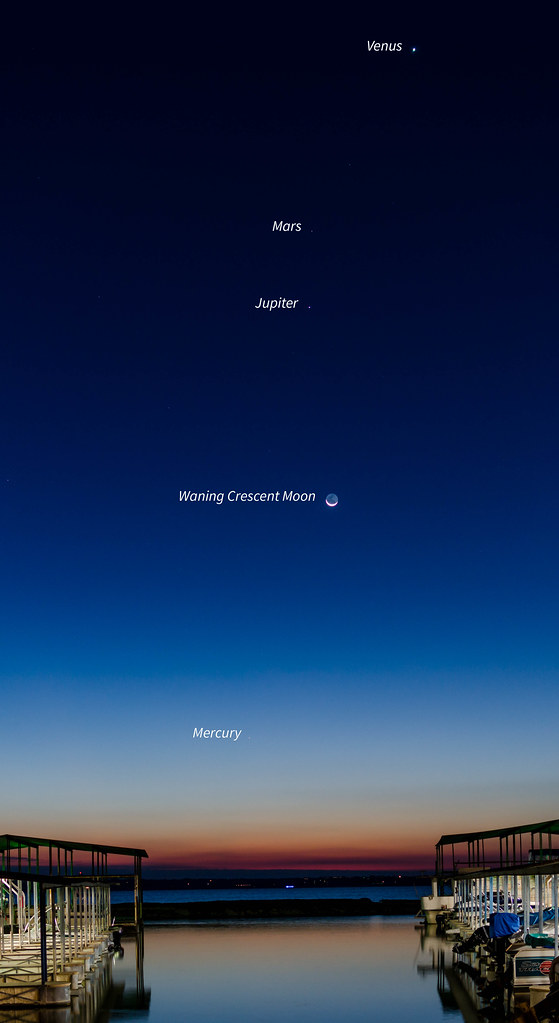
Moon and Planets (labeled)

Moon and Planets Oct 2015 (labeled).jpg Another view of moon and four planets, this time labeled (inspired by Alan Dyer of AmazingSky.net).

Saturday, October 10, 2015

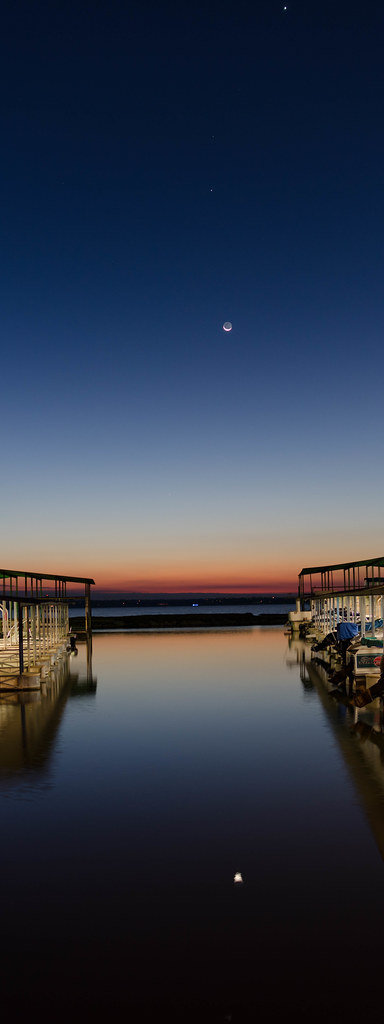
Moon and Planets


Moon and Planets with Reflection Oct 2015A view of the waning crescent moon (with reflection), Mercury, Jupiter, Mars, Venus before dawn on October 10th, 2015. Oh, and with Earth in the foreground!

Multiple shots stitched together.
f/2.5
1/2 sec
ISO 400
35mm
Nikon D7000

Tuesday, January 6, 2009

Mercury at Twilight


Mercury at Twilight, originally uploaded by neatonjr.


One of my first targets for this year, Mercury hanging low in the western sky not long before sunset. Not as exciting as the view from the front-row seat spacecraft Messenger has, but still a beautify site. I only wish I'd gotten a good shot of Mercury, Jupiter, Venus and the Moon a day or two earlier.