Sequence from 2012 Annular Solar Eclipse Photo by Nathan Eaton
We are just a month away from the next solar eclipse! On October 14th, 2023, people from the upper west coast down across Texas and in parts of Central and South America will have the opportunity to see an annular solar eclipse. As with all solar eclipses, this one involves the Moon passing between the Earth and the Sun. This time, the Moon will be farther out in its orbit around the Earth, making its angular size just a bit smaller than that of the Sun. In such a case, the Moon doesn't quite cover the face of the Sun. Consequently, at mid-eclipse viewers along the centerline of the eclipse track will get to see the Ring of Fire, a view in which the Moon is centered over the Sun with a fraction of the solar surface showing all round the Moon.
The image sequence above is one I took during an annular eclipse in 2012 when we were visiting Albuquerque, New Mexico. Shot with a Nikon D7000 DSLR through a telephoto lens and a Baader film white light filter, it shows the eclipse from near the start at top left as the Moon has begun to cover the Sun, progressing across and down to the Ring of Fire view at bottom left then on through near the eclipse end at bottom right. For that eclipse, the Sun set before the eclipse was over so I wasn't able to get any shots of the final phase. The reason for the yellow color in that last shot is partly because the Sun was close to sunset and partly due to heavy smoke in the atmosphere from fires west of Albuquerque. Basically, the image came out yellow for the same reason a sunset with heavy clouds to the west looks yellowish to reddish; the denser atmosphere with heavy particulates (in this case, smoke) filters out shorter wavelengths, only letting the longer (and redder) wavelengths through.
To see how close the path of the eclipse comes to where you live and to see where and when you can view it in person, check out Xavier Jubier's interactive map for the eclipse. Click anywhere on the map and it will give you details of the eclipse for that location including when it starts and ends, how long it lasts and how much of the Sun will be eclipsed by the Moon. Note that the path of the eclipse on the map represents the areas where the annular form of the eclipse will be visible. In the Dallas area, we'll experience a partial eclipse since the Moon never moves completely over the face of the Sun from our vantage point. Unfortunately, we won't get to see the Ring of Fire here.
While the Internet and both digital and print media made a big to-do over the recent lunar eclipse, the January 2019 Super Blood Wolf Moon, I was actually a little disappointed in this one. Yes, it was big. Yes, it was red. Yes, it was, well, a Wolf Moon (the name used for a January full Moon for centuries, according to the Farmer's Almanac). But there's a problem... it was almost straight overhead.
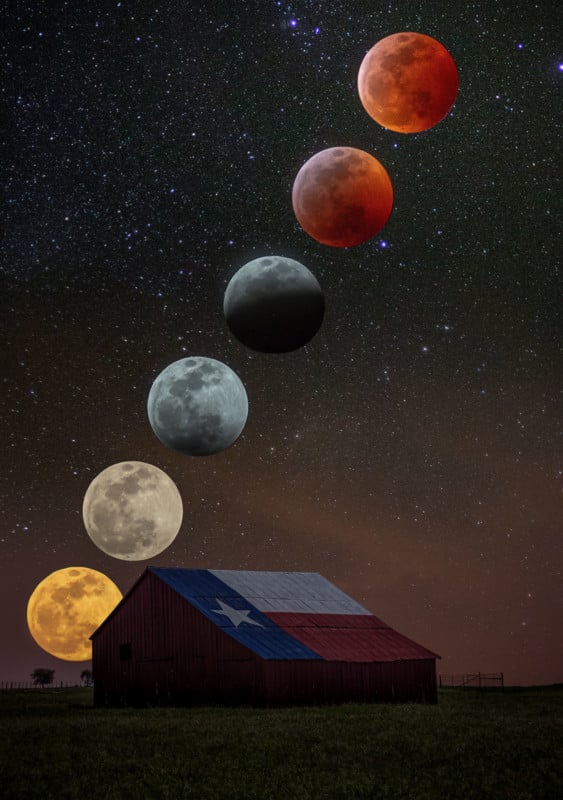
Why would that matter? If your primary interest is being able to see the entire eclipse, start to finish, then there's no surer bet than a night like Sunday night. A great example is the wonderful composite by a fellow Texas Astronomical Society member, Jason Ware (you can see the original post for this on Facebook here).
Jason Ware Jan 2019
Another of my favorite shots from this latest eclipse was from a Canadian astrophotographer, Alan Dyer (below and here). Similar to Jason's shot above, I like how both are a composite that show the key points in the sequence.
Alan Dyer Jan 2019
However, for me the Moon is often more interesting seeing it juxtaposed against something earthly, whether man-made or natural. Here are a few examples from past lunar eclipses I've shot.
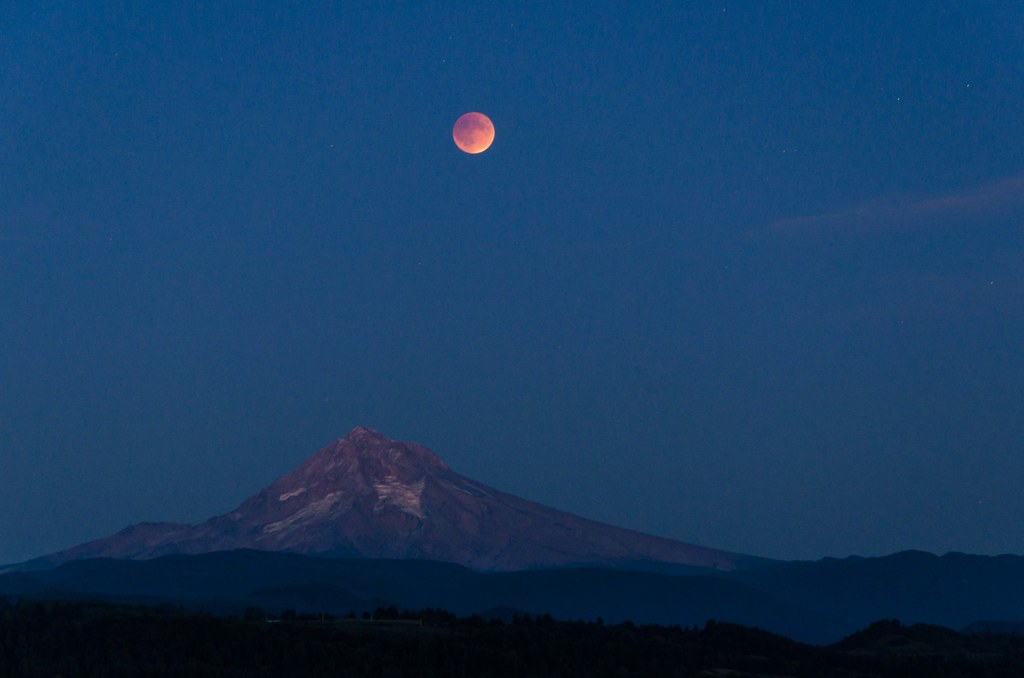
This first shot below was taken in September 2015, the day before my wife's birthday, while we were in the Northwest visiting friends who live in Vancouver, WA. Shot just east of Portland, that's a very bald Mt Hood below the Moon (snowfall had been pretty sparse that year). The eclipse was already in progress as the Moon rose that night so it was in totality by the time it was just above the mountain. What an incredible view!
Nathan Eaton Sept 2015
Of course, sometimes a lunar eclipse occurring when the Moon is close to the horizon is not a blessing. For example, the shot below was taken of the January 2018 Super Blood Blue Moon setting over downtown Dallas. It occurred during morning twilight so the sky brightened well before the eclipse was over and before the Moon had set, making it difficult to really get the full effect of the total eclipse.
Nathan Eaton Jan 2018
On the other hand, sometimes what you see in an image is not necessarily what it looked like in person. Whether you realized it or not, I bet you have seen a widely shared, simply amazing view of the Moon above a city skyline or similarly distinctive foreground, one where the Moon just jumps out at you! Often times, this is really a combination of two great shots, one of the foreground and one of the Moon but where the Moon had been altered by enlarging it and possibly moving it to strategically position it in relation to the foreground. I think many of these are really stunning and a joy to see. What bothers me is when it isn't made crystal clear that the photographer has taken poetic license, that it isn't a realistic portrayal of the Moon. Thanks to the Moon Illusion, we are used to to the idea that the Moon looks larger close to the horizon so it is not surprising that many people assume a shot where the Moon looks larger than normal is real.
A variation of this is composites similar to the ones above but where they are over a foreground subject. I am a big fan of these but, again, when the Moon is shown "larger than life" relative to the foreground, I think the photographer needs to call out the exaggeration. A great example of this done well, both the photograph and the photographer being upfront about what changed, is this shot by Jason Weingart that was highlighted in PetaPixel.
Jason Weingart Jan 2019
As another example of why it's important to be clear about when a shot has been materially changed, consider this post of a "larger than life" shot of the moon by Beau Rolfe on Facebook. In Beau's very cool shots, taken of the December 2018 full Moon, the lunar orb really is this big, but it's because it was shot with a really long lens (600mm), not because he edited the image in software to make the Moon look larger or shot the Moon with a longer lens than the foreground was shot with. Regardless, his shots still raised questions of "where can I go to see it that large?" and "was this Photoshopped?" (questions friends of mine brought these shots to my attention to ask about).
When you have a lunar eclipse like this month where the Moon is high in the sky, the focus (at least for photography) turns more to the Moon itself rather than the Moon and a foreground landscape. Here are examples of that, one from April 2014 when we were at the Perot museum into the middle of the night for an eclipse party and also a similar one at height of the latest eclipse, taken Sunday night from our backyard. Both were shot through our 10" Dobsonian telescope, captured with camera on my phone pointed through the eyepiece. Not ideal (see the lens flare in first one and the "field of view" in second) but I think they are still interesting shots.
Nathan Eaton April 2014
Nathan Eaton Jan 2019
As fun as it is to see all the different ways in which people shoot an eclipse, I also like the other ways in which people celebrate the eclipse. For example, I didn't make it there but one of our favorite watering holes, The Flying Saucer, had a unique way of celebrating, offering "Moon related" adult beverages.
One of the other fascinating aspects of this eclipse is the historic first sighting of a meteor strike during the eclipse. A key contributing factor to discovery of this event was that scientists were actually looking for it. It would have been pretty incredible to have been watching through my telescope just as the strike occurred!
To close, I'm including a couple of shots I took from the backyard Sunday night. First, a shot taken with my Nikon D750 using the longest lens I had handy, a 120mm Nikkor (actually, the D750 kit lens, a 24-120mm zoom). Image is cropped from an HDR stack of three bracketed shots.
Nathan Eaton Jan 2019
Finally, here is is a shot of the evening with us huddled around the fire pit trying to stay warm while watching the eclipse with our 8 month old Weimaraner, Luna. Not only is her given name take from the Moon, but her AKC registered name, suggested by our granddaughter Kai, is based on such an event: Runner's Lunar Eclipse. Seemed fitting to have her out with us while we were watching such a beautiful sight. I hope you were able to catch a glimpse of it, too!
One year ago, I stood in awe watching something I'd never seen before, a total eclipse of the sun. It was an awesome adventure - plenty of information on that in previous posts - but for that I had to travel all the way to Marshall, MO.
In a little less than 6 years, I will walk outside my back door and have the opportunity to see the same thing.
As with the eclipse of August 21, 2017, the one on April 8, 2024, will cross a significant portion of North America, this time slicing north east from South Texas to Northern Maine, providing millions of people the opportunity to see such a rare sight.
With the adrenaline rush of racing 11 miles south at the last minute with Beau Hartweg to see totality through relatively clear skies, after we returned to Camp Drake, base of operations for Project Stratoclipse, I almost didn't have the presence of mind to take advantage of the fact that the clouds had finally cleared and take any shots of the partial phase of the eclipse. I guess it felt like since I'd missed the first half and totality to clouds, shooting any close-up shots was anti-climatic.
And then I remembered the sunspots. The show was almost over by the time I was set up again but I did manage to get a few decent shots before the end. The first shot is from about 6 minutes before the end of the eclipse and the second one is from less than a minute before the end (4th contact or C4). Note that in the second one there is another group of sunspots visible that were covered by the moon in the first one.
Pretty cool! Can't wait for 2024!
For anyone interested, these were shot with a Nikon D7000 and a Nikon 80-400mm lens on a (roughly) polar-aligned equatorial mount. The shots were taken through a home-made Baader film solar filter.
About 6 minutes before end of eclipse (C4), one sunspot group.
Less than a minute left before C4, second set of sunspots now visible.
This is a first pass attempt at creating a time lapse video of the eclipse using wide-angle shots taken in Marshall, Missouri.
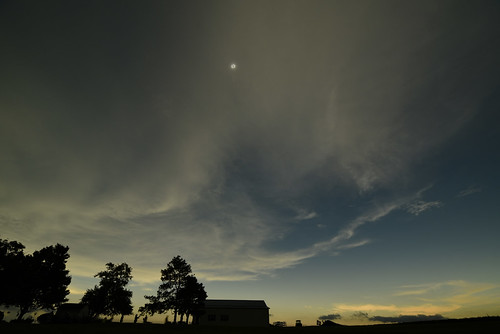
The entire first half of the eclipse was obscured by clouds with the sun just peeking through at totality. Ironically, for most of the end of the eclipse (starting about 15 minutes after totality ended) the Sun was shining against a clear, blue sky.
Notice the umbra moving in from the right and then moving off to the left. In mid-totality, notice how distinctive the Sun's corona is, even as small as the Sun is in the overall image. Not entirely satisfied with this, yet, but sharing while I continue to work on a "final" version.
Due to the clouds, I didn't get the close-up shots of the sun that I'd prepared for, instead making a last minute dash 10 miles south for a spot with clear enough skies that we could at least see totality. While I'm disappointed in not capturing that view of the eclipse, the experience of seeing totality with my own eyes was pretty incredible!
However, I did get a sequence of wide-angle shots for a time lapse. The first half is nothing but clouds and from about 15 minutes after totality until the end of the eclipse the sun was sitting in clear skies but the sequence still shows the movement of the umbra across the field of view and, as you can see in this shot from roughly the middle of totality, there is enough detail to be able to see the corona around the sun.
Still working on completing the time lapse... will post when it's complete.
This was my live reporting from on-site in Missouri during the early phase of the Great American Eclipse, waiting for totality (and worried about the clouds).
Late post from the day of the eclipse, originally posted live on Facebook.
[Originally published on Sept 29th; updated with version of photo published on Flickr]
Having invested a lot of time and energy to prepare for and take this shot of Mount Hood from Jonsrud View Point in Sandy, Oregon, I looked forward to checking out all the interesting shots other people were posting. However, two days later I am troubled by what I'm seeing online. While Photoshop and similar tools are valuable aids in fine-tuning photographs for display, it's easy to bend an image to something that could only have existed in the imagination of the photographer. In some cases, the changes are slight - the image is only slightly different than reality, reflecting a difference in tone, crop, etc. - but in other cases things are morphed beyond the realm of reality. In full disclosure, I used Photoshop on my tablet to retouch this image and remove a spot that resulted from a dust spec on the sensor of my camera. Note that I haven't yet had time to do other edits, ones only possible once I am home and have access to my PC again such as reducing the noise (edits intended to make the image look more realistic, not less). At a later date, I'll post the edited version. Other photographers though have not only "cleaned up" their photographs, but they have gone to extreme lengths to transform the images captured in their cameras. In some cases, the moon is shown much larger than it actually was. In other cases, it's positioned differently - it's either lower in the sky, shown in different settings, etc. What they have all done is portray the moon in an very unrealistic manner. Many would say "that's just a case of poetic license... what's the problem with that?". I don't have an issue with poetic license - it's something I've exercised many times myself. What I do have an issue with though is presenting something of scientific interest, a natural astronomical event, in a way that may be difficult for someone who didn't personally observe the event and may not be familiar enough with similar natural phenomena to discern that what they are seeing is not what they would have seen standing out under the sky last Sunday night. Note that I'm not talking about the sequence shots that show multiple instances of the moon in a single image (assuming they are proportionately sized and positioned). Those actually tell a useful story of the progression of the event and most people would understand that the image is a composite of multiple shots. To their credit, the photographers for most of the sequence images I've seen, even the ones who materially modify the position and size of the moon in such shots, point out that the image is a composite. I am not arguing against these images. In fact, I applaud the creativity of the people who produced them - there are several that I'd love to have as the wallpaper on my PC or perhaps even as a print hanging on my wall. For me, what's missing though is transparency about what the image represents, a factual explanation of how it differs from nature. While some people would skim right past a disclaimer that explains the moon image was enlarged to make a more interesting shot, at least all who view such a thing would have the opportunity to understand what they see isn't realistic and why. Reaction of friends and family when I raised this issue was "good point, but who's going to pay any attention". They may be right but I'm a glass-half-full kind of guy so I'm posting this anyway, hoping that at least a few people pay attention. I'm also a big believer in civil discourse and not a fan of flaming so rather than post comments directly on the images I'm talking about, I'd rather explain the concern here where I'll then share it via social media. If it makes a few people looking at images from Sunday night's lunar eclipse (or other similar natural phenomena) pause and consider whether a given image is realistic or not, great. If this comes to the attention of the photographers responsible for such images, even better. If any of them take the point to heart and update captions to clarify what they changed, fantastic. If you agree or, more importantly, disagree with me on this, feel free to say so in the comments.
Lots of stories to tell about this eclipse but for now I'll share this quick sequence I put to together using some of the shots I took with my D7000 and a Baader film filter and also share what happened to that filter.
I created the filter by mounting the Baader film on the lens hood for my 55-200mm lens. I also created filters for our Nikon binoculars by mounting the film on cardboard tubes that fit over the binocular objective lenses. After the eclipse, we were packing to travel and I wrapped all three filters in clothes packed in our suitcase. Unfortunately, I forgot to tell my wife and she washed the clothes, including the filters. Noing left of the cardboard or Baader film, though of course the lens hood is fine.
So, I get to create a new set for the Venus transit coming up up June 5th. Thankfully, we'll see that from home so I don't have to worry about the next set going through the wash...
Click the eclipse montage to see more information on what went into creating it.













 The journey continues beyond 2009... check it out!

