While my equipment at home was running on automatic, capturing images for a timelapse of the solar eclipse today (see my last post), we were at Fair Park in Dallas for the State Fair of Texas. Our granddaughter, Harper, was showing one of her rabbits in the stock show. Rabbits have been her first breed to manage and show since joining FFA but this was our first opportunity to see Harper showing her bunnies.
If you know anything about showing at a stock show, it's a lot of hurry-up-and-wait. It turned out that judging for Harper's group wasn't until late afternoon. With all that time free, I wandered around the fair grounds checking out the eclipse and checking out people checking out the eclipse. Thanks to groups like the Texas Astronomical Society of Dallas handing out eclipse glasses for free, lots of folks were watching it. And doing so safely!
Of course, it wouldn't have been a trip to the fair without having a Fletcher's corny dog and a funnel cake! Have you been to the fair, yet? There's still time!
Here are views from the day. As always, click on an image to see full-size. Enjoy!
Folks being safe watching the eclipse with appropriate eye protection.
Big Tex holding up the Sun
Big Tex and the solar eclipse viewed through eclipse glasses
Crescent shadows from tree leaves adorn a Fair Park coupon booth during mid-eclipse
My wife Linda and I have a number of things about which we are passionate. This blog is representative of one: astronomy. We not only enjoy exploring the sky, day and night, but we enjoy sharing it with others. Inspired by pioneering sidewalk astronomers like John Dobson, we occasionally participate in "star parties", joining other amateur astronomers in sharing views of and information about the planets, stars and celestial events with the public.
Another of our passions is William Shakespeare, a bard (storyteller). Shakespeare was one of the most famous storytellers of all time. We are active supporters of local Shakespeare companies such as Shakespeare Dallas. We not only enjoy their productions but believe in and support their efforts to make Shakespeare accessible and relevant to everyone in the Dallas area.
For a long time, we have had a vision of bringing these two passions together. About four years ago, we started discussing this idea with Jenni Stewart, Associate Artistic Director of Shakespeare Dallas (SD). She got excited about the possibility of doing something that brings the art of Shakespeare and the science of Astronomy together in a unique way, providing a special experience for the people of the Metroplex. This fall, working with Jenni and with Matt Cooper, the observing coordinator for Texas Astronomical Society (TAS), we finally made it happen!
On Thursday, October 3rd, 2019, SD continued their fall production of Macbeth, taking it from their home base in Samuel Grand Park out to a new venue in Coppell, The Sound at Cypress Waters. That evening, a conjunction of Jupiter and the Moon took place during the twilight period before the play and continuing on into the darkness of night. Per arrangements made with Jenni, a special area was set up next to the audience seating area. Matt and another TAS member Dennis Wardell brought out their telescopes and set them up while the audience was arriving to see Macbeth. Linda and I also set up one of our telescopes. Throughout the period before the play and during intermission, we treated people attending the play to views of Jupiter, the Moon and Saturn. They learned about conjunctions, lunar phases, the geography of the Moon, the moons of Jupiter (all four were visible), the rings of Saturn and more.
Based on reactions from the audience, I'd say the event was a smashing success. So much so, we had more telescopes out at performances over the next two nights.
So, what did starring at the sky have to do with Shakespeare or, in particular, the play Macbeth? Here is the flyer we handed out to people attending the viewing and the longer version made available on the Shakespeare Dallas event page on Facebook:
This is not the end, just the beginning... Jenni is already working on an idea to do an event specifically focused on Shakespeare and astronomy, this time at the main SD location at Samuell Grand Park. Stay tuned!
Images from the event
The Sound at Cypress Waters
Event planning: Viewing Direction of Moon at Site PlanIt screenshot
Event planning: Expected Night Sky View Stellarium screenshot
Telescope Setup, Preview with Shakespeare Dallas Staff
Pre-show crowd
Crowd growing during intermission
Dennis hosting viewers of all ages
Matt aligning his 22" truss-tube Dobsonian scope
Explaining the view through our
Dobsonian scope to a young audience member
While the Internet and both digital and print media made a big to-do over the recent lunar eclipse, the January 2019 Super Blood Wolf Moon, I was actually a little disappointed in this one. Yes, it was big. Yes, it was red. Yes, it was, well, a Wolf Moon (the name used for a January full Moon for centuries, according to the Farmer's Almanac). But there's a problem... it was almost straight overhead.
Why would that matter? If your primary interest is being able to see the entire eclipse, start to finish, then there's no surer bet than a night like Sunday night. A great example is the wonderful composite by a fellow Texas Astronomical Society member, Jason Ware (you can see the original post for this on Facebook here).
Jason Ware Jan 2019
Another of my favorite shots from this latest eclipse was from a Canadian astrophotographer, Alan Dyer (below and here). Similar to Jason's shot above, I like how both are a composite that show the key points in the sequence.
Alan Dyer Jan 2019
However, for me the Moon is often more interesting seeing it juxtaposed against something earthly, whether man-made or natural. Here are a few examples from past lunar eclipses I've shot.
This first shot below was taken in September 2015, the day before my wife's birthday, while we were in the Northwest visiting friends who live in Vancouver, WA. Shot just east of Portland, that's a very bald Mt Hood below the Moon (snowfall had been pretty sparse that year). The eclipse was already in progress as the Moon rose that night so it was in totality by the time it was just above the mountain. What an incredible view!
Nathan Eaton Sept 2015
Of course, sometimes a lunar eclipse occurring when the Moon is close to the horizon is not a blessing. For example, the shot below was taken of the January 2018 Super Blood Blue Moon setting over downtown Dallas. It occurred during morning twilight so the sky brightened well before the eclipse was over and before the Moon had set, making it difficult to really get the full effect of the total eclipse.
Nathan Eaton Jan 2018
On the other hand, sometimes what you see in an image is not necessarily what it looked like in person. Whether you realized it or not, I bet you have seen a widely shared, simply amazing view of the Moon above a city skyline or similarly distinctive foreground, one where the Moon just jumps out at you! Often times, this is really a combination of two great shots, one of the foreground and one of the Moon but where the Moon had been altered by enlarging it and possibly moving it to strategically position it in relation to the foreground. I think many of these are really stunning and a joy to see. What bothers me is when it isn't made crystal clear that the photographer has taken poetic license, that it isn't a realistic portrayal of the Moon. Thanks to the Moon Illusion, we are used to to the idea that the Moon looks larger close to the horizon so it is not surprising that many people assume a shot where the Moon looks larger than normal is real.
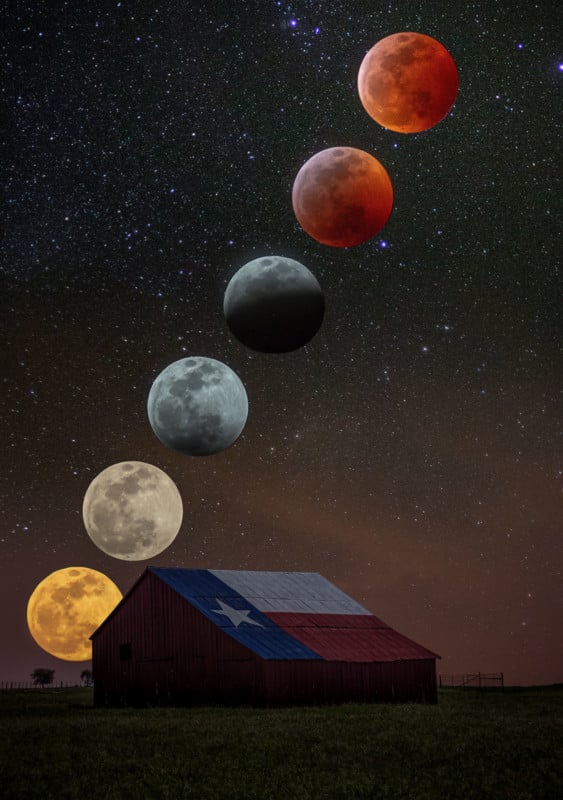
A variation of this is composites similar to the ones above but where they are over a foreground subject. I am a big fan of these but, again, when the Moon is shown "larger than life" relative to the foreground, I think the photographer needs to call out the exaggeration. A great example of this done well, both the photograph and the photographer being upfront about what changed, is this shot by Jason Weingart that was highlighted in PetaPixel.
Jason Weingart Jan 2019
As another example of why it's important to be clear about when a shot has been materially changed, consider this post of a "larger than life" shot of the moon by Beau Rolfe on Facebook. In Beau's very cool shots, taken of the December 2018 full Moon, the lunar orb really is this big, but it's because it was shot with a really long lens (600mm), not because he edited the image in software to make the Moon look larger or shot the Moon with a longer lens than the foreground was shot with. Regardless, his shots still raised questions of "where can I go to see it that large?" and "was this Photoshopped?" (questions friends of mine brought these shots to my attention to ask about).
When you have a lunar eclipse like this month where the Moon is high in the sky, the focus (at least for photography) turns more to the Moon itself rather than the Moon and a foreground landscape. Here are examples of that, one from April 2014 when we were at the Perot museum into the middle of the night for an eclipse party and also a similar one at height of the latest eclipse, taken Sunday night from our backyard. Both were shot through our 10" Dobsonian telescope, captured with camera on my phone pointed through the eyepiece. Not ideal (see the lens flare in first one and the "field of view" in second) but I think they are still interesting shots.
Nathan Eaton April 2014
Nathan Eaton Jan 2019
As fun as it is to see all the different ways in which people shoot an eclipse, I also like the other ways in which people celebrate the eclipse. For example, I didn't make it there but one of our favorite watering holes, The Flying Saucer, had a unique way of celebrating, offering "Moon related" adult beverages.
One of the other fascinating aspects of this eclipse is the historic first sighting of a meteor strike during the eclipse. A key contributing factor to discovery of this event was that scientists were actually looking for it. It would have been pretty incredible to have been watching through my telescope just as the strike occurred!
To close, I'm including a couple of shots I took from the backyard Sunday night. First, a shot taken with my Nikon D750 using the longest lens I had handy, a 120mm Nikkor (actually, the D750 kit lens, a 24-120mm zoom). Image is cropped from an HDR stack of three bracketed shots.
Nathan Eaton Jan 2019
Finally, here is is a shot of the evening with us huddled around the fire pit trying to stay warm while watching the eclipse with our 8 month old Weimaraner, Luna. Not only is her given name take from the Moon, but her AKC registered name, suggested by our granddaughter Kai, is based on such an event: Runner's Lunar Eclipse. Seemed fitting to have her out with us while we were watching such a beautiful sight. I hope you were able to catch a glimpse of it, too!
The viewing at the planetarium yesterday got a lot of media attention. There were trucks out from Channel 4 and Channel 23. Here is the coverage from Channel 4 which includes an interview with Gary Carter of the Texas Astronomical Society. You can see our equipment at about the 30-40 second mark (that's me in the light blue shirt and Tilley hat).
Well, between the Texas heat and summer thunder storms, seeing Venus transit the sun was challenging but it was still an exciting event. A nice sized crowd turned out at the Russell Planetarium (West Mesquite High School) where we set up our 8" Dobsonian and shared our Canon image-stabilized binoculars for public viewing (both outfitted with Baader film filters).
I also set up our Parks 60mm refractor but instead of having people line up to view directly through it, I used a barlow to attach my Nikon D7000, tethered it to a laptop and displayed the transit full-screen on the laptop while capturing live high-def video. So, rather than a long line like the other telescopes, with this setup a small crowd could watch at once. When the clouds obscured the view, I could play back the video and still allow people to watch - handy for the few people who arrived during a cloudy period and had not yet been able to see the transit.
Did I mention it was hot? It was ironic that we were all out there anxious to see the sun but also wishing for shade. And with the sun so low and the heat in the 90s, the turbulence was pretty bad so pictures and video weren't as sharp as they could have been but, wow, it was still an amazing sight.
Thanks to Paul Ballou for hosting this event at the planetarium. Besides having Texas Astronomical Society on hand with telescopes and the Dallas Museum of Nature and Science present to help, he was showing the live NASA feed of the transit from Mauna Kea in the theater so during periods where it was cloudy, people who attended could go inside and cool off while continuing to watch the transit.
Only another 105 years till we get to do this again...








 The journey continues beyond 2009... check it out!


