Showing posts with label PhotoPills. Show all posts

Wednesday, July 3, 2024

Star Trails over Georgia Strait, Vancouver Island


On a recent trip to Vancouver Island, staying on the coast of the Georgia Strait in Union Bay, we had a few days of crystal clear weather. On one of those nights I decided to try taking a star trail shot. Rather than taking one long exposure (as with film), my plan was to shoot multiple short exposures and merge them in post processing. Although the sky over the Georgia Strait is relatively dark (Bortle Scale 3), the Moon was nearly full so I followed the techniques outlined in this article about shooting star trails in light polluted skies. 

I set up my Nikon D750 and Irix 15mm lens in the backyard of our Airbnb, did some test shots, started the camera intervalometer and went to bed. About 6:30 in the morning, the sunlight streaming into the bedroom woke me and I decided to bring the camera inside before going back to bed. I was a little surprised the camera was still shooting as I'd started it before midnight and had assumed the battery would have died after 4 or 5 hours. 

When I took a look at the images captured that night, naturally the ones towards the end were all over-exposed; sunrise had been at 5:12AM. However, I also noticed that the sky never really got fully dark in any of the images. Consulting PhotoPills, it turns out that astronomical twilight that evening was from 11:18PM through 12:01AM and astronomical twilight the next morning was from 11:59PM the previous evening through 3:25AM. In other words, there was never a time when it was truly night (the time between twilights). Being located at almost 50 degrees north latitude and as it was a day before the summer solstice, summer nights there are really short!

This image is my first pass at post-processing and only covers about an hour and 45 minutes. Even still, it took about 4 hours of work to go through the images removing light trails from airplanes and satellites. I have more images to process, at least through 3:25AM (the start of nautical twilight) but besides having a higher number of airplane and satellite trails to edit out, those images also have a lot of ferry traffic on the strait, leaving long bright streaks of light along the waterline. I'll eventually work on those but for now I'm satisfied with what I have done so far. 

As you can see, shooting directly out over the strait involved having the camera aimed just a little east of due north. The small arc in the center of all the other concentric arcs is the star Polaris, the North Star.  The brighter star trails around it are from stars in constellations like Cassiopeia, Cepheus, Perseus and Cygnus. If you look closely, you'll see some color variations; not all the stars are white. 

One light streak I left in that isn't a star trail is on the far right. Blogger doesn't provide a way for you to zoom in but if you could you'd see a small meteor, a shooting star. 

Enjoy! Be sure to click on the image to see enlarged. 

Update: I've replaced the original image with a revised edit in which I blended a single foreground image for a more natural appearance. 

Monday, May 1, 2023

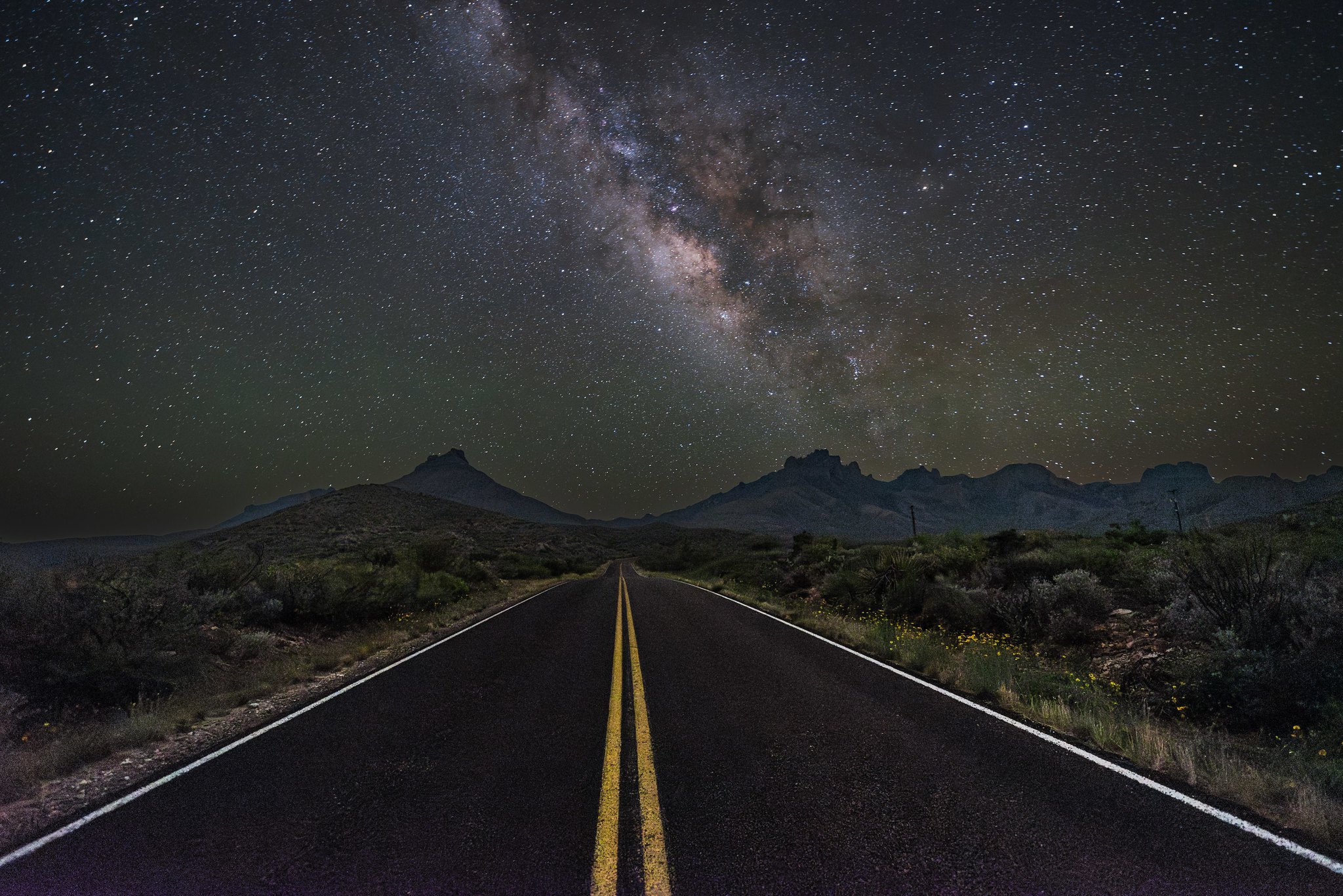
The Road to the Stars

The Road to the Stars
neatonjr @ Flickr

After a long session capturing images of the Milky Way in Big Bend National Park for time lapse, my son Brian and I headed back to the Chisos Basin, stopping along the way at a spot I had mapped out in PhotoPills to capture a shot with a perspective view of the road ahead with the Milky Way beyond. 

Initially the plan had been to capture a sequence of relatively short exposure images with separate foreground and sky shots at different ISO, then stacking registration frames to get the highest quality result possible. Unfortunately, just as I was setting up, we saw headlights down below. With such dark skies, the headlights were obvious while the car was still on Gano Springs Road and about 4 miles away so we knew we had 5-6 minutes but that wasn't enough to capture the planned sequence, just enough to get the composition framed and focused using test shots. I went for one 30 second shot knowing I'd get a little star trailing, then we threw everything back in the car and headed to the lodge. We had finished with enough time that the other car was still a mile or more behind us.

To pull out detail in the foreground, I did initial adjustments to the sky such as exposure, curves, white balance, etc. and then used the Lightroom sky masking tool to mask the sky, inverted it and then made adjustments to lighten the foreground. After touching up some noise spots with the healing brush, this is the end result.

Image details:
Nikon D750 on Radian tripod
Irix Firefly f/2.4 15mm lens
ISO 6400
30 seconds @ f/2.8

Click on the image to see large on Flickr. 

Enjoy! 

Tuesday, June 28, 2022

Moon and Five Planets over Downtown Dallas Skyline - This Time With the Pleiades


In my last post, I described my efforts to capture an interesting image with the Moon and all five naked-eye planets lined up in the order of their orbits out from the Sun. As the conditions on June 24th were not ideal and elusive Mercury was mostly lost in the haze over Downtown Dallas, I tried again on Sunday, June 26th. The sky was much clearer (at least over the Dallas skyline) and there was less haze. Thankfully, staying up almost all night a second time was definitely worth it!

In the image above, I've added an enlarged insert of each object and labeled them to give everyone a more clear idea of what they are looking at without having to click on the image to see it full screen and then zoom in to tell what each object is. The original, unlabeled image is also included below. 

While the surprise on Friday's outing was the ISS flyby (I'm still working on the timelapse videos from both Friday and Sunday), the surprise in these images is that I also captured the Pleiades star cluster (M45), which you may know as the Seven Sisters (immortalized in the Subaru logo)! 

Another difference between this image and the one from the 24th is that the Moon is "older", now 28 days through its cycle (vs. 26 days on the 24th). Just two days from being a New Moon, in this image it is a thin crescent, only 4% illuminated. However, thanks to the length of the exposure (2 seconds), the camera captured not just the sun-lit crescent but it also captured earthshine, the portion of the Moon not in sunlight but still lit but the sunlight reflected off of the Earth. 

For anyone interested in how this image was created, I started out by taking multiple shots with a Nikon D750 and the kit lens, a Nikkor 24-105mm f/4 lens set to it's widest at 24mm. Each of the 6 images used were taken in portrait orientation and, using a tripod, I started shooting to the left of Mercury, then moved the camera about 35 degrees to the right so that the next shot would be overlapped with the previous, continuing until I had the final shot including Saturn. Each image was taken at ISO 200, f/4 and as noted above, exposed for 2 seconds.  The screenshot to the right was my shooting plan from PhotoPills with the red dot representing my location on the west levee of the Trinity river and the black dot representing the Bank of America Plaza tower (the tallest building in Dallas, the one in the panorama with the bright green lights), about 1.6 miles away. The Margaret Hunt Hill Bridge, the white suspension bridge arch in the center of the panorama, crosses the Trinity.  The lighter dashed lines with black dots represent the left, center and right of the field of view in the panorama. 

Post-processing involved using software (Adobe Bridge and Adobe Camera Raw) to merge the 6 shots into one panorama, then crop and apply adjustments for exposure, sharpness, etc. Next, I edited that image in Photoshop to add the insets and labels. As the merged image exhibited some color banding in the morning twilight sky, I used a technique involving adding a little noise to the image to reduce the banding. Note that I also took some creative license with this shot, editing the inset of the Pleiades to emphasize the major stars so it would be more recognizable.

As always, click an image to view full-screen. Enjoy!


Monday, May 30, 2022

A Night to Remember

When traveling to visit our friends who live in Palm Desert, CA, I packed the gear I could carry on a flight, opting for my travel tripod instead of a heavier Radian tripod and leaving the Star Adventurer tracker at home. My friend David had reserved a camp site for us for Mother's Day evening and his son-in-law Erik joined us. After setting up camp and enjoying the view as twilight ended, we hit the sack and set alarms.

My original plan was to do a multi-shot panorama of the full Milky Way arch. Unfortunately, when planning the shoot in PhotoPills (photo planning software), I had inadvertently scrolled forward a day so when my alarm went off instead of having a half-hour of moonlight to shoot the foreground and time enough to shoot the full arch while it was relatively low in the sky, I woke up up to a moonless sky and the arch already getting a bit too high for the shot I planned. Once I realized my mistake, I focused on just enjoying the view and getting a few decent shots including this one, taken with a Nikon D750 and an Irix Firefly 15mm f/2.4 wide angle lens.

My decision to go with B&W was in part because the sky colors were off and rather than do heavy edits to get a more natural look, I chose to take color out of the equation. My assumption about the colors I found when editing the raw image is that it perhaps had to do with the massive amount of dust in the air. That entire weekend, winds from San Bernadino south to the Salton Sea where blowing so hard that when we left Palm Desert Sunday afternoon headed to the campground, we couldn't see a mile down the road and could hardly see the mountains of Joshua Tree. At the campground at 3000 feet, the air was much clearer but the sunset that evening was orangish as was the light dome from Blythe that shows up in this image (which I also think was more prominent due to the amount of dust in the atmosphere).

The labels in this image were carried forward from a test shot done a few nights before taken at our friend's place above Palm Desert, an attempt to do some test shooting for the panorama that was thwarted by high, thin clouds. I had shared the one shot from that night where Scorpius was visible with friends, including similar labeling, so this version of this shot was labeled to relate the two images. See below for the unlabeled version plus a few other shots from the trip.

Click on any image to see enlarged.

The Milky Way over Joshua Tree National Park
(Light dome is Blythe, CA)

Low visibility leaving Palm Desert, CA

Sunset at Joshua Tree National Park

Cottonwood Campground Amphitheater

Campsite