Showing posts with label Jupiter. Show all posts

Sunday, August 13, 2023

2023 Perseids and Mesquite Tree

In the wee hours of this morning, my mother Doris' birthday, I drove out east of Dallas looking for dark(er) skies to view and capture the 2023 Perseid meteor shower. The first spot I had planned to try turned out to have more brightness in the sky than I hoped for so I went a little farther out and found a quiet spot on a country road in College Mound just southeast of Terrell. Parking well off the road in front of a pasture gate, I set up two cameras shooting east across the pasture with a mesquite tree in the foreground. I'm still going through all the images and may eventually post a composite similar to the one I did in 2016 but this image has the best and brightest of the ones I captured. 

This was taken with a Nikon D750 using an Irix Firefly 15mm f/2.4 wide angle lens. It's a 20 second exposure taken at f/2.8 and IS) 6400. I processed it in Lightroom to adjust brightness, contrast and color temperature. 

Not an ideal composition given the streaking speck of comet dust is right at the edge of the frame and cut off midflight but it's still a beauty. And it's not alone. Besides the Pleiades and Jupiter, look close and you'll find at least one other Perseid and at least one satellite. Even with the comparatively dark Bortle 4.5 class skies, there are still light domes on the horizon from towns further east like Wills Point to the left. The yellowish glow towards the center is from the rising crescent moon not yet visible above the treeline.

I'll share more once I have time to go through the rest of the images from both cameras. In the meantime, enjoy!

Click the image to enlarge. 

Tuesday, June 28, 2022

Moon and Five Planets over Downtown Dallas Skyline - This Time With the Pleiades


In my last post, I described my efforts to capture an interesting image with the Moon and all five naked-eye planets lined up in the order of their orbits out from the Sun. As the conditions on June 24th were not ideal and elusive Mercury was mostly lost in the haze over Downtown Dallas, I tried again on Sunday, June 26th. The sky was much clearer (at least over the Dallas skyline) and there was less haze. Thankfully, staying up almost all night a second time was definitely worth it!

In the image above, I've added an enlarged insert of each object and labeled them to give everyone a more clear idea of what they are looking at without having to click on the image to see it full screen and then zoom in to tell what each object is. The original, unlabeled image is also included below. 

While the surprise on Friday's outing was the ISS flyby (I'm still working on the timelapse videos from both Friday and Sunday), the surprise in these images is that I also captured the Pleiades star cluster (M45), which you may know as the Seven Sisters (immortalized in the Subaru logo)! 

Another difference between this image and the one from the 24th is that the Moon is "older", now 28 days through its cycle (vs. 26 days on the 24th). Just two days from being a New Moon, in this image it is a thin crescent, only 4% illuminated. However, thanks to the length of the exposure (2 seconds), the camera captured not just the sun-lit crescent but it also captured earthshine, the portion of the Moon not in sunlight but still lit but the sunlight reflected off of the Earth. 

For anyone interested in how this image was created, I started out by taking multiple shots with a Nikon D750 and the kit lens, a Nikkor 24-105mm f/4 lens set to it's widest at 24mm. Each of the 6 images used were taken in portrait orientation and, using a tripod, I started shooting to the left of Mercury, then moved the camera about 35 degrees to the right so that the next shot would be overlapped with the previous, continuing until I had the final shot including Saturn. Each image was taken at ISO 200, f/4 and as noted above, exposed for 2 seconds.  The screenshot to the right was my shooting plan from PhotoPills with the red dot representing my location on the west levee of the Trinity river and the black dot representing the Bank of America Plaza tower (the tallest building in Dallas, the one in the panorama with the bright green lights), about 1.6 miles away. The Margaret Hunt Hill Bridge, the white suspension bridge arch in the center of the panorama, crosses the Trinity.  The lighter dashed lines with black dots represent the left, center and right of the field of view in the panorama. 

Post-processing involved using software (Adobe Bridge and Adobe Camera Raw) to merge the 6 shots into one panorama, then crop and apply adjustments for exposure, sharpness, etc. Next, I edited that image in Photoshop to add the insets and labels. As the merged image exhibited some color banding in the morning twilight sky, I used a technique involving adding a little noise to the image to reduce the banding. Note that I also took some creative license with this shot, editing the inset of the Pleiades to emphasize the major stars so it would be more recognizable.

As always, click an image to view full-screen. Enjoy!


Friday, June 24, 2022

Moon and Five Planets over Downtown Dallas Skyline


Step outside this morning about 45 minutes before sunrise and you would have seen an incredible sight, a unique alignment of the visible planets along with a waning crescent Moon.  It's not all that rare to see some combination of planets before sunrise or after sunset but it's pretty rare for them to be aligned in the order that they occur extending out from the Sun: Mercury, Venus, Mars, Jupiter and Saturn. Even more so with the Moon in view.

There's nothing special or mysterious about this alignment. It just happens that the relationship between Earth and each of the other planets in their orbits around the Sun is such that they line up this way now. But isn't it beautiful! 

I had originally planned to go find a spot out in the countryside with dark skies to take this shot but just the Moon and planets on their own with nothing interesting in the foreground seemed a bit boring. I did a number of test shots over the past week and determined that even with the bright lights of downtown Dallas, they would still be visible in a shot like this. 

Unfortunately, the haze was just a bit too heavy this morning for Mercury to really show up. It's there but just hard to see without zooming in really close. Given how close the planet orbits the Sun, it is never that far above the horizon while the sky is still dark enough to see it. I have some other shots I still need to go through though so if I have another where it's more visible, I will post it. 

This image was created by taking four shots with a 15mm wide angle lens. Two were taken with the camera level (to avoid vertical distortion of buildings, bridges, etc.), one aimed just left of the Margaret Hunt Hill bridge (the brightly lit suspension bridge) and the other aimed towards the bright street light to the right. The other images were taken in the same directions but aimed high enough to capture Jupiter and Saturn. The four images were merged as a panorama in Adobe Lightroom. 

The panorama above is only part of what I was working on this morning. I also captured nearly 3000 shots over almost 3 hours that I plan to assemble into a timelapse video. The image to the left shows the shooting setup. The camera on the left is my Nikon D750 with a 14mm Rokinon lens; it's taking the timelapse sequence of images. The camera on the right is my son Brian's D750 with our Irix 15mm lens; it's what I used to take the shots for the panorama. 

Stay tuned for the timelapse! Besides the Moon and planets, it features a special guest appearance from the ISS. 

Click on images to view it full-screen. 

Saturday, May 7, 2022

Four Morning Planets, Part Duex

As mentioned in my last post, I am looking for additional opportunities to capture the parade of naked-eye planets across the morning skies this spring. Unfortunately, over the past two weeks, most mornings were overcast, whether in Dallas or Los Angeles, preventing me from seeing and shooting this unique event again. Sadly, that included even being able to see the close conjunction of Jupiter and Venus as they traded places in the parade. 

Thankfully, in Palm Desert things have been much clearer so a few days ago I was able to capture them again, this time with palm trees and Southern California mountains instead of oak trees and Lake Buchanan. I was also able to plan the shot, shooting earlier in the morning before the twilight glare made it so difficult to see them as in the prior post. 


Saturday, April 16, 2022

Four Morning Planets

After wrapping up my time shooting the Milky Way outside our room at the Canyon of the Eagles resort on Lake Buchanan (see my last post), I noticed a bright light through the trees and stepped across to the eastern view of the lake to check it out. Realizing it was Venus, I recalled the unique alignment happening this spring, a clear view of four of the five planets able to be seen with the naked eye in the morning skies: Jupiter, Venus, Mars and Saturn. I set up my equipment again and took a number of shots; below is the best of them with the planets aligned as in the Stellarium screen shot above. 

As this will progress into early summer with the planets jockeying for position relative to each other, the stars and occasionally the moon, I'll be looking for additional opportunities to capture this rare alignment including in late June when Mercury joins the other four. 

Click on image to view full screen.


Saturday, November 23, 2019

The Bard and the Heavens

My wife Linda and I have a number of things about which we are passionate. This blog is representative of one: astronomy. We not only enjoy exploring the sky, day and night, but we enjoy sharing it with others. Inspired by pioneering sidewalk astronomers like John Dobson, we occasionally participate in "star parties", joining other amateur astronomers in sharing views of and information about the planets, stars and celestial events with the public.

Another of our passions is William Shakespeare, a bard (storyteller). Shakespeare was one of the most famous storytellers of all time. We are active supporters of local Shakespeare companies such as Shakespeare Dallas.  We not only enjoy their productions but believe in and support their efforts to make Shakespeare accessible and relevant to everyone in the Dallas area.

For a long time, we have had a vision of bringing these two passions together. About four years ago, we started discussing this idea with Jenni Stewart, Associate Artistic Director of Shakespeare Dallas (SD). She got excited about the possibility of doing something that brings the art of Shakespeare and the science of Astronomy together in a unique way, providing a special experience for the people of the Metroplex. This fall, working with Jenni and with Matt Cooper, the observing coordinator for Texas Astronomical Society (TAS), we finally made it happen!

On Thursday, October 3rd, 2019, SD continued their fall production of Macbeth, taking it from their home base in Samuel Grand Park out to a new venue in Coppell, The Sound at Cypress Waters. That evening, a conjunction of Jupiter and the Moon took place during the twilight period before the play and continuing on into the darkness of night. Per arrangements made with Jenni, a special area was set up next to the audience seating area. Matt and another TAS member Dennis Wardell brought out their telescopes and set them up while the audience was arriving to see Macbeth. Linda and I also set up one of our telescopes. Throughout the period before the play and during intermission, we treated people attending the play to views of Jupiter, the Moon and Saturn. They learned about conjunctions, lunar phases, the geography of the Moon, the moons of Jupiter (all four were visible), the rings of Saturn and more.

Based on reactions from the audience, I'd say the event was a smashing success. So much so, we had more telescopes out at performances over the next two nights.

So, what did starring at the sky have to do with Shakespeare or, in particular, the play Macbeth? Here is the flyer we handed out to people attending the viewing and the longer version made available on the Shakespeare Dallas event page on Facebook:

The Art of Shakespeare and Science of the Renaissance

The Art of Shakespeare and Science of the Renaissance (full version)

This is not the end, just the beginning... Jenni is already working on an idea to do an event specifically focused on Shakespeare and astronomy, this time at the main SD location at Samuell Grand Park. Stay tuned!

Images from the event


The Sound at Cypress Waters

Event planning: Viewing Direction of Moon at Site
PlanIt screenshot
Event planning: Expected Night Sky View
Stellarium screenshot


Telescope Setup, Preview with Shakespeare Dallas Staff
Pre-show crowd
Crowd growing during intermission
Dennis hosting viewers of all ages

Matt aligning his 22" truss-tube Dobsonian scope
Explaining the view through our
Dobsonian scope to a young audience member
Shakespeare Dallas production of Macbeth

Sunday, October 11, 2015

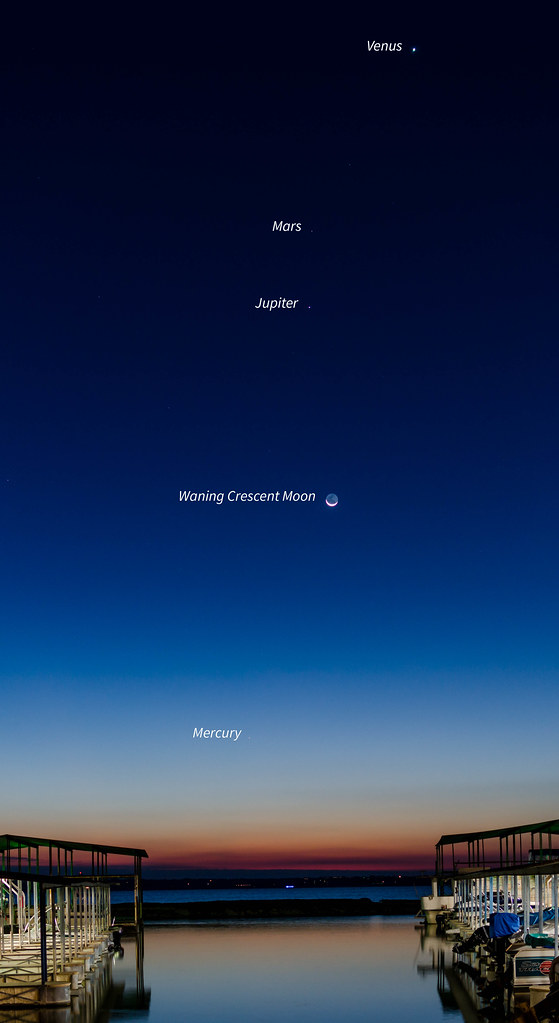
Moon and Planets (labeled)

Moon and Planets Oct 2015 (labeled).jpg Another view of moon and four planets, this time labeled (inspired by Alan Dyer of AmazingSky.net).

Saturday, October 10, 2015

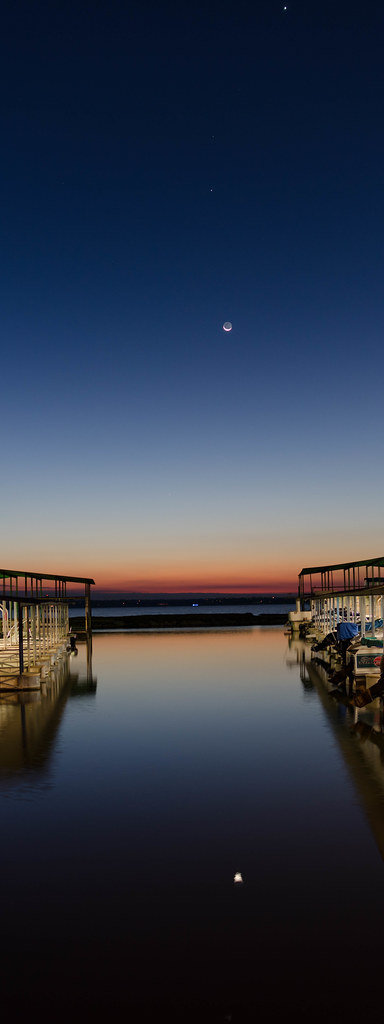
Moon and Planets


Moon and Planets with Reflection Oct 2015A view of the waning crescent moon (with reflection), Mercury, Jupiter, Mars, Venus before dawn on October 10th, 2015. Oh, and with Earth in the foreground!

Multiple shots stitched together.
f/2.5
1/2 sec
ISO 400
35mm
Nikon D7000