If you follow the Astronomy Picture of the Day (APOD) like I do, you may have seen the December 2024 entry showcasing a photographer in Colorado who used a security camera to track a shadow on their driveway at the same time each day for nearly a year. As the seasons changed, this shadow traced out a distinctive figure-eight pattern known as an analemma. I found the simplicity and ingenuity of using readily available technology to capture such a complex phenomenon fascinating.
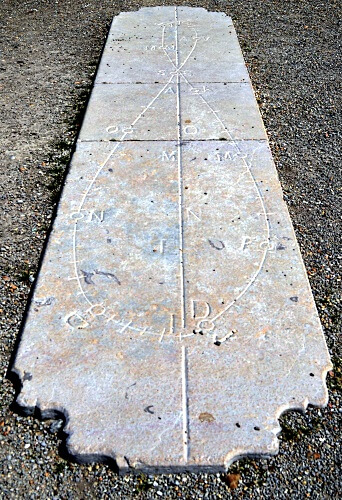
What caught my attention wasn't just the clever use of a security camera to track the sun's movement, but how it connected ancient and modern ways of marking time. Most of us have seen sundials in gardens or parks, where shadows mark the time of day. Fewer people are aware of solar calendars, like the Noon Mark on the south face of the Royal Observatory in Greenwich, which uses carefully placed markers to track a shadow's position at noon throughout the year, forming the same figure-eight analemma shape. In the video above, here was someone using modern technology to capture the same astronomical pattern that astronomers and timekeepers have been tracking for centuries.
Inspired by this APOD, I decided to capture a shadow analemma using technology myself. I'll dive into the details of that in my next post, but first, I’d like to share a bit of historical and scientific context.
The word analemma comes from ancient Greece, where it originally referred not to the figure-eight pattern itself but to the mathematical techniques used for calculating the Sun’s position in the sky. It was derived from the Greek word analēmma, which referred to the support or pedestal of a sundial. In astronomical terms, however, analēmma described the methods used to account for the variations in the Sun's apparent motion throughout the year. This early use of the term was central to creating accurate solar calendars and tracking celestial events.
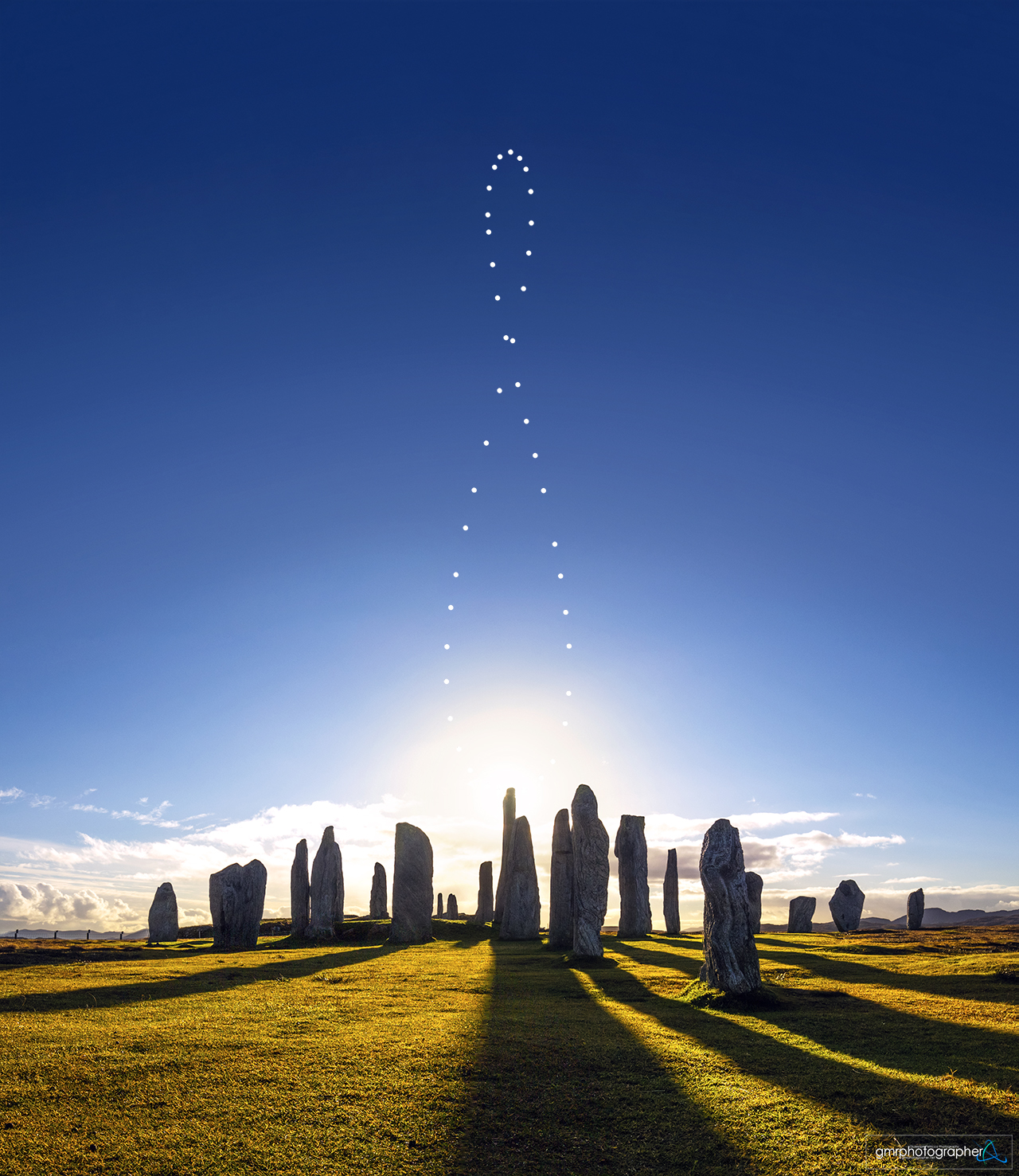
In modern usage, analemma now refers to the distinctive figure-eight pattern traced by the Sun's position in the sky when observed at the same time each day throughout the year. This pattern arises from two astronomical phenomena: the tilt of the Earth's axis and its elliptical orbit around the Sun.
The Earth's axial tilt of 23.5 degrees is the easy part of the pattern to understand. Because of this tilt, the Sun appears lower in the sky during winter and higher during summer in the Northern Hemisphere, with the opposite occurring in the Southern Hemisphere. If this were the only factor, the analemma would form a vertical line rather than a figure-eight, as the Sun's position in the sky would rise daily between the winter and summer solstices and descend daily between summer and winter.
However, because the Earth's orbit around the Sun is an ellipse, it is closer to the Sun around January and farther from the Sun around July. According to Kepler's Second Law, an orbiting body moves faster as it is getting closer to the body it orbits and slower as it is moving farther away. When the Earth is speeding up, the Sun appears a little ahead of its average position in the sky (i.e., where it would be if Earth's orbit were a perfect circle) and, as it is slowing down, it appears a little behind its average position. This, combined with the Sun's changing elevation through the seasons, creates the figure-eight pattern.
Long before cameras could record the Sun's position in the sky, ancient civilizations from Egypt to China used a down-to-earth approach to track time: observing shadows cast by the Sun—patterns that, over time, reflected the effects of the analemma. They built elaborate structures specifically designed to mark the passage of days and seasons by the position of shadows. These structures were not just timekeeping tools; they were woven into religious and cultural traditions, guiding agricultural cycles and celebrations.
In the modern era, photographers have found a new way to capture the Sun's path: sky analemmas. By mounting a camera in a fixed position and taking photographs of the Sun at precisely the same time each day throughout the year, they create composite images showing the Sun's position tracing a distinctive figure-eight pattern across the sky. These images have become iconic astronomical artworks, requiring dedication and precise timing to create. However, they offer a more abstract way to visualize the Sun's movement—one made possible by photographic technology.
Shadow analemmas are particularly intriguing because they translate this celestial pattern into something tangible. While sky analemmas show where the Sun is, shadow analemmas reveal the effect of the Sun's position on our immediate environment. By following the Sun's path through the shadows it casts on familiar surfaces, we can experience the same astronomical phenomena that guided ancient timekeeping. Shadow analemmas can bridge historical traditions and modern science.
In this project, I seek to unite ancient astronomical practices with modern technology by developing an automated system to capture a year-long shadow analemma. Throughout this series, I'll explore the technical details of my setup, the challenges I've encountered, and the insights I've gained. Join me on this journey to explore the intersection of astronomy, photography, and the rhythms of everyday life.
If you read my previous post on the RadioLab / IAU story of quasi-moon named Zoozve and the contest to name another quasi-moon, you may be happy to hear that the finalists have been selected and it is time to vote!
Although I thought my submission, Zephyrus, was a great name for a quasi-moon, unfortunately the panel reviewing the submissions didn't select it. But given they had over 2,700 entries to pick from, I guess my odds were pretty long anyway. 😲
Here are the names they selected as finalists:
Bakunawa - a mythical dragon from Philippine folklore
Cardea - the Roman goddess of doorways and transitions
Ehaema - the "Mother Twilight" from Estonian lore
Enkidu - the wild and noble companion from the ancient Sumerian Epic of Gilgamesh
Ótr - a shape-shifting dwarf from Norse mythology
Tarriaksuk - shadow beings of Inuit legend that mirror human forms yet dwell in another dimension
Tecciztecatl - an Aztec lunar god who once aspired to be the sun
Care to join me in voting for one of these 7 to be selected as the formal name of quasi-moon currently known as (164207) 2004 GU9? We have until January 1st, 2025. You can cast your vote here!
A friend, Michael, recently shared a post on Facebook from the account History pictures about drafting in the pre-CAD days. It brought back a rush of memories I hadn’t revisited in years. They were fond memories so I thought I would share it here along with some thoughts for the future.
From Square One
Michael was sharing the post because it brought back memories for him of taking drafting in 7th grade. Like Michael, my journey with technical drawing started in school. I took a semester of Drafting in my senior year. Not only did I enjoy the class, but it created a new connection with my Dad.
Although his job as a telephone switching office manager didn't involve drafting, he had taken classes at technical school that involved creating electrical diagrams. He passed down his drafting square and mechanical pencils to me - and I still have that square today!
After high school and a year of college, I joined the U.S. Navy, though that's a story for another time. After the Navy, I had dreams of becoming an architect. While full-time college wasn't financially feasible, and pursuing an architecture degree part-time wasn't practical, I found a middle ground after we returned to Texas: going back to Eastfield College. Taking evening classes while working during the day, I pursued an Associate Degree in Drafting & Design. Here are some examples of some of my schoolwork.
At Eastfield, I did a good bit of hand drafting but I also studied computer aided drafting and design (CADD) systems. Eastfield had a ComputerVision system called CADDS that was my first experience with drafting with computers and only the second time I had worked with a computer (the first being a semester-long introductory class in high school). CADDS was a complex beast with a steep learning curve, at least for someone new to the technology. Our teacher had war stories of working on the prior generations of CADD systems where he had to create designs using punch cards. I'm glad that was before my time!
What was new and upcoming, though? AutoCAD. Eastfield had set up a small lab with a handful of PCs running MS-DOS and AutoCAD. It was an exciting advancement, even in its early versions. AutoCAD is what really got me excited about CADD. I left drafting and CADD behind professionally almost 35 years ago, but these days I still use AutoDesk software: I've created or modified several designs using the free version of Fusion 360 for objects to create with a 3D printer.
Early version of AutoCAD
Current version of Fusion 360
Breaking New Ground
My degree gave me the foundation I needed to start working in CADD professionally, and one remarkable connection opened the right door. Thanks to Mom's close friend Virginia Helton, PE, I landed a position at the Texas Department of Highways and Public Transportation (now TxDOT) as a CADD technician. Virginia's story was pioneering – when she received her engineering license, she was one of only three women among 700 civil engineers in Texas. By the time I joined the Highway Department, the gender balance was slowly improving but still had a long way to go. Although I never worked directly with Virginia, her role in launching my CADD career gave me a deep appreciation for those who break barriers and help others follow.
Once I joined the Highway Department, I felt like I had joined the big leagues. They used CADD systems from Intergraph. From its early days creating software for missile guidance systems for NASA, Intergraph had grown to a major provider of CADD hardware and software. The Texas Highway Department was an early adopter of Intergraph CADD workstations due to the company's advances in mapping technology, a key function for civil engineering.
The Intergraph workstation I used was large, with two monitors, a large digitizing table, a puck (like a wheel-less mouse) and a keyboard. It ran software called Interactive Graphics and Design System (IGDS). Under the monitors was a large cabinet that had the local computing hardware. The workstation was connected to a Digital Equipment Corporation (DEC) VAX 11/785 minicomputer located in the regional data center across the parking lot.
Projects That Left Their Mark
In some cases I was taking working notes from an engineer and creating a set of engineering drawings (eventually to be printed as blueprints) and in other cases I was taking older, hand-drawn designs and copying them into the computer to be referenced or updated (essentially, laying them out on the digitizing table and tracing them with the CADD system). I don't recall everything I worked on - some were small projects and some were large - but a few stuck with me.
Have you ever driven under SH114 on O'Connor Blvd in Los Colinas? I drew the civil engineering designs for the update done to that interchange in the mid-80s.
Remember what Central Expressway was like before the major expansion in the 90s? Much of the actual engineering work on that project was subcontracted out to commercial engineering firms but the right of way maps, the plans that showed where we could build, were done by the Highway Department. Towards the end of my 5 years with the Highway Department, I'd moved to the Right of Way Division. Although the engineer who brought me over did so because of my growing reputation for having (self-taught) programming skills, I still had drafting duties, one of which involved working on the new right of way maps for the Central Expressway.
Back to the Drawing Board
While my day job at the Highway Department involved computer-aided design, my drafting pencils weren't gathering dust. I landed an interesting freelance opportunity that would put my hand-drafting skills to work. The project involved creating architectural design drawings for a large house in Garland - one with its own interesting story. The original owner, a guy I was told had a string of dry cleaning businesses and a large family, had commissioned the house but then ended up going into bankruptcy. The bank took possession of the house and hired a general contractor to finish it and get it sold.
A lifelong friend Neil Kirkpatrick, who had the contract to build the backyard fences, referred me to the general contractor who wanted to use architectural sketches instead of photos in the marketing materials. I visited the house several times and worked with the original blueprints and my site notes to create the drawings. At the time, I was a little frustrated that they wanted everything done by hand instead of using CADD but looking back it was a long, hard project that was very rewarding (at least in terms of personal satisfaction - I don't recall what I got paid but it wasn't all that much).
Sketching the Future
A lot has changed in the last 40 years. My journey from mechanical pencils to massive CADD workstations to lightweight design software like Fusion 360 mirrors the broader evolution of technical drawing. But even those advances seem incremental compared to what's happening now – consider the image at the top of this blog, which wasn't drawn by hand or even designed with software, but generated by AI. While we can't yet speak designs into existence through CADD systems, that future feels surprisingly close.
Is that a bad thing? I'll leave each of you to decide that for yourselves. But after four decades in technology, including my transition from drafter to programmer to architect, I can offer two perspectives.
First, my transition from CADD technician to programmer was driven by a realization: as much as I enjoyed the creative outlet of drafting, I was beginning to feel like I was just translating others' ideas rather than creating my own. I wanted to be the person responsible for the real innovation, which led me to software development and technology architecture. Had I not aspired to move into a creator role, technological evolution might have eventually eliminated my position entirely, as happened to many who were content in their existing roles. This mirrors a larger shift we've seen - just as word processing eventually led to business people writing their own materials instead of dictating to secretaries, computer aided design has evolved to where engineers can directly translate their vision into reality.
Second, I recall what a senior engineer at the Highway Department told me about CADD adoption. He noted that while computers didn't necessarily help them create better engineering drawings than by hand, they could iterate designs so quickly that in the time it previously took to do a hand-drawn version, they could refine a design multiple times - resulting in more efficient, safer, and more cost-effective solutions.
These transformative forces - the democratization of tools and the acceleration of iteration - are now being amplified by AI in ways we're just beginning to understand. The AI image in the header of this blog hints at what's coming. While we might not yet fully design via conversation, it may be just around the corner. And when it arrives, instead of replacing creativity it will hopefully remove barriers between imagination and implementation, just as past advances have done.
Postscripts
For those of you who aren't familiar with computer-aided graphics, you may be wondering "what's CAD vs. CADD"? Computer Aided Design (CAD) is a more generalized term for the technology and function. Computer Aided Drafting and Design (CADD) really harkens back to the days I've discussed above when draftsmen (and women) transcribed the work of an engineer into drawings.
For those of you who are fans of the British comedy from the 70s, Monty Python's Flying Circus, you will have caught that besides the title of this post highlighting it is a departure from the topics I usually cover here, it is also the catch phrase from this classic show. To close out, here is the trailer from the film of the same title.







 The journey continues beyond 2009... check it out!


